
Learning Objectives
- Distinguish between the roles of Osteoblasts (builders) and Osteoclasts (crushers).
- Explain the RANK/RANKL/OPG signaling pathway in bone remodeling.a
- Identify key biochemical markers of osteoblastic activity.
- Describe the effects of Estrogen and Parathyroid Hormone (PTH) on bone density.
1. Osteoblasts vs. Osteoclasts
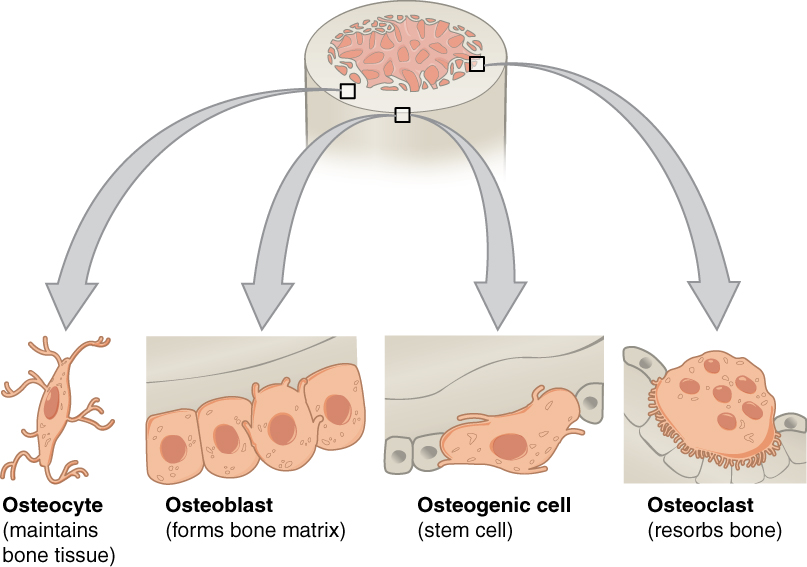
Bone is a dynamic tissue constantly being remodeled by two primary cell types that work in a coordinated balance.
| Cell Type | Function | Origin |
|---|---|---|
| Osteoblast | Builds bone by secreting collagen and catalyzing mineralization (requires Alkaline Phosphatase). | Mesenchymal stem cells. |
| Osteoclast | Dissolves bone (“Crushes”) by secreting $H^{+}$ and collagenases to break down the matrix. | Monocyte/Macrophage lineage (fusion of precursors). |
2. The RANKL/OPG Signaling Pathway
Osteoblasts actually control the activity of osteoclasts through specific molecular signals.
- RANKL: Expressed by osteoblasts. It binds to the RANK receptor on osteoclast precursors to stimulate their fusion and activation.
- OPG (Osteoprotegerin): A “decoy” receptor produced by osteoblasts. It binds to RANKL, preventing it from hitting the RANK receptor, thereby inhibiting osteoclasts.
- The Balance: A high OPG/RANKL ratio leads to bone formation; a low ratio leads to bone resorption.
3. Hormonal Regulation
Bone density is heavily influenced by systemic hormones that shift the balance of the cells mentioned above.
- Estrogen: The “protector” of bone. It inhibits osteoblast apoptosis and induces osteoclast apoptosis.
- Clinical: Estrogen deficiency (menopause) leads to increased RANKL and decreased OPG, causing rapid bone loss and Osteoporosis.
- Parathyroid Hormone (PTH):
- Low/Intermittent: Anabolic (builds bone).
- Chronic/High: Catabolic (destroys bone). It increases RANKL expression, leading to osteitis fibrosa cystica.
Clinical Notes & Step 1 Pearls:
- Lab Markers: To see if osteoblasts are working, look for Bone ALP, Osteocalcin, and Type I procollagen propeptides.
- Denosumab: A monoclonal antibody used for osteoporosis that mimics OPG by binding to RANKL.
- Alkaline Environment: Osteoblasts require a high pH (alkaline) for mineralization; this is why Alkaline Phosphatase (ALP) is their hallmark enzyme.
Activity: Bone Cell Signaling
Quick Mnemonics:
OsteoBlast: Builds Bone.
OsteoClast: Crushes (Resorbs) bone.
OPG: Osteoprotegerin Protects Generous bone (blocks the crushers).
You must be logged in to post a comment.