
Learning Objectives
Master the 4 lung volumes and 4 capacities. Understand which values can be measured by spirometry, the clinical significance of Functional Residual Capacity (FRC), and how these values change in obstructive vs. restrictive lung diseases for the USMLE Step 1.
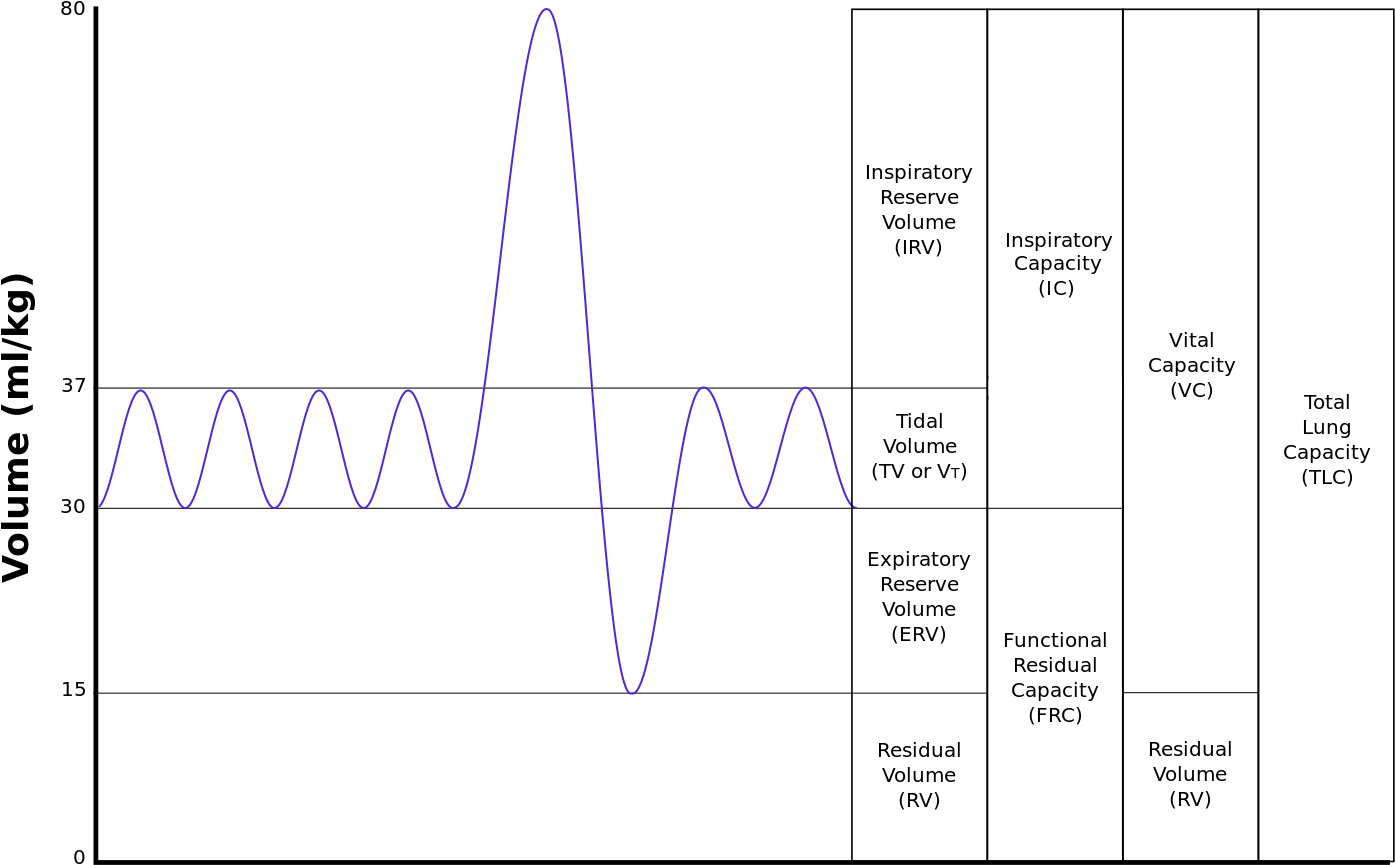
1. The 4 Physiologic Lung Volumes
Volumes are the basic individual “building blocks” of lung function.
| Volume | Definition | Typical Value |
|---|---|---|
Tidal Volume ( ) ) |
Air moving in/out during quiet, normal breathing. | ~500 mL (6–8 mL/kg) |
| Inspiratory Reserve (IRV) | Air that can still be breathed in after a normal inspiration. | Maximal effort |
| Expiratory Reserve (ERV) | Air that can still be breathed out after a normal expiration. | Maximal effort |
| Residual Volume (RV) | Air remaining in lungs after maximal expiration. | Cannot be measured by spirometry. |
2. The 4 Lung Capacities
A capacity is the sum of two or more physiologic volumes.
| Capacity | Formula | Significance |
|---|---|---|
| Inspiratory (IC) |  |
Max air that can be inhaled after a normal exhalation. |
| Functional Residual (FRC) |  |
The equilibrium point is where chest wall and lung forces balance. |
| Vital Capacity (VC) |  |
Maximal air that can be expired after a maximal inspiration. |
| Total Lung (TLC) |  |
Total volume in the lungs after maximal inspiration. |
3. Measurement and Clinical Mechanics
Certain volumes are “invisible” to standard spirometry because they can never be exhaled into the machine.
| Concept | Description |
|---|---|
| The Spirometry Rule | Anything containing RV (RV, FRC, TLC) cannot be measured by spirometry alone; it requires helium dilution or body plethysmography. |
| FRC Balance | At FRC, the inward collapsing force of the lungs equals the outward pulling force of the chest wall. Airway pressure is 0. |
Activity:
High-Yield Clinical Pearls:
- Obstructive vs. Restrictive: In Obstructive disease (COPD), air trapping causes increased RV, FRC, and TLC. In Restrictive disease (Fibrosis), all volumes and capacities are decreased.
- The Helium Dilution Test: This is the go-to method for measuring FRC/RV when spirometry isn’t enough.
- Capacity Rule: If a capacity’s name includes the word “Residual,” it contains Residual Volume and cannot be measured by spirometry.
You must be logged in to post a comment.