
Learning Objectives
- Identify the rate-limiting enzyme of the urea cycle and its required allosteric activator.
- Distinguish between the mitochondrial and cytoplasmic steps of the cycle.
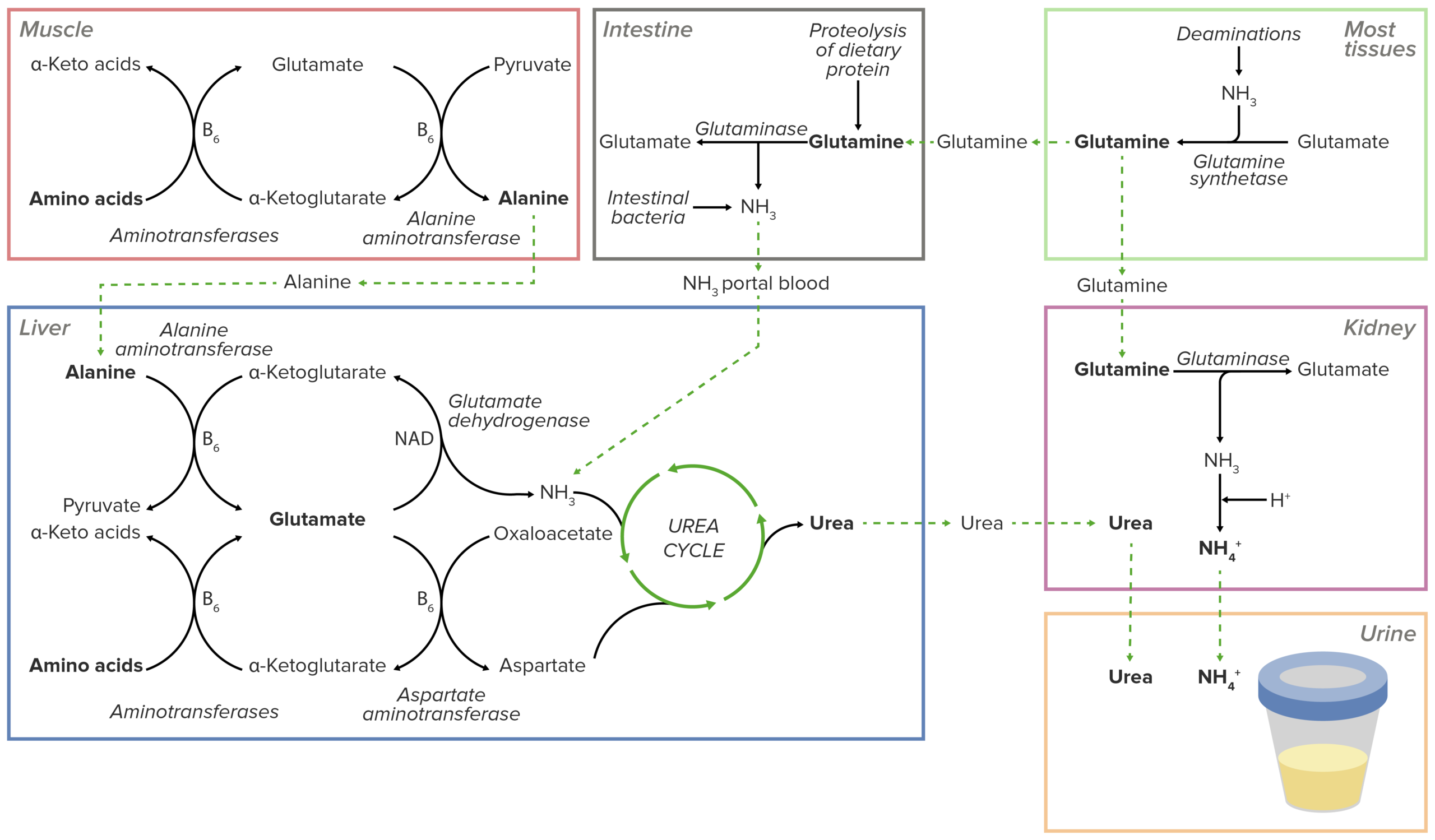
- Trace the path of excess nitrogen from ammonia to urea excretion.
- Recognize the role of Aspartate in providing the second nitrogen atom for urea.
1. Overview of Nitrogen Disposal
Amino acid catabolism involves the removal of the amino group, which generates ammonia ($NH_{3}$). Because ammonia is highly toxic, especially to the central nervous system, the body converts it into urea, a water-soluble compound that can be safely excreted by the kidneys. This process occurs almost exclusively in the liver and spans two cellular compartments: the mitochondria and the cytoplasm.
2. The Mitochondrial Steps
The cycle begins in the mitochondrial matrix, where the first nitrogen atom and the carbon atom of urea are incorporated.
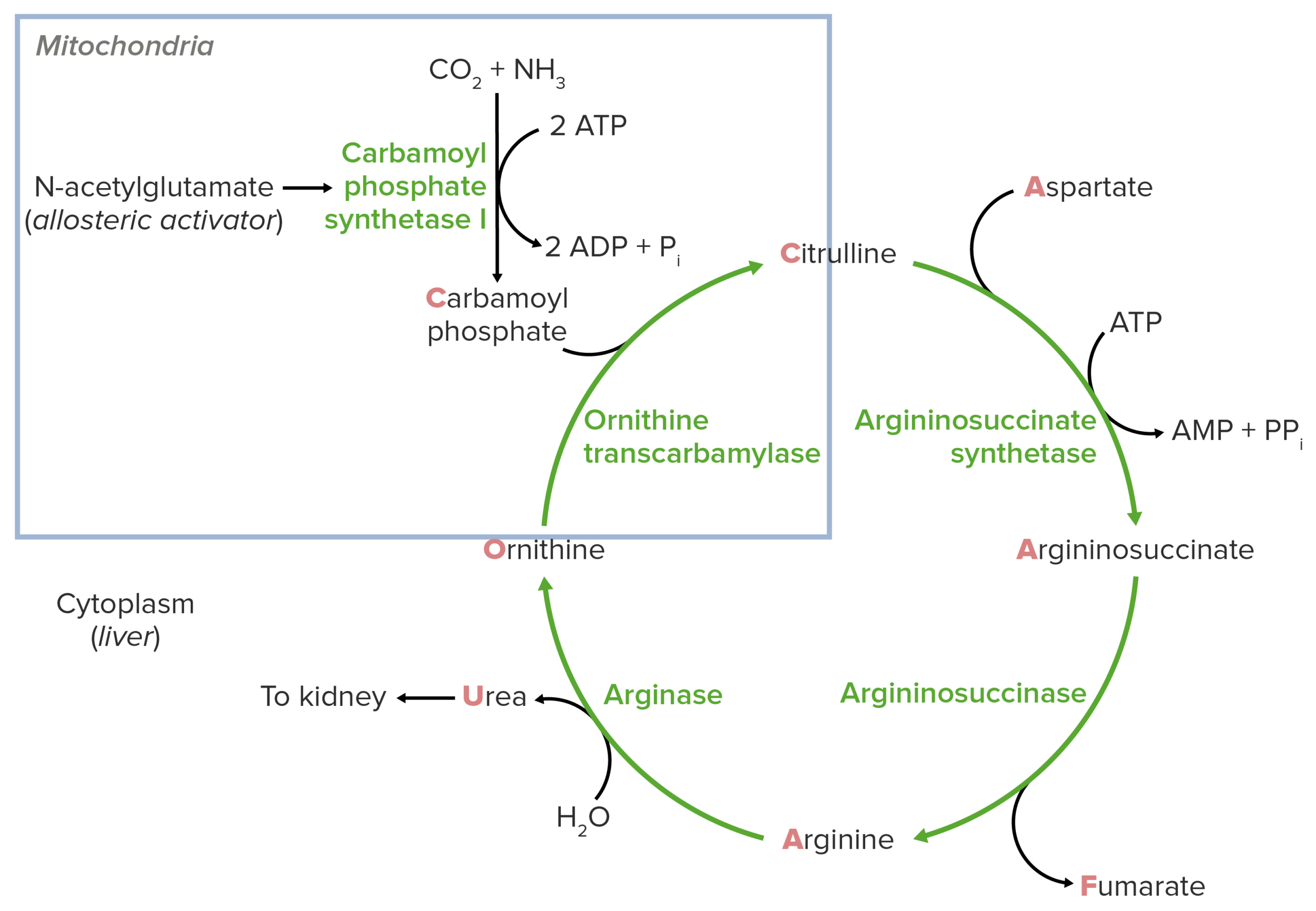
- Formation of Carbamoyl Phosphate: $NH_{3}$ and $HCO_{3}^{-}$ are combined to form Carbamoyl Phosphate. This is catalyzed by Carbamoyl Phosphate Synthetase I (CPS I).
- Rate-Limiting Step: CPS I is the rate-limiting enzyme of the urea cycle. It absolutely requires N-acetylglutamate (NAG) as an allosteric activator.
- Entry into the Cycle: Carbamoyl phosphate combines with Ornithine to form Citrulline (catalyzed by Ornithine Transcarbamylase). Citrulline then exits the mitochondria.
Activity
Note:
CPS I is for the Urea cycle (Mitochondria).
(Compare to CPS II, which is used in Pyrimidine synthesis in the Cytoplasm).
3. The Cytoplasmic Steps
Once Citrulline enters the cytoplasm, the second nitrogen atom is added, and the urea molecule is completed and released.
- Argininosuccinate Formation: Citrulline condenses with Aspartate (the source of the second nitrogen) to form Argininosuccinate.
- Cleavage: Argininosuccinate is cleaved into Arginine and Fumarate. Fumarate can then enter the TCA cycle.
- Urea Release: Arginine is cleaved by Arginase to produce Urea and regenerate Ornithine, which returns to the mitochondria to restart the cycle.
| Metabolite | Role in Cycle |
|---|---|
| Aspartate | Provides the 2nd nitrogen for Urea. |
| N-acetylglutamate | Essential activator for CPS I. |
| Fumarate | The link between the Urea and TCA cycles. |
High-Yield Mnemonic:
“Ordinarily, Careless Crappers Are Also Frivolous About Urination”
- Ornithine, Carbamoyl phosphate, Citrulline, Aspartate, Argininosuccinate, Fumarate, Arginine, Urea.
You must be logged in to post a comment.