
Learning Objectives
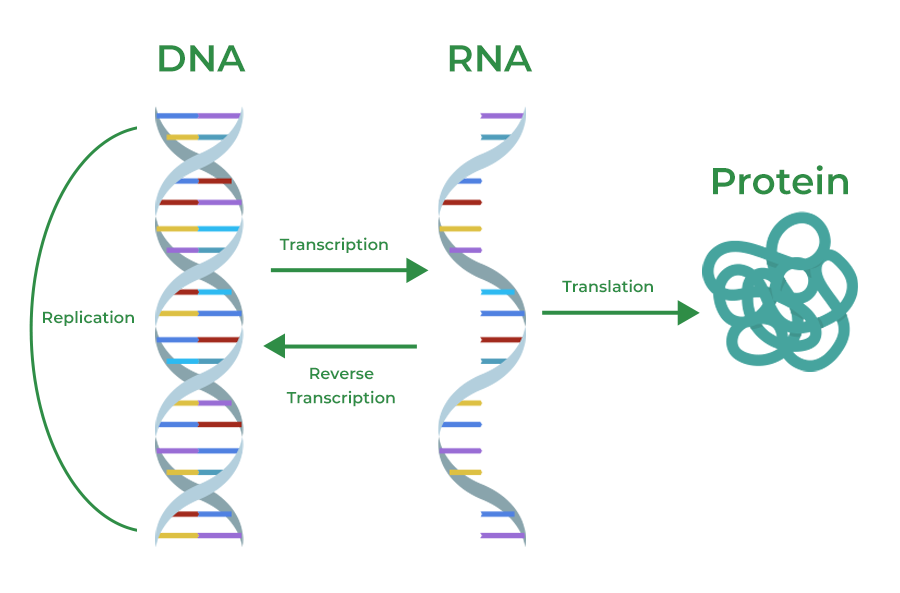
- Explain the flow of genetic information according to the central dogma of molecular biology (
), including viral reverse transcription exceptions.
- Compare and contrast gene expression and DNA replication by biological purpose, DNA copy number, subcellular localization, and cell-cycle timing.
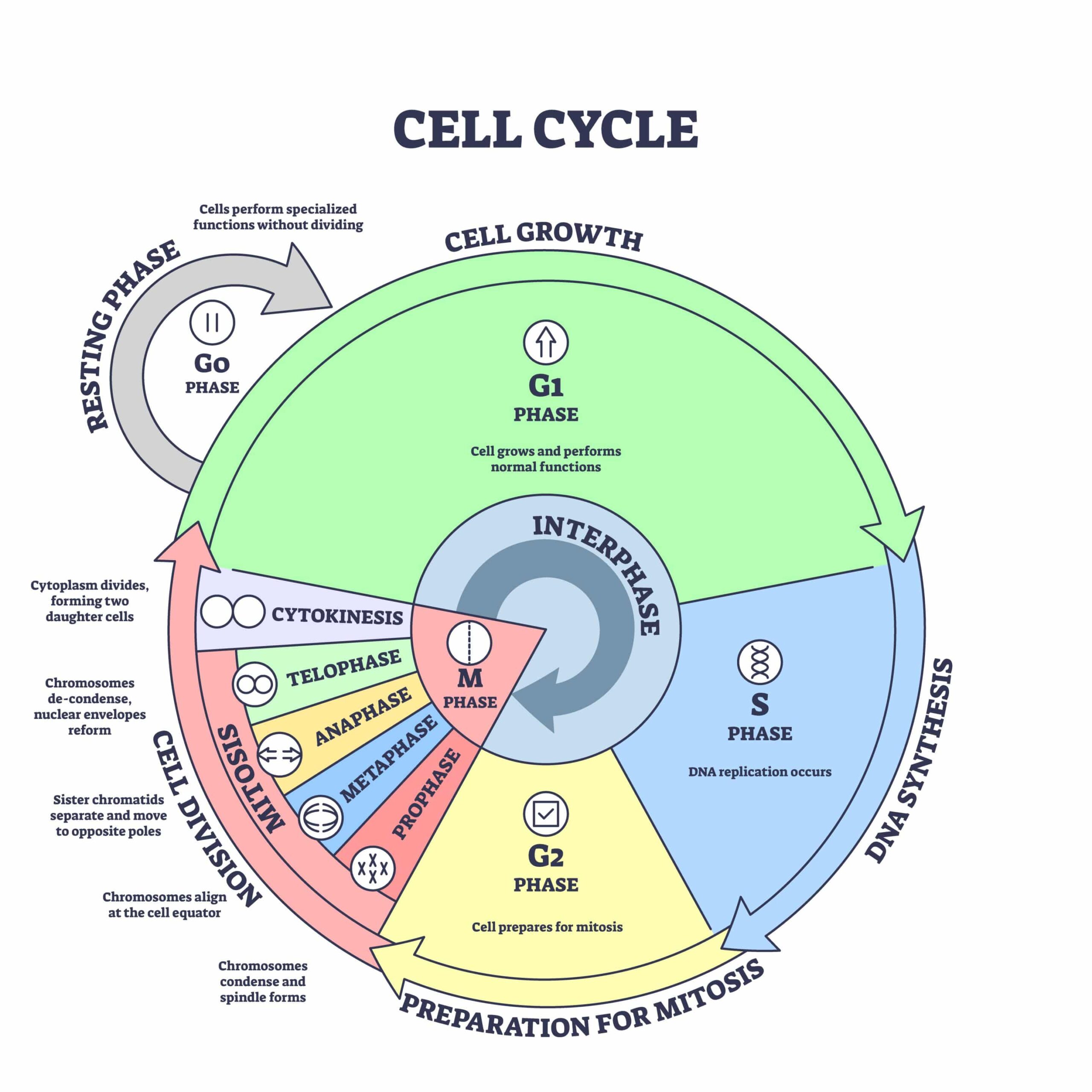
- Outline the phases of the eukaryotic cell cycle (
,
,
,
, and
) and correlate phase-specific antineoplastic (chemotherapy) agents with their target phases.
- Distinguish the chemical structure, nomenclature, and bioenergetic functions of nucleosides (base + sugar) versus nucleotides (nucleoside + phosphate group[s]).
DNA stores genetic information in a linear nucleotide base sequence. Through tightly regulated molecular processes, cells selectively express specific genes to maintain structure and metabolism while duplicating their entire genome before division.
Central Dogma & Comparison of Gene Expression vs. DNA Replication
Central Dogma of Molecular Biology

- Gene Definition: Classically defined as a specific segment of DNA encoding a functional RNA molecule or polypeptide protein.
- Viral Exception: Retroviruses (e.g., HIV) utilize reverse transcriptase to synthesize complementary DNA (cDNA) from an RNA template (
).
| Feature | Gene Expression | DNA Replication |
|---|---|---|
| Biological Purpose | Synthesizes functional proteins and RNAs required for cellular structure and metabolic function. | Duplicates the entire complement of chromosomes before cell division. |
| Scale / What is Copied | Small, discrete DNA segments transcribed into RNA ( nucleotide pairs). |
Entire chromosomal DNA molecules ( nucleotide pairs). |
| Subcellular Location | • Transcription: Nucleus • Translation: Cytoplasm (ribosomes) |
Nucleus (exclusively). |
| Cell-Cycle Timing | Continuously active throughout Interphase (, , and ). |
Restricted strictly to S phase. |
Activity
Eukaryotic Cell Cycle & Chemotherapy Pharmacology
| Cell-Cycle Phase | Cellular & Chromosomal Events | Targeted Chemotherapy Drugs |
|---|---|---|
| Phase (Interphase) |
Active cellular growth, organelle duplication, and RNA/protein synthesis before DNA replication. Terminally differentiated, non-cycling cells (e.g., neurons, skeletal muscle) exit into . |
Non-specific alkylating/crosslinking agents (e.g., cyclophosphamide, cisplatin) act across all phases including and . |
| S Phase (Interphase) | DNA synthesis; each chromosome is duplicated into two identical sister chromatids joined at the centromere. | Antimetabolites & ribonucleotide reductase inhibitors: methotrexate, 5-fluorouracil (5-FU), hydroxyurea. |
| Phase (Interphase) |
Continued cellular growth, protein synthesis, and DNA integrity/repair checkpoint verification before mitotic entry. | Free-radical DNA strand-scission agent: bleomycin. |
| M Phase (Mitosis) | Nuclear division (mitosis) and physical cytoplasmic cleavage (cytokinesis) yielding two genetically identical daughter cells. | Microtubule inhibitors: • Paclitaxel (hyperstabilizes microtubules) • Vincristine, vinblastine (prevent polymerization) |
Structure & Nomenclature of Nucleosides and Nucleotides
Structural Architecture & High-Energy Bonds
- Nucleoside: Nitrogenous base + Pentose sugar (ribose or deoxyribose). The nitrogenous base is attached via a glycosidic bond to the
carbon of the sugar.
- Nucleotide: Nucleoside + one or more phosphate groups attached to the
carbon of the pentose sugar (e.g., UMP, ATP, dGMP).
- High-Energy Phosphate Bonds: Nucleoside di- and triphosphates (such as ATP and GTP) store chemical energy within phosphoanhydride bonds that release free energy upon hydrolysis to drive biosynthetic reactions.
| Nitrogenous Base | Nucleoside (Base + Sugar) | Nucleotide Form (Nucleoside + Phosphate) |
|---|---|---|
|
Adenine (Purine)
|
Adenosine (Deoxyadenosine) | AMP / ADP / ATP (dAMP / dADP / dATP) |
| Guanine (Purine) | Guanosine (Deoxyguanosine) | GMP / GDP / GTP (dGMP / dGDP / dGTP) |
| Cytosine (Pyrimidine) | Cytidine (Deoxycytidine) | CMP / CDP / CTP (dCMP / dCDP / dCTP) |
| Uracil (Pyrimidine — RNA) | Uridine (Deoxyuridine) | UMP / UDP / UTP (dUMP / dUDP / dUTP) |
| Thymine (Pyrimidine — DNA) | Deoxythymidine (often written simply as Thymidine) | dTMP / dTDP / dTTP |
High-Yield Differential Clues & Diagnostic Pearls
Board-Exam Pattern Recognition Rules
- Phosphate Attachment Sites: Always remember the carbon numbering on the pentose ring: the nitrogenous base attaches at C-
, the incoming nucleotide forms a phosphodiester bond at C-
, and the phosphate group(s) attach at C-
- Cell-Cycle Specific Chemotherapy Traps:
• S-Phase Drugs (Methotrexate, 5-FU, Hydroxyurea): Starve dividing cells of deoxyribonucleotides during DNA synthesis.
•
• M-Phase Drugs (Taxanes & Vinca Alkaloids): Disrupt mitotic spindle dynamics, arresting cells in metaphase. - Thymine Nomenclature Convention: Because thymine is almost exclusively incorporated into DNA rather than RNA, the prefix “deoxy-” is routinely omitted in clinical nomenclature (e.g., thymidine refers to deoxythymidine).
Key Points & Memory Hooks:
- Core Rule: Gene expression transcribes small DNA segments into RNA throughout interphase, whereas DNA replication duplicates entire chromosomes exclusively during S phase; a nucleoside is a base + sugar ($1’$ carbon) and a nucleotide adds phosphate(s) at the $5’$ carbon.
- Memory Hook: NucleoSide = Sugar + Base; NucleoTide = Takes Phosphate! Chemotherapy Phases: S = Stop synthesis (MTX, 5-FU, Hydroxyurea); G2 = Bleomycin breaks; M = Microtubule madness (Taxols/Vincas)!
You must be logged in to post a comment.