
Curriculum
- 22 Sections
- 449 Lessons
- 10 Weeks
Expand all sectionsCollapse all sections
- U01.01 BiochemistryThis biochemistry review for USMLE Step 1 covers essential topics including metabolism, enzymology, and molecular biology.136
- 1.1U01.01.001 Chromatin structure
- 1.2U01.01.002 Nucleotides
- 1.3U01.01.003 De novo pyrimidine and purine synthesis
- 1.4U01.01.004 Purine salvage deficiencies
- 1.5U01.01.005 Genetic code features
- 1.6U01.01.006 DNA replication
- 1.7U01.01.007 DNA repair
- 1.8U01.01.008 Mutations in DNA
- 1.9U01.01.009 Lac operon
- 1.10U01.01.010 Functional organization of a eukaryotic gene
- 1.11U01.01.011 Regulation of gene expression
- 1.12U01.01.012 RNA processing (eukaryotes)
- 1.13U01.01.013 RNA polymerases
- 1.14U01.01.014 Introns vs exons
- 1.15U01.01.015 Splicing of pre-mRNA
- 1.16U01.01.016 tRNA
- 1.17U01.01.017 Start and stop codons
- 1.18U01.01.018 Protein synthesis
- 1.19U01.01.019 Posttranslational modifications
- 1.20U01.01.020 Chaperone protein
- 1.21U01.01.021 Cell cycle phases
- 1.22U01.01.022 Rough endoplasmic reticulum
- 1.23U01.01.023 Smooth endoplasmic reticulum
- 1.24U01.01.024 Cell trafficking
- 1.25U01.01.025 Peroxisome
- 1.26U01.01.026 Proteasome
- 1.27U01.01.027 Cytoskeletal elements
- 1.28U01.01.028 Microtubule
- 1.29U01.01.029 Cilia structure
- 1.30U01.01.030 Primary ciliary dyskinesia
- 1.31U01.01.031 Sodium-potassium pump
- 1.32U01.01.032 Collagen
- 1.33U01.01.033 Collagen synthesis and structure
- 1.34U01.01.034 Osteogenesis imperfecta
- 1.35U01.01.035 Ehlers-Danlos syndrome
- 1.36U01.01.036 Menkes disease
- 1.37U01.01.037 Elastin
- 1.38U01.01.038 Marfan syndrome
- 1.39U01.01.039 Homocystinuria
- 1.40U01.01.040 Polymerase chain reaction
- 1.41U01.01.041 CRISPR/Cas9
- 1.42U01.01.042 Blotting Procedures
- 1.43U01.01.043 Flow cytometry
- 1.44U01.01.044 Microarrays
- 1.45U01.01.045 Enzyme-linked immunosorbent assay
- 1.46U01.01.046 Karyotyping
- 1.47U01.01.047 Fluorescence in situ hybridization
- 1.48U01.01.048 Molecular cloning
- 1.49U01.01.049 Gene expression modifications
- 1.50U01.01.050 Genetic terms
- 1.51U01.01.051 Population genetics
- 1.52U01.01.052 Hardy-Weinberg population genetics
- 1.53U01.01.053 Disorders of imprinting
- 1.54U01.01.054 Modes of inheritance
- 1.55U01.01.055 Autosomal dominant diseases
- 1.56U01.01.056 Autosomal recessive diseases
- 1.57U01.01.057 Cystic fibrosis
- 1.58U01.01.058 X-linked recessive disorders
- 1.59U01.01.059 Muscular dystrophies
- 1.60U01.01.060 Mitochondrial Diseases
- 1.61U01.01.061 Rett syndrome
- 1.62U01.01.062 Fragile X syndrome
- 1.63U01.01.063 Trinucleotide repeat expansion diseases
- 1.64U01.01.064 Autosomal trisomies
- 1.65U01.01.065 Genetic disorders by chromosome
- 1.66U01.01.066 Robertsonian translocation
- 1.67U01.01.067 Cri-du-chat syndrome
- 1.68U01.01.068 Williams syndrome
- 1.69U01.01.069 Essential fatty acids
- 1.70U01.01.070 Vitamins: fat soluble
- 1.71U01.01.071 Vitamins: Water soluble
- 1.72U01.01.072 Dietary supplementation
- 1.73U01.01.073 Vitamin A
- 1.74U01.01.074 Vitamin B1
- 1.75U01.01.075 Vitamin B2
- 1.76U01.01.076 Vitamin B3
- 1.77U01.01.077 Vitamin B5
- 1.78U01.01.078 Vitamin B6
- 1.79U01.01.079 Vitamin B7
- 1.80U01.01.080 Vitamin B9
- 1.81U01.01.081 Vitamin B12
- 1.82U01.01.082 Vitamin C
- 1.83U01.01.083 Vitamin D
- 1.84U01.01.084 Vitamin E
- 1.85U01.01.085 Vitamin K
- 1.86U01.01.086 Zinc
- 1.87U01.01.087 Protein-energy malnutrition
- 1.88U01.01.088 Ethanol metabolism
- 1.89U01.01.089 Enzyme terminology
- 1.90U01.01.090 Rate-determining enzymes of metabolic processes
- 1.91U01.01.091 Metabolic compartmentation
- 1.92U01.01.092 Summary of pathways
- 1.93U01.01.093 Activated carriers
- 1.94U01.01.094 Universal electron acceptors
- 1.95U01.01.095 Hexokinase vs glucokinase
- 1.96U01.01.096 Glycolysis regulation
- 1.97U01.01.097 Regulation by fructose-2,6- bisphosphate
- 1.98U01.01.098 Pyruvate dehydrogenase complex
- 1.99U01.01.099 Pyruvate dehydrogenase complex deficiency
- 1.100U01.01.100 Pyruvate metabolism
- 1.101U01.01.101 TCA cycle
- 1.102U01.01.102 Electron transport chain and oxidative phosphorylation
- 1.103U01.01.103 Gluconeogenesis, irreversible enzymes
- 1.104U01.01.104 Pentose phosphate pathway
- 1.105U01.01.105 Glucose-6-phosphate dehydrogenase deficiency
- 1.106U01.01.106 Disorders of fructose metabolism
- 1.107U01.01.107 Disorders of galactose metabolism
- 1.108U01.01.108 Sorbitol
- 1.109U01.01.109 Lactase deficiency
- 1.110U01.01.110 Amino acids
- 1.111U01.01.111 Urea cycle
- 1.112U01.01.112 Transport of ammonia by alanine
- 1.113U01.01.113 Hyperammonemia
- 1.114U01.01.114 Ornithine transcarbamylase deficiency
- 1.115U01.01.115 Amino acid derivatives
- 1.116U01.01.116 Catecholamine synthesis/tyrosine catabolism
- 1.117U01.01.117 Phenylketonuria
- 1.118U01.01.118 Maple syrup urine disease
- 1.119U01.01.119 Alkaptonuria
- 1.120U01.01.120 Homocystinuria
- 1.121U01.01.121 Cystinuria
- 1.122U01.01.122 Organic acidemias
- 1.123U01.01.123 Glycogen regulation by insulin and glucagon/epinephrine
- 1.124U01.01.124 Glycogen
- 1.125U01.01.125 Glycogen storage diseases
- 1.126U01.01.126 Lysosomal storage diseases
- 1.127U01.01.127 Fatty acid metabolism
- 1.128U01.01.128 Ketone bodies
- 1.129U01.01.129 Fasted vs fed state
- 1.130U01.01.130 Metabolic fuel use
- 1.131U01.01.131 Lipid transport
- 1.132U01.01.132 Key enzymes in lipid transport
- 1.133U01.01.133 Major apolipoproteins
- 1.134U01.01.134 Lipoprotein functions
- 1.135U01.01.135 Abetalipoproteinemia
- 1.136U01.01.136 Familial dyslipidemias
- U01.02 ImmunologyPrepare for USMLE Step 1 Immunology with a comprehensive review covering foundational concepts, immune system mechanisms, and key disorders to solidify your understanding and boost exam readiness.39
- 2.1U01.02.001 Immune system organs
- 2.2U01.02.002 Lymph node
- 2.3U01.02.003 Lymphatic drainage associations
- 2.4U01.02.004 Spleen
- 2.5U01.02.005 Thymus
- 2.6U01.02.006 Innate vs adaptive immunity
- 2.7U01.02.007 Immune privilege
- 2.8U01.02.008 Major histocompatibility complex I and II
- 2.9U01.02.009 HLA subtypes associated with diseases
- 2.10U01.02.010 Natural killer cells
- 2.11U01.02.011 Major functions of B and T cells
- 2.12U01.02.012 Differentiation of T Cells
- 2.13U01.02.013 Macrophage–Lymphocyte Interaction (Th1–Macrophage Axis)
- 2.14U01.02.014 Cytotoxic T cell
- 2.15U01.02.015 Regulatory T cells
- 2.16U01.02.016 T- and B-cell activation
- 2.17U01.02.017 Anergy
- 2.18U01.02.018 Antibody Structure and Function
- 2.19U01.02.019 Immunoglobulin Isotypes
- 2.20U01.02.020 Antigen Type and Immunologic Memory
- 2.21U01.02.021 Complement System
- 2.22U01.02.022 Complement disorders
- 2.23U01.02.023 Cytokines
- 2.24U01.02.024 Respiratory Burst
- 2.25U01.02.025 Type I Interferons (IFN-α, IFN-β)
- 2.26U01.02.026 Cell Surface Proteins
- 2.27U01.02.027 Passive vs active immunity
- 2.28U01.02.028 Vaccination
- 2.29U01.02.029 Hypersensitivity types
- 2.30U01.02.030 Blood transfusion reactions
- 2.31U01.02.031 Autoantibodies
- 2.32U01.02.032 Immunodeficiencies: B-cell disorders
- 2.33U01.02.033 Immunodeficiencies: T-cell disorders
- 2.34U01.02.034 Immunodeficiencies B- & T- cell disorders
- 2.35U01.02.035 Immunodeficiencies Phagocyte dysfunction
- 2.36U01.02.036 Infections in immunodeficiency
- 2.37U01.02.037 Transplant rejection
- 2.38U01.02.038 Immunosuppressants
- 2.39U01.02.039 Recombinant cytokines and clinical uses
- U01.03 MicrobiologyReview essential microbiology topics for the USMLE Step 1, covering key pathogens, mechanisms of disease, and antimicrobial principles critical for mastering infectious disease concepts.183
- 3.1U01.03.001 Bacterial structures
- 3.2U01.03.002 Cell envelope
- 3.3U01.03.003 Stains
- 3.4U01.03.004 Growth media
- 3.5U01.03.005 Anaerobes
- 3.6U01.03.006 Intracellular bacteria
- 3.7U01.03.007 Encapsulated bacteria
- 3.8U01.03.008 Urease-positive organisms
- 3.9U01.03.009 Catalase-positive organisms
- 3.10U01.03.010 Pigment producing bacteria
- 3.11U01.03.011 Biofilm producing bacteria
- 3.12U01.03.012 Spore forming bacteria
- 3.13U01.03.013 Bacterial virulence factor
- 3.14U01.03.014 Antibiotic resistance mechanisms
- 3.15U01.03.015 Bacterial genetics
- 3.16U01.03.016 Features of exotoxins and endotoxins
- 3.17U01.03.017 Bacteria with exotoxins
- 3.18U01.03.018 Bacterial endotoxin
- 3.19U01.03.019 Gram-positive lab algorithm
- 3.20U01.03.020 Hemolytic Bacteria
- 3.21U01.03.021 Staphylococcus aureus
- 3.22U01.03.022 Staphylococcus epidermidis
- 3.23U01.03.023 Staphylococcus saprophyticus
- 3.24U01.03.024 Streptococcus pneumoniae
- 3.25U01.03.025 Viridans group streptococci
- 3.26U01.03.026 Streptococcus pyogenes (group A streptococci)
- 3.27U01.03.027 Streptococcus agalactiae (group B streptococci)
- 3.28U01.03.028 Streptococcus gallolyticus
- 3.29U01.03.029 Enterococci
- 3.30U01.03.030 Bacillus anthracis
- 3.31U01.03.031 Bacillus cereus
- 3.32U01.03.032 Clostridioides difficile
- 3.33U01.03.033 Clostridium tetani
- 3.34U01.03.034 Clostridium botulinum
- 3.35U01.03.035 Clostridium perfringens
- 3.36U01.03.036 Corynebacterium diphtheriae
- 3.37U01.03.037 Listeria monocytogenes
- 3.38U01.03.038 Nocardia
- 3.39U01.03.039 Actinomyces
- 3.40U01.03.040 Mycobacteria
- 3.41U01.03.041 Tuberculosis
- 3.42U01.03.042 Leprosy
- 3.43U01.03.043 Gram-negative lab algorithm
- 3.44U01.03.044 Neisseria
- 3.45U01.03.045 Haemophilus influenzae
- 3.46U01.03.046 Burkholderia cepacia complex
- 3.47U01.03.047 Bordetella pertussis
- 3.48U01.03.048 Brucella
- 3.49U01.03.049 Legionella pneumophila
- 3.50U01.03.050 Pseudomonas aeruginosa
- 3.51U01.03.051 Salmonella
- 3.52U01.03.052 Shigella
- 3.53U01.03.053 Yersinia enterocolitica
- 3.54U01.03.054 Lactose-fermenting enteric bacteria
- 3.55U01.03.055 Escherichia coli
- 3.56U01.03.056 Klebsiella
- 3.57U01.03.057 Campylobacter jejuni
- 3.58U01.03.058 Proteus mirabilis
- 3.59U01.03.059 Vibrio cholerae
- 3.60U01.03.060 Helicobacter pylori
- 3.61U01.03.061 Spirochetes A
- 3.62U01.03.062 Lyme disease
- 3.63U01.03.063 Leptospira interrogans
- 3.64U01.03.064 Syphilis
- 3.65U01.03.065 Diagnosing syphilis
- 3.66U01.03.066 Chlamydiae
- 3.67U01.03.067 Chlamydia trachomatis serotypes
- 3.68U01.03.068 Gardnerella vaginalis
- 3.69U01.03.069 Zoonotic bacteria
- 3.70U01.03.070 Rickettsial diseases and vector-borne illnesses
- 3.71U01.03.071 Mycoplasma pneumoniae
- 3.72U01.03.072 Systemic mycoses
- 3.73U01.03.073 Opportunistic fungal infections
- 3.74U01.03.074 Pneumocystis jirovecii
- 3.75U01.03.075 Sporothrix schenckii
- 3.76U01.03.076 Protozoa: Gastrointestinal infections
- 3.77U01.03.077 Protozoa: CNS infections
- 3.78U01.03.078 Protozoa: Hematologic infections
- 3.79U01.03.079 Protozoa: Others
- 3.80U01.03.080 Nematode routes of infection
- 3.81U01.03.081 Nematodes (roundworms)
- 3.82U01.03.082 Cestodes (tapeworms)
- 3.83U01.03.083 Trematodes (flukes)
- 3.84U01.03.084 Ectoparasites
- 3.85U01.03.085 Viral structure—general features
- 3.86U01.03.086 Viral genetics
- 3.87U01.03.087 Viral genomes
- 3.88U01.03.088 Viral envelopes
- 3.89U01.03.089 DNA viruses
- 3.90U01.03.090 Herpesviruses
- 3.91U01.03.091 HSV identification
- 3.92U01.03.092 Receptors used by viruses
- 3.93U01.03.093 RNA viruses
- 3.94U01.03.094 Picornavirus
- 3.95U01.03.095 Rhinovirus
- 3.96U01.03.096 Rotavirus A
- 3.97U01.03.097 Influenza viruses
- 3.98U01.03.099 Rubella virus
- 3.99U01.03.098 Paramyxoviruses
- 3.100U01.03.100 Acute laryngotracheobronchitis
- 3.101U01.03.101 Measles (rubeola) virus
- 3.102U01.03.102 Mumps virus
- 3.103U01.03.103 Arboviruses transmitted by Aedes mosquitoes
- 3.104U01.03.104 Yellow fever virus
- 3.105U01.03.105 Zika virus
- 3.106U01.03.106 Rabies virus
- 3.107U01.03.107 Ebola virus
- 3.108U01.03.108 Severe acute respiratory syndrome coronavirus 2
- 3.109U01.03.109 Hepatitis viruses
- 3.110U01.03.110 Extrahepatic manifestations of hepatitis B and C
- 3.111U01.03.111 Hepatitis serologic markers
- 3.112U01.03.112 HIV
- 3.113U01.03.113 HIV diagnosis
- 3.114U01.03.114 Common diseases of HIV-positive adults
- 3.115U01.03.115 Prions
- 3.116U01.03.116 Normal microbiota: dominant
- 3.117U01.03.117 Bugs causing foodborne illness
- 3.118U01.03.118 Bugs causing diarrhea
- 3.119U01.03.119 Common causes of pneumonia
- 3.120U01.03.120 Common causes of meningitis
- 3.121U01.03.121 Cerebrospinal fluid findings in meningitis
- 3.122U01.03.122 Infections causing brain abscess
- 3.123U01.03.123 Osteomyelitis
- 3.124U01.03.124 Red rashes of childhood
- 3.125U01.03.125 Urinary tract infections
- 3.126U01.03.126 Common vaginal infections
- 3.127U01.03.127 Sexually transmitted infections
- 3.128U01.03.128 TORCH infections
- 3.129U01.03.129 Pelvic inflammatory disease
- 3.130U01.03.130 Healthcare-associated infections
- 3.131U01.03.131 Bugs affecting unvaccinated children
- 3.132U01.03.132 Antimicrobial therapy
- 3.133U01.03.133 Penicillin G, V
- 3.134U01.03.134 Penicillinase-sensitive penicillins
- 3.135U01.03.136 Piperacillin
- 3.136U01.03.135 Penicillinase-resistant penicillins
- 3.137U01.03.137 Cephalosporins
- 3.138U01.03.138 ß -lactamase inhibitors
- 3.139U01.03.139 Carbapenems
- 3.140U01.03.140 Aztreonam
- 3.141U01.03.141 Vancomycin
- 3.142U01.03.142 Protein synthesis inhibitors
- 3.143U01.03.143 Aminoglycosides
- 3.144U01.03.144 Tetracyclines
- 3.145U01.03.145 Tigecycline
- 3.146U01.03.146 Chloramphenicol
- 3.147U01.03.147 Clindamycin
- 3.148U01.03.148 Linezolid
- 3.149U01.03.149 Macrolides
- 3.150U01.03.150 Polymyxins
- 3.151U01.03.151 Sulfonamides
- 3.152U01.03.152 Dapsone
- 3.153U01.03.153 Trimethoprim
- 3.154U01.03.154 Fluoroquinolones
- 3.155U01.03.155 Daptomycin
- 3.156U01.03.156 Metronidazole
- 3.157U01.03.157 Antituberculous drugs
- 3.158U01.03.158 Antimycobacterial therapy
- 3.159U01.03.159 Antimicrobial prophylaxis
- 3.160U01.03.160 Prophylaxis in HIV infection/AIDS
- 3.161U01.03.161 Antifungal therapy
- 3.162U01.03.162 Amphotericin B
- 3.163U01.03.163 Nystatin
- 3.164U01.03.164 Flucytosine
- 3.165U01.03.165 Azoles
- 3.166U01.03.166 Terbinafine
- 3.167U01.03.167 Echinocandins
- 3.168U01.03.168 Griseofulvin
- 3.169U01.03.169 Antiprotozoal therapy
- 3.170U01.03.170 Anti-mite/louse therapy
- 3.171U01.03.171 Chloroquine
- 3.172U01.03.172 Antihelminthic therapy
- 3.173U01.03.173 Oseltamivir, zanamivir
- 3.174U01.03.174 Baloxavir
- 3.175U01.03.175 Remdesivir
- 3.176U01.03.176 Acyclovir, famciclovir, valacyclovir
- 3.177U01.03.177 Ganciclovir
- 3.178U01.03.178 Foscarnet
- 3.179U01.03.179 Cidofovir
- 3.180U01.03.180 HIV therapy
- 3.181U01.03.181 Hepatitis C therapy
- 3.182U01.03.182 Disinfection and sterilization
- 3.183U01.03.183 Antimicrobials to avoid in pregnancy
- U01.04 General PathologyExplore key concepts in general pathology essential for the USMLE Step 1. This review covers fundamental principles, disease mechanisms, and clinical correlations to help you excel in your medical exam.37
- 4.1U01.04.001 Cellular adaptations
- 4.2U01.04.002 Cell injury
- 4.3U01.04.003 Apoptosis
- 4.4U01.04.004 Necrosis
- 4.5U01.04.005 Ischemia
- 4.6U01.04.006 Types of infarcts
- 4.7U01.04.007 Free radical injury
- 4.8U01.04.008 Types of calcification
- 4.9U01.04.009 Psammoma Bodies
- 4.10U01.04.010 Amyloidosis
- 4.11U01.04.011 Inflammation
- 4.12U01.04.012 Acute phase reactants
- 4.13U01.04.013 Erythrocyte sedimentation rate
- 4.14U01.04.014 Acute inflammation
- 4.15U01.04.015 Leukocyte extravasation
- 4.16U01.04.016 Chronic inflammation
- 4.17U01.04.017 Wound healing
- 4.18U01.04.018 Granulomatous inflammation
- 4.19U01.04.019 Scar formation
- 4.20U01.04.020 Neoplasia and neoplastic progression
- 4.21U01.04.021 Tumor nomenclature
- 4.22U01.04.022 Tumor grade vs stage
- 4.23U01.04.023 Hallmarks of cancer
- 4.24U01.04.024 Immune checkpoint interactions
- 4.25U01.04.025 Cancer epidemiology
- 4.26U01.04.026 Common metastases
- 4.27U01.04.027 Oncogenes
- 4.28U01.04.028 Tumor suppressor genes
- 4.29U01.04.029 Carcinogens
- 4.30U01.04.030 Oncogenic microbes
- 4.31U01.04.031 Serum tumor markers
- 4.32U01.04.032 Liquid biopsy
- 4.33U01.04.033 Immunohistochemical stains
- 4.34U01.04.034 P-glycoprotein
- 4.35U01.04.035 Paraneoplastic syndromes
- 4.36U01.04.036 Normal aging
- 4.37U01.04.037 Lipofuscin
- U01.05 PharmacologyMaster key pharmacology concepts for the USMLE Step 1 with a focus on drug mechanisms, therapeutic uses, adverse effects, and interactions essential for high-yield exam performance.42
- 5.1U01.05.001 Enzyme kinetics
- 5.2U01.05.002 Pharmacokinetics
- 5.3U01.05.003 Dosage calculation
- 5.4U01.05.004 Drug metabolism
- 5.5U01.05.005 Elimination of drugs
- 5.6U01.05.006 Urine pH and drug elimination
- 5.7U01.05.007 Efficacy vs potency
- 5.8U01.05.008 Receptor binding
- 5.9U01.05.009 Therapeutic index
- 5.10U01.05.010 Types of drug interactions
- 5.11U01.05.011 Autonomic receptors
- 5.12U01.05.012 Acetylcholine receptors
- 5.13U01.05.013 Pain transmission
- 5.14U01.05.014 Micturition control
- 5.15U01.05.015 Tissue distribution of adrenergic receptors
- 5.16U01.05.016 G-protein–linked second messengers
- 5.17U01.05.017 Autonomic drugs
- 5.18U01.05.018 Cholinomimetic agents
- 5.19U01.05.019 Anticholinesterase poisoning
- 5.20U01.05.020 Muscarinic antagonists
- 5.21U01.05.021 Atropine
- 5.22U01.05.022 Sympathomimetics
- 5.23U01.05.023 Physiologic effects of sympathomimetics
- 5.24U01.05.024 Sympatholytics (2-agonists)
- 5.25U01.05.025 ɑ-blockers
- 5.26U01.05.026 ß-blockers
- 5.27U01.05.027 Phosphodiesterase inhibitors
- 5.28U01.05.028 Ingested seafood toxins
- 5.29U01.05.029 Age-related changes in pharmacokinetics
- 5.30U01.05.030 Specific toxicity treatments
- 5.31U01.05.031 Drug reactions: Cardiovascular
- 5.32U01.05.032 Drug reactions: Endocrine/reproductive
- 5.33U01.05.033 Drug reactions—gastrointestinal
- 5.34U01.05.034 Drug reactions—hematologic
- 5.35U01.05.035 Drug reactions—musculoskeletal/skin/connective tissue
- 5.36U01.05.036 Drug reactions—neurologic
- 5.37U01.05.037 Drug reactions—renal/genitourinary
- 5.38U01.05.038 Drug reactions—respiratory
- 5.39U01.05.039 Drug reactions—multiorgan
- 5.40U01.05.040 Drugs affecting pupil size
- 5.41U01.05.041 Cytochrome P-450 interactions
- 5.42U01.05.042 Sulfa drugs
- U01.06 Public Health SciencesReview essential Public Health Sciences topics for the USMLE Step 1, covering epidemiology, biostatistics, health policy, and ethics to strengthen your understanding of foundational public health principles.57
- 6.1U01.06.001 Observational studies
- 6.2U01.06.002 Clinical trial
- 6.3U01.06.003 Off-label drug use
- 6.4U01.06.004 Bradford Hill criteria
- 6.5U01.06.005 Quantifying risk
- 6.6U01.06.006 Demographic transition
- 6.7U01.06.007 Kaplan–Meier Curve
- 6.8U01.06.008 Evaluation of diagnostic tests
- 6.9U01.06.009 Likelihood ratio
- 6.10U01.06.010 Receiving operating characteristic curve
- 6.11U01.06.011 Precision vs accuracy
- 6.12U01.06.012 Incidence vs prevalence
- 6.13U01.06.013 Bias and study errors
- 6.14U01.06.014 Confounding vs effect modification
- 6.15U01.06.015 Statistical distribution
- 6.16U01.06.016 Statistical hypotheses
- 6.17U01.06.017 Outcomes of statistical hypothesis testing
- 6.18U01.06.018 Statistical vs clinical significance
- 6.19U01.06.019 Confidence interval
- 6.20U01.06.020 Meta-analysis
- 6.21U01.06.021 Common statistical tests
- 6.22U01.06.022 Pearson correlation coefficient
- 6.23U01.06.023 Core ethical principles
- 6.24U01.06.024 Decision-making capacity
- 6.25U01.06.025 Informed consent
- 6.26U01.06.026 Consent for minors
- 6.27U01.06.027 Advance directives
- 6.28U01.06.028 Ventilator-assisted life support
- 6.29U01.06.029 Surrogate decisionmaker
- 6.30U01.06.030 Confidentiality
- 6.31U01.06.031 Accepting gifts from patients
- 6.32U01.06.032 Patient-centered interviewing techniques
- 6.33U01.06.033 Establishing rapport
- 6.34U01.06.034 Delivering bad news
- 6.35U01.06.035 Gender- and sexuality inclusive history taking
- 6.36U01.06.036 Cultural formulation interview
- 6.37U01.06.037 Motivational interviewing
- 6.38U01.06.038 Trauma-informed care
- 6.39U01.06.039 Challenging patient and ethical scenarios
- 6.40U01.06.040 Communicating with patients with disabilities
- 6.41U01.06.041 Use of interpreters
- 6.42U01.06.042 Disease prevention
- 6.43U01.06.043 Major medical insurance plans
- 6.44U01.06.044 Healthcare payment models
- 6.45U01.06.045 Medicare and Medicaid
- 6.46U01.06.046 Hospice care
- 6.47U01.06.047 Types of medical errors
- 6.48U01.06.0 48 Medical error analysis
- 6.49U01.06.049 Burnout vs fatigue
- 6.50U01.06.050 Safety culture
- 6.51U01.06.051 Human factors design
- 6.52U01.06.052 PDSA cycle
- 6.53U01.06.053 Quality measurements
- 6.54U01.06.054 Swiss cheese model
- 6.55U01.06.055 Changes in the elderly
- 6.56U01.06.056 Common causes of death (US) by age
- 6.57U01.06.057 Conditions with frequent hospital readmissions
- U01.07 Cardiovascular systemComprehensive review of essential cardiovascular system topics to help you excel in the USMLE Step 1 exam, covering key concepts from anatomy to pathology.67
- 7.1U01.07.031 Congenital heart diseases45 Minutes
- 7.2U01.07.032 Congenital cardiac defect associations25 Minutes
- 7.3U01.07.033 Hypertension30 Minutes
- 7.4U01.07.034 Hyperlipidemia25 Minutes
- 7.5U01.07.035 Arteriosclerosis30 Minutes
- 7.6U01.07.036 Atherosclerosis30 Minutes
- 7.7U01.07.037 Aortic aneurysm30 Minutes
- 7.8U01.07.038 Traumatic aortic rupture20 Minutes
- 7.9U01.07.039 Aortic dissection30 Minutes
- 7.10U01.07.040 Ischemic heart disease manifestations40 Minutes
- 7.11U01.07.041 Evolution of myocardial infarction25 Minutes
- 7.12U01.07.042 Diagnosis of myocardial infarction20 Minutes
- 7.13U01.07.043 ECG localization of STEMI25 Minutes
- 7.14U01.07.044 Myocardial infarction complications35 Minutes
- 7.15U01.07.045 Acute coronary syndrome treatments30 Minutes
- 7.16U01.07.046 Cardiomyopathies35 Minutes
- 7.17U01.07.047 Heart failure30 Minutes
- 7.18U01.07.048 Shock25 Minutes
- 7.19U01.07.049 Cardiac tamponade20 Minutes
- 7.20U01.07.050 Bacterial endocarditis30 Minutes
- 7.21U01.07.051 Rheumatic fever35 Minutes
- 7.22U01.07.052 Syphilitic heart disease30 Minutes
- 7.23U01.07.053 Acute pericarditis30 Minutes
- 7.24U01.07.054 Myocarditis25 Minutes
- 7.25U01.07.055 Vasculitides60 Minutes
- 7.26U01.07.056 Cardiac tumors30 Minutes
- 7.27U01.07.057 Kussmaul sign30 Minutes
- 7.28U01.07.058 Hereditary hemorrhagic telangiectasia20 Minutes
- 7.29U01.07.059 Hypertension treatment25 Minutes
- 7.30U01.07.060 Hydralazine25 Minutes
- 7.31U01.07.061 Hypertensive emergencies25 Minutes
- 7.32U01.07.062 Nitrates25 Minutes
- 7.33U01.07.063 Ranolazine15 Minutes
- 7.34U01.07.064 Sacubitril15 Minutes
- 7.35U01.07.065 Antianginal therapy40 Minutes
- 7.36U01.07.066 Lipid-lowering agents60 Minutes
- 7.37U01.07.067 Cardiac glycosides30 Minutes
- 7.38U01.07.068 Antiarrhythmics— sodium channel blockers (class I)30 Minutes
- 7.39U01.07.069 Antiarrhythmics— β-blockers (class II)30 Minutes
- 7.40U01.07.070 Antiarrhythmics— potassium channel blockers (class III)30 Minutes
- 7.41U01.07.071 Antiarrhythmics— calcium channel blockers (class IV)40 Minutes
- 7.42U01.07.072 Other antiarrhythmics30 Minutes
- 7.43U01.07.001 Heart morphogenesis
- 7.44U01.07.002 Heart embryology
- 7.45U01.07.003 Fetal-postnatal derivatives
- 7.46U01.07.004 Fetal circulation
- 7.47U01.07.005 Anatomy of the heart
- 7.48U01.07.006 Cardiac output variables
- 7.49U01.07.007 Cardiac output equations
- 7.50U01.07.008 Starling curves
- 7.51U01.07.009 Resistance, pressure, flow
- 7.52U01.07.010 Cardiac and vascular function curves
- 7.53U01.07.011 Pressure-volume loops and cardiac cycle
- 7.54U01.07.012 Jugular venous pressure tracings
- 7.55U01.07.013 Pressure-volume loops and valvular disease
- 7.56U01.07.014 Splitting of S2
- 7.57U01.07.015 Auscultation of the heart
- 7.58U01.07.016 Heart murmurs
- 7.59U01.07.017 Myocardial action potential
- 7.60U01.07.018 Pacemaker
- 7.61U01.07.019 Electrocardiogram
- 7.62U01.07.020 Atrial natriuretic peptide
- 7.63U01.07.021 B-type (brain) natriuretic peptide
- 7.64U01.07.022 Baroreceptors and chemoreceptors
- 7.65U01.07.023 Normal cardiac pressures
- 7.66U01.07.024 Auto-regulation
- 7.67U01.07.025 Capillary fluid exchange
- U01.08 Endocrine systemMaster essential concepts of the endocrine system for USMLE Step 1, covering hormone regulation, feedback mechanisms, and key disorders to boost your exam readiness.56
- 8.1U01.08.01 Thyroid development
- 8.2U01.08.02 Pituitary Gland
- 8.3U01.08.03 Adrenal cortex and medulla
- 8.4U01.08.04 Endocrine pancreas cell types
- 8.5U01.08.05 Hypothalamic-Pituitary Hormones
- 8.6U01.08.06 Growth hormone
- 8.7U01.08.07 Antidiuretic hormone
- 8.8U01.08.008 Prolactin
- 8.9U01.08.009 Thyroid hormones
- 8.10U01.08.010 Parathyroid hormone
- 8.11U01.08.011 Calcium homeostasis
- 8.12U01.08.012 Calcitonin
- 8.13U01.08.013 Glucagon
- 8.14U01.08.014 Insulin
- 8.15U01.08.015 Adrenal steroids and congenital adrenal hyperplasias
- 8.16U01.08.016 Cortisol
- 8.17U01.08.017 Appetite regulation
- 8.18U01.08.018 Signaling pathways of endocrine hormones
- 8.19U01.08.019 Signaling pathways of steroid hormones
- 8.20U01.08.020 Syndrome of inappropriate antidiuretic hormone secretion
- 8.21U01.08.021 Primary polydipsia and diabetes insipidus
- 8.22U01.08.022 Hypopituitarism
- 8.23U01.08.023 Acromegaly
- 8.24U01.08.024 Hypothyroidism vs hyperthyroidism
- 8.25U01.08.025 Hypothyroidism
- 8.26U01.08.026 Hyperthyroidism
- 8.27U01.08.027 Causes of goiter
- 8.28U01.08.028 Thyroid adenoma
- 8.29U01.08.029 Thyroid cancer
- 8.30U01.08.030 Diagnosing parathyroid disease
- 8.31U01.08.031 Hypoparathyroidism
- 8.32U01.08.032 Lab values in hypocalcemic disorders
- 8.33U01.08.033 Hyperparathyroidism
- 8.34U01.08.034 Familial hypocalciuric hypercalcemia
- 8.35U01.08.035 Diabetes mellitus
- 8.36U01.08.036 Type 1 vs type 2 diabetes mellitus
- 8.37U01.08.037 Hyperglycemic emergencies
- 8.38U01.08.038 Hypoglycemia in diabetes mellitus
- 8.39U01.08.039 Cushing syndrome
- 8.40U01.08.040 Adrenal insufficiency
- 8.41U01.08.041 Hyperaldosteronism
- 8.42U01.08.042 Neuroendocrine tumors
- 8.43U01.08.043 Neuroblastoma
- 8.44U01.08.044 Pheochromocytoma
- 8.45U01.08.045 Multiple endocrine neoplasias
- 8.46U01.08.046 Pancreatic islet cell tumors
- 8.47U01.08.047 Carcinoid tumors
- 8.48U01.08.048 Zollinger-Ellison syndrome
- 8.49U01.08.049 Diabetes mellitus therapy
- 8.50U01.08.050 Thionamides
- 8.51U01.08.051 Levothyroxine, liothyronine
- 8.52U01.08.052 Hypothalamic/pituitary drugs
- 8.53U01.08.053 Fludrocortisone
- 8.54U01.08.054 Cinacalcet
- 8.55U01.08.055 Sevelamer
- 8.56U01.08.056 Cation exchange resins
- U01.09 Gastrointestinal systemReview key topics in the gastrointestinal system for the USMLE Step 1, covering essential concepts in anatomy, physiology, pathology, and pharmacology to reinforce your understanding and test readiness.80
- 9.1U01.10.001 Tongue development
- 9.2U01.10.002 Normal gastrointestinal embryology
- 9.3U01.10.003 Ventral wall defects
- 9.4U01.10.004 Congenital umbilical hernia
- 9.5U1.10.005 Tracheoesophageal anomalies
- 9.6U1.10.006 Hypertrophic pyloric stenosis
- 9.7U1.10.007 Intestinal atresia
- 9.8U1.10.008 Pancreas and spleen embryology
- 9.9U1.10.009 Retroperitoneal structures
- 9.10U1.10.010 Important gastrointestinal ligaments
- 9.11U1.10.011 Digestive tract anatomy
- 9.12U1.10.012 Digestive tract histology
- 9.13U1.10.013 Abdominal aorta and branches
- 9.14U1.10.014 Nutcracker syndrome
- 9.15U1.10.015 Superior mesenteric artery syndrome
- 9.16U1.10.016 Gastrointestinal blood supply and innervation
- 9.17U1.10.017 Celiac trunk
- 9.18U1.10.018 Portosystemic anastomoses
- 9.19U1.10.019 Pectinate line
- 9.20U1.10.020 Liver tissue architecture
- 9.21U1.10.021 Biliary structures
- 9.22U1.10.022 Femoral region
- 9.23U1.10.023 Inguinal canal
- 9.24U1.10.024 Myopectineal orifice
- 9.25U1.10.025 Hernias
- 9.26U1.10.026 Gastrointestinal regulatory substances
- 9.27U1.10.027 Gastrointestinal secretory products
- 9.28U1.10.028 Locations of gastrointestinal secretory cells
- 9.29U1.10.029 Pancreatic secretions
- 9.30U1.10.030 Carbohydrate absorption
- 9.31U1.10.031 Vitamin and mineral absorption
- 9.32U1.10.032 Peyer patches
- 9.33U1.10.033 Bile
- 9.34U1.10.034 Bilirubin
- 9.35U1.10.035 Oral pathologies
- 9.36U1.10.036 Achalasia
- 9.37U1.10.037 Other esophageal pathologies
- 9.38U1.10.038 Barrett esophagus
- 9.39U1.10.039 Esophageal cancer
- 9.40U1.10.040 Gastritis
- 9.41U1.10.041 Ménétrier disease
- 9.42U1.10.042 Gastric cancer
- 9.43U1.10.043 Peptic ulcer disease
- 9.44U1.10.044 Ulcer complications
- 9.45U1.10.045 Acute gastrointestinal bleeding
- 9.46U1.10.046 Malabsorption syndromes
- 9.47U1.10.047 Inflammatory bowel diseases
- 9.48U1.10.048 Microscopic colitis
- 9.49U1.10.049 Irritable bowel syndrome
- 9.50U1.10.050 Diverticula of the GI tract
- 9.51U1.10.051 Zenker diverticulum
- 9.52U1.10.052 Meckel diverticulum
- 9.53U1.10.053 Hirschsprung disease
- 9.54U1.10.054 Malrotation
- 9.55U1.10.055 Intussusception
- 9.56U1.10.056 Volvulus
- 9.57U1.10.057 Short bowel syndrome
- 9.58U1.10.058 Other intestinal disorders
- 9.59U1.10.059 Colonic polyp
- 9.60U1.10.060 Polyposis syndromes
- 9.61U1.10.061 Lynch syndrome
- 9.62U1.10.062 Colorectal cancer
- 9.63U1.10.063 Molecular pathogenesis of colorectal cancer
- 9.64U1.10.064 Cirrhosis and portal hypertension
- 9.65U1.10.065 Budd-Chiari syndrome
- 9.66U1.10.066 Spontaneous bacterial peritonitis
- 9.67U1.10.067 Serum markers of liver pathology
- 9.68U1.10.068 Reye syndrome
- 9.69U1.10.069 Alcoholic liver disease
- 9.70U1.10.070 Steatotic liver disease
- 9.71U1.10.071 Autoimmune hepatitis
- 9.72U1.10.072 Hepatic encephalopathy
- 9.73U1.10.073 Liver tumors
- 9.74U1.10.074 ɑ1-antitrypsin deficiency
- 9.75U1.10.075 Jaundice
- 9.76U1.10.076 Benign neonatal hyperbilirubinemia
- 9.77U1.10.077 Biliary atresia
- 9.78U1.10.078 Hereditary hyperbilirubinemias
- 9.79U1.10.079 Wilson disease
- 9.80U1.10.080 Hemochromatosis
- U01.10 Hematology and OncologyThis review covers essential Hematology and Oncology topics for the USMLE Step 1, including hematopoiesis, coagulation, anemias, leukemias, lymphomas, and neoplastic syndromes.98
- 10.1Neutrophil left shift
- 10.2Heme synthesis, porphyrias, and lead poisoning
- 10.3Lead poisoning
- 10.4Acute intermittent porphyria
- 10.5Porphyria cutanea tarda
- 10.6Iron poisoning
- 10.7Coagulation disorders
- 10.8Platelet disorders
- 10.9Bernard-Soulier syndrome
- 10.10Glanzmann thrombasthenia
- 10.11Immune thrombocytopenia
- 10.12Thrombotic microangiopathies
- 10.13Mixed platelet and coagulation disorders
- 10.14Hereditary thrombosis syndromes
- 10.15Antithrombin deficiency
- 10.16Factor V Leiden
- 10.17Protein C or S deficiency
- 10.18Prothrombin gene mutation
- 10.19Blood transfusion therapy
- 10.20Leukemia vs lymphoma
- 10.21Hodgkin vs non‑Hodgkin lymphoma
- 10.22Hodgkin lymphoma
- 10.23Non-Hodgkin lymphoma
- 10.24Burkitt lymphoma
- 10.25Diffuse large B-cell lymphoma
- 10.26Follicular lymphoma
- 10.27Follicular lymphoma
- 10.28Mantle cell lymphoma
- 10.29Marginal zone lymphoma
- 10.30Primary central nervous system lymphoma
- 10.31Adult T-cell lymphoma
- 10.32Mycosis fungoides/ Sézary syndrome
- 10.33Plasma cell dyscrasias
- 10.34Multiple myeloma
- 10.35Waldenstrom macroglobulinemia
- 10.36Monoclonal gammopathy of undetermined significance
- 10.37Myelodysplastic syndromes
- 10.38Leukemias
- 10.39Lymphoid neoplasms Acute lymphoblastic leukemia/lymphoma
- 10.40Chronic lymphocytic leukemia/small lymphocytic lymphoma
- 10.41Hairy cell leukemia
- 10.42Acute myelogenous leukemia
- 10.43Chronic myelogenous leukemia
- 10.44Chronic myeloproliferative disorders
- 10.45Polycythemia vera
- 10.46Essential thrombocythemia
- 10.47Myelofibrosis
- 10.48Polycythemia
- 10.49Chromosomal translocations
- 10.50Langerhans cell histiocytosis
- 10.51Tumor lysis syndrome
- 10.52Hemophagocytic lymphohistiocytosis
- 10.53Direct thrombin inhibitors
- 10.54Heparin
- 10.55Warfarin
- 10.56Heparin vs warfarin
- 10.57Direct factor Xa inhibitor
- 10.58Thrombolytics
- 10.59ADP receptor inhibitors
- 10.60Glycoprotein IIb/IIIa inhibitors
- 10.61Glycoprotein IIb/IIIa inhibitors
- 10.62Cancer therapy—targets
- 10.63Antitumor antibiotics
- 10.64Antimetabolites
- 10.65Azathioprine, 6-mercaptopurine
- 10.66Cladribine
- 10.67Cytarabine (arabinofuranosyl cytidine
- 10.685-fluorouracil
- 10.69Methotrexate
- 10.70Alkylating agents
- 10.71Busulfan
- 10.72Cyclophosphamide, ifosfamide
- 10.73Nitrosoureas (eg, carmustine, lomustine)
- 10.74Procarbazine
- 10.75Microtubule inhibitors
- 10.76Paclitaxel, other taxanes
- 10.77Vincristine, vinblastine
- 10.78Cisplatin, carboplatin, oxaliplatin
- 10.79Etoposide, teniposide
- 10.80Irinotecan, topotecan
- 10.81Hydroxyurea
- 10.82Bevacizumab
- 10.83Erlotinib
- 10.84Cetuximab, panitumumab
- 10.85Imatinib, dasatinib, nilotinib
- 10.86Rituximab
- 10.87Bortezomib, carfilzomib
- 10.88Tamoxifen, raloxifene
- 10.89Key chemotoxicities
- 10.90U01.10.001 Fetal Erythropoiesis
- 10.91U01.10.002 Blood groups
- 10.92U01.10.003 Hemolytic Disease of the Fetus and Newborn
- 10.93U01.10.004 Hematopoiesis
- 10.94U01.10.005 Neutrophils
- 10.95U01.10.006 Erythrocytes
- 10.96U01.10.007 Thrombocytes (platelets)
- 10.97U01.10.008 Monocytes
- 10.98U01.10.009 Macrophages
- U01.11 Musculoskeletal, Skin, and Connective TissueReview essential topics for the USMLE Step 1 Musculoskeletal, Skin, and Connective Tissue systems, covering anatomy, physiology, pathology, and pharmacology fundamentals critical for exam success.84
- 11.1U01.11.001 Upper extremity nerves
- 11.2U01.11.002 Rotator cuff muscles
- 11.3U01.11.003 Arm abduction
- 11.4U01.11.004 Brachial plexus lesions
- 11.5U01.11.005 Wrist region
- 11.6U01.11.006 Distortions of the hand
- 11.7U01.11.007 Knee exam
- 11.8U01.11.008 Actions of hip muscles
- 11.9U01.11.009 Lower extremity nerves
- 11.10U01.11.010 Ankle sprains
- 11.11U01.11.011 Signs of lumbosacral radiculopathy
- 11.12U01.11.012 Neurovascular pairing
- 11.13U01.11.013 Motor neuron action potential to muscle contraction
- 11.14U01.11.014 Types of muscle fibers
- 11.15U01.11.015 Skeletal muscle adpatations
- 11.16U01.11.016 Vascular smooth muscle contraction and relaxation
- 11.17U01.11.017 Muscle proprioceptors
- 11.18U01.11.018 Bone formation
- 11.19U01.11.019 Cell biology of bone
- 11.20U01.11.020 Overuse injuries of the elbow
- 11.21U01.11.021 Wrist and hand injuries
- 11.22U01.11.022 Clavicle fractures
- 11.23U01.11.023 Psoas abscess
- 11.24U01.11.024 Common knee conditions
- 11.25U01.11.025 Common musculoskeletal conditions
- 11.26U01.11.026 Childhood musculoskeletal conditions
- 11.27U01.11.027 Common pediatric fractures
- 11.28U01.11.028 Achondroplasia
- 11.29U01.11.029 Osteoporosis
- 11.30U01.11.030 Osteopetrosis
- 11.31U01.11.031 Osteomalacia and rickets
- 11.32U01.11.032 Osteitis deformans
- 11.33U01.11.033 Avascular necrosis of bone
- 11.34U01.11.034 Lab values in bone disorders
- 11.35U01.11.035 Primary bone tumors
- 11.36U01.11.036 Osteoarthritis vs rheumatoid arthritis
- 11.37U01.11.037 Gout
- 11.38U01.11.038 Calcium pyrophosphate deposition disease
- 11.39U01.11.039 Systemic juvenile idiopathic arthritis
- 11.40U01.11.040 Sjögren syndrome
- 11.41U01.11.041 Septic arthritis
- 11.42U01.11.042 Osteomyelitis
- 11.43U01.11.043 Seronegative spondyloarthritis
- 11.44U01.11.044 Systemic lupus erythematosus
- 11.45U01.11.045 Antiphospholipid syndrome
- 11.46U01.11.046 Polymyalgia rheumatica
- 11.47U01.11.047 Fibromyalgia
- 11.48U01.11.048 Polymyositis & Dermatomyositis
- 11.49U01.11.049 Myositis ossificans
- 11.50U01.11.050 IgG4-related disease
- 11.51U01.11.051 Vasculitides
- 11.52U01.11.052 Neuromuscular junction diseases
- 11.53U01.11.053 Raynaud phenomenon
- 11.54U01.11.054 Scleroderma
- 11.55U01.11.055 Skin layers
- 11.56U01.11.056 Epithelial cell junctions
- 11.57U01.11.057 Exocrine glands
- 11.58U01.11.058 Dermatologic macroscopic terms
- 11.59U01.11.059 Dermatologic microscopic terms
- 11.60U01.11.060 Pigmented skin disorders
- 11.61U01.11.061 Seborrheic dermatitis
- 11.62U01.11.062 Common skin disorders
- 11.63U01.11.063 Vascular tumors of skin
- 11.64U01.11.064 Skin infections
- 11.65U01.11.065 Cutaneous mycoses
- 11.66U01.11.066 Autoimmune blistering skin disorders
- 11.67U01.11.067 Other blistering skin disorders
- 11.68U01.11.068 Cutaneous ulcers
- 11.69U01.11.069 Miscellaneous skin disorders
- 11.70U01.11.070 Estimation of body surface area
- 11.71U01.11.071 Burn classification
- 11.72U01.11.072 Skin cancer
- 11.73U01.11.073 Arachidonic acid pathways
- 11.74U01.11.074 Acetaminophen
- 11.75U01.11.075 Aspirin
- 11.76U01.11.076 Celecoxib
- 11.77U01.11.077 Nonsteroidal anti-inflammatory drugs
- 11.78U01.11.078 Leflunomide
- 11.79U01.11.079 Bisphosphonates
- 11.80U01.11.080 Recombinant parathyroid hormone
- 11.81U01.11.081 Gout drugs
- 11.82U01.11.082 TNF-α inhibitors
- 11.83U01.11.083 Psoriasis biologics
- 11.84U01.11.084 Imiquimod
- U01.12 Neurology and Special SensesMaster the foundational concepts of Neurology and Special Senses with our USMLE Step 1 review, covering essential topics like neuroanatomy, neurophysiology, and sensory pathways.134
- 12.1U01.12.034 Brain stem—ventral view
- 12.2U01.12.035 Brain stem—dorsal view
- 12.3U01.12.036 Brainstem cross sections
- 12.4U01.12.037 Cranial nerve nuclei
- 12.5U01.12.038 Vagal nuclei
- 12.6U01.12.039 Cranial nerve and vessel pathways
- 12.7U01.12.040 Cranial nerves
- 12.8U01.12.041 Cranial nerve reflexes
- 12.9U01.12.042 Mastication muscles
- 12.10U01.12.043 Spinal nerves
- 12.11U01.12.044 Conus medullaris and cauda equina syndrome
- 12.12U01.12.045 Spinal cord—lower extent
- 12.13U01.12.046 Spinal cord and associated tracts
- 12.14U01.12.047 Spinal tract anatomy and functions
- 12.15U01.12.048 Clinical reflexes
- 12.16U01.12.049 Primitive reflexes
- 12.17U01.12.050 Landmark dermatomes
- 12.18U01.12.051 Common brain lesions20 Minutes
- 12.19U01.12.052 Abnormal motor posturing
- 12.20U01.12.053 Ischemic brain disease/stroke
- 12.21U01.12.054 Cerebral edema
- 12.22U01.12.055 Effects of strokes20 Minutes
- 12.23U01.12.056 Neonatal intraventricular hemorrhage
- 12.24U01.12.057 Extracranial injuries
- 12.25U01.12.058 Intracranial hemorrhage
- 12.26U01.12.059 Thalamic pain syndrome
- 12.27U01.12.060 Phantom limb pain
- 12.28U01.12.061 Diffuse axonal injury
- 12.29U01.12.062 Aphasia
- 12.30U01.12.063 Aneurysms
- 12.31U01.12.064 Fever vs heat stroke
- 12.32U01.12.065 Seizures
- 12.33U01.12.066 Headaches
- 12.34U01.12.067 Trigeminal neuralgia
- 12.35U01.12.068 Dyskinesias
- 12.36U01.12.069 Restless legs syndrome20 Minutes
- 12.37U01.12.070 Neurodegenerative disorders
- 12.38U01.12.071 Dementia
- 12.39U01.12.072 Idiopathic intracranial hypertension
- 12.40U01.12.073 Hydrocephalus
- 12.41U01.12.074 Multiple sclerosis
- 12.42U01.12.075 Other demyelinating and dysmyelinating disorders20 Minutes
- 12.43U01.12.076 Neurocutaneous disorders15 Minutes
- 12.44U01.12.077 Adult primary brain tumors25 Minutes
- 12.45U01.12.078 Childhood primary brain tumors20 Minutes
- 12.46U01.12.079 Herniation syndromes
- 12.47U01.12.080 Motor neuron signs
- 12.48U01.12.081 Spinal lesions
- 12.49U01.12.082 Poliomyelitis
- 12.50U01.12.083 Brown-Séquard syndrome
- 12.51U01.12.084 Friedreich ataxia
- 12.52U01.12.085 Cerebral palsy
- 12.53U01.12.086 Common cranial nerve lesions
- 12.54U01.12.087 Facial nerve lesions
- 12.55U01.12.088 Auditory anatomy and physiology
- 12.56U01.12.089 Otitis externa
- 12.57U01.12.090 Otitis media
- 12.58U01.12.091 Common causes of hearing loss
- 12.59U01.12.092 Diagnosing hearing loss
- 12.60U01.12.093 Cholesteatoma
- 12.61U01.12.094 Vertigo
- 12.62U01.12.095 Normal eye anatomy
- 12.63U01.12.096 Conjunctivitis
- 12.64U01.12.097 Refractive errors
- 12.65U01.12.098 Lens disorders
- 12.66U01.12.099 Aqueous humor pathway
- 12.67U01.12.100 Glaucoma
- 12.68U01.12.101 Age-related macular degeneration
- 12.69U01.12.102 Retinal disorders
- 12.70U01.12.102 Papilledema
- 12.71U01.12.104 Leukocoria
- 12.72U01.12.105 Uveitis
- 12.73U01.12.106 Pupillary control
- 12.74U01.12.107 Relative afferent pupillary defect
- 12.75U01.12.108 Horner syndrome
- 12.76U01.12.109 Ocular motility
- 12.77U01.12.110 Strabismus
- 12.78U01.12.111 III, IV, VI palsies
- 12.79U01.12.112 Visual field defects
- 12.80U01.12.113 Cavernous sinus
- 12.81U01.12.114 Internuclear ophthalmoplegia
- 12.82U01.12.115 Eyelid disorders
- 12.83U01.12.116 Epilepsy therapy
- 12.84U01.12.117 Barbiturates
- 12.85U01.12.118 Benzodiazepines
- 12.86U01.12.119 Insomnia therapy
- 12.87U01.12.120 Triptans Sumatriptan
- 12.88U01.12.121 Parkinson disease therapy
- 12.89U01.12.122 Carbidopa/levodopa
- 12.90U01.12.123 Neurodegenerative disease therapy
- 12.91U01.12.124 Local anesthetics
- 12.92U01.12.125 Anesthetics—general principles
- 12.93U01.12.126 Neuromuscular blocking drugs
- 12.94U01.12.127 Malignant hyperthermia
- 12.95U01.12.128 Skeletal muscle relaxants
- 12.96U01.12.129 Opioid analgesics
- 12.97U01.12.130 Tramadol
- 12.98U01.12.131 Butorphanol, nalbuphine
- 12.99U01.12.132 Capsaicin
- 12.100U01.12.133 Glaucoma therapy
- 12.101U01.12.001 Neural development
- 12.102U01.12.002 Regional specification of developing brain
- 12.103U01.12.003 Central and peripheral nervous systems origins
- 12.104U01.12.004 Neural tube defects
- 12.105U01.12.005 Brain malformations
- 12.106U01.12.006 Posterior fossa malformations
- 12.107U01.12.007 Syringomyelia
- 12.108U01.12.008 Cells of the nervous system
- 12.109U01.12.009 Neuron action potential
- 12.110U01.12.010 PNS glial cells
- 12.111U01.12.011 Sensory receptors
- 12.112U01.12.012 Peripheral nerve
- 12.113U01.12.013 Neuronal response to axonal injury
- 12.114U01.12.014 Neurotransmitter changes with disease
- 12.115U01.12.015 Meninges
- 12.116U01.12.016 Blood-brain barrier
- 12.117U01.12.017 Vomiting center
- 12.118U01.12.018 Sleep physiology
- 12.119U01.12.019 REM sleep behavior disorder
- 12.120U01.12.020 Factors affecting sleep architecture
- 12.121U01.12.021 Hypothalamus
- 12.122U01.12.022 Thalamus
- 12.123U01.12.023 Limbic system
- 12.124U01.12.024 Dopaminergic pathways
- 12.125U01.12.025 Cerebellum
- 12.126U01.12.026 Basal ganglia
- 12.127U01.12.027 Cerebral cortex regions
- 12.128U01.12.028 Cerebral perfusion
- 12.129U01.12.029 Homunculus
- 12.130U01.12.030 Cerebral arteries—cortical distribution
- 12.131U01.12.031 Circle of Willis
- 12.132U01.12.032 Dural venous sinuses
- 12.133U01.12.033 Ventricular system
- 12.134U01.12.034 Brain stem—ventral view
- U01.13 PsychiatryPsychiatry for the USMLE Step 1 focuses on understanding the pathophysiology, diagnosis, and treatment of psychiatric disorders, with an emphasis on key concepts like neurotransmitter imbalances, mental health disorders, and pharmacology.25
- 13.1U01.13.001 Classical conditioning
- 13.2U01.13.002 Operant conditioning
- 13.3U01.13.003 Transference and countertransference
- 13.4U01.13.004 Ego defenses
- 13.5U01.13.005 Grief
- 13.6U01.13.006 Normal infant and child development
- 13.7U01.13.007 Child abuse
- 13.8U01.13.008 Vulnerable child syndrome
- 13.9U01.13.009 Childhood and early-onset disorders
- 13.10U01.13.010 Orientation
- 13.11U01.13.011 Amnesias
- 13.12U01.13.012 Dissociative disorders
- 13.13U01.13.013 Delirium
- 13.14U01.13.014 Psycosis
- 13.15U01.13.015 Mood disorders
- 13.16U01.13.016 Schizophrenia spectrum disorders
- 13.17U01.13.016 Manic episode
- 13.18U01.13.018 Hypomanic episode
- 13.19U01.13.019 Bipolar disorder
- 13.20U01.13.020 Major depressive disorder
- 13.21U01.13.021
- 13.22U01.13.022
- 13.23U01.13.023
- 13.24U01.13.024
- 13.25U01.13.025
- U01.14 Renal SystemThe Renal System review for USMLE Step 1 covers key concepts including renal physiology, nephron function, acid-base balance, electrolyte regulation, and renal pathology, crucial for understanding both normal and abnormal kidney functions.81
- 14.1Duplex collecting system
- 14.2Posterior urethral valves
- 14.3Kidney anatomy and glomerular structure
- 14.4Course of ureters
- 14.5Fluid compartments
- 14.6Glomerular filtration barrier
- 14.7Renal clearance
- 14.8Glomerular filtration rate
- 14.9Effective renal plasma flow
- 14.10Filtration
- 14.11Changes in glomerular dynamics
- 14.12Calculation of reabsorption and secretion rate
- 14.13Glucose clearance
- 14.14Nephron transport physiology
- 14.15Renal tubular defects
- 14.16Fanconi syndrome
- 14.17Bartter syndrome
- 14.18Gitelman syndrome
- 14.19Liddle syndrome
- 14.20Syndrome of Apparent Mineralocorticoid Excess
- 14.21Relative concentrations along proximal convoluted tubules
- 14.22Renin-angiotensin-aldosterone system
- 14.23Juxtaglomerular apparatus
- 14.24Kidney endocrine functions
- 14.25Hormones acting on kidney
- 14.26Potassium shifts
- 14.27Electrolyte disturbance
- 14.28Features of renal disorder20 Minutes
- 14.29Acid-base physiology
- 14.30Acidosis and alkalosis
- 14.31Renal tubular acidosis
- 14.32Casts in urine
- 14.33Nomenclature of glomerular disorders
- 14.34Glomerular diseases
- 14.35Nephritic syndrome
- 14.36Nephrotic syndrome
- 14.37Nephritic-nephrotic syndrome
- 14.38Acute poststreptococcal glomerulonephritis
- 14.39Rapidly progressive (crescentic) glomerulonephritis
- 14.40Diffuse proliferative glomerulonephritis
- 14.41IgA nephropathy (Berger disease)
- 14.42Alport syndrome
- 14.43Membranoproliferative glomerulonephritis
- 14.44Minimal change disease
- 14.45Focal segmental glomerulosclerosis
- 14.46Membranous nephropathy
- 14.47Amyloidosis
- 14.48Diabetic glomerulonephropathy
- 14.49Kidney stones20 Minutes
- 14.50Hydronephrosis
- 14.51Urinary incontinence
- 14.52Acute cystitis
- 14.53Pyelonephritis
- 14.54Acute kidney injury
- 14.55Acute interstitial nephritis
- 14.56Acute tubular necrosis
- 14.57Diffuse cortical necrosis
- 14.58Renal papillary necrosis
- 14.59Consequences of renal failure
- 14.60Renal osteodystrophy
- 14.61Renal cyst disorders20 Minutes
- 14.62Renovascular disease
- 14.63Renal cell carcinoma
- 14.64Renal oncocytoma
- 14.65Nephroblastoma
- 14.66Urothelial carcinoma of the bladder
- 14.67Squamous cell carcinoma of the bladder
- 14.68Diuretics site of action
- 14.69Mannitol
- 14.70Acetazolamide
- 14.71Loop diuretics
- 14.72Thiazide diuretics
- 14.73Potassium-sparing diuretics
- 14.74Diuretics: electrolyte changes
- 14.75Angiotensinconverting enzyme inhibitors
- 14.76Angiotensin II receptor blockers
- 14.77Aliskiren
- 14.78U01.14.001 Kidney embryology
- 14.79U01.14.002 Potter sequence (syndrome)
- 14.80U01.14.003 Horseshoe kidney
- 14.81U01.14.004 Congenital solitary functioning kidney
- U01.15 Reproductive SystemThe USMLE Step 1 Reproductive System review covers key concepts in human reproduction, including anatomy, physiology, endocrinology, and common pathologies affecting both male and female reproductive health.125
- 15.1Umbilical cord
- 15.2Urachus15 Minutes
- 15.3Vitelline duct15 Minutes
- 15.4Aortic arch derivatives25 Minutes
- 15.5Pharyngeal apparatus15 Minutes
- 15.6Pharyngeal cleft derivatives15 Minutes
- 15.7Pharyngeal arch derivatives25 Minutes
- 15.8Pharyngeal pouch derivatives20 Minutes
- 15.9Cleft lip and cleft palate15 Minutes
- 15.10Genital embryology20 Minutes
- 15.11Sexual differentiation20 Minutes
- 15.12Uterine (Müllerian duct) anomalies
- 15.13Male/female genital homologs
- 15.14Congenital penile abnormalities
- 15.15Descent of testes and ovaries
- 15.16Gonadal drainage
- 15.17Female reproductive anatomy
- 15.18Adnexal torsion
- 15.19Female reproductive epithelial histology
- 15.20Male reproductive anatomy
- 15.21Urethral injury
- 15.22Autonomic innervation of male sexual response
- 15.23Seminiferous tubules
- 15.24Spermatogenesis
- 15.25Estrogen
- 15.26Progesterone
- 15.27Oogenesis
- 15.28Ovulation
- 15.29Menstrual cycle
- 15.30Abnormal uterine bleeding
- 15.31Pregnancy
- 15.32Human chorionic gonadotropin
- 15.33Human placental lactogen
- 15.34Apgar score
- 15.35Infant and child development
- 15.36Low birth weight
- 15.37Lactation
- 15.38Menopause
- 15.39Androgens
- 15.40Tanner stages of sexual development
- 15.41Tanner stages of sexual development
- 15.42Precocious puberty
- 15.43Sex chromosome disorder
- 15.44Diagnosing disorders of sex hormones
- 15.45Other disorders of sex development
- 15.46Placental aromatase deficiency
- 15.47Androgen insensitivity syndrome
- 15.485α-reductase deficiency
- 15.49Kallmann syndrome
- 15.50Abruptio placentae
- 15.51Morbidly adherent placenta
- 15.52Placenta previa
- 15.53Vasa previa
- 15.54Postpartum hemorrhage
- 15.55Ectopic pregnancy
- 15.56Amniotic fluid abnormalities
- 15.57Hydatidiform mole
- 15.58Choriocarcinoma
- 15.59Hypertension in pregnancy20 Minutes
- 15.60Gynecologic tumor epidemiology
- 15.61Bartholin cyst and abscess
- 15.62Lichen sclerosus
- 15.63Lichen simplex chronicus
- 15.64Vulvar carcinoma
- 15.65Extramammary Paget disease
- 15.66Imperforate hymen
- 15.67Vaginal tumors
- 15.68Dysplasia and carcinoma in situ
- 15.69Primary ovarian insufficiency
- 15.70Most common causes of anovulation
- 15.71Functional hypothalamic amenorrhea
- 15.72Polycystic ovarian syndrome
- 15.73Primary dysmenorrhea
- 15.74Ovarian cysts
- 15.75Ovarian neoplasms
- 15.76Epithelial tumors
- 15.77Germ cell tumors
- 15.78Sex cord stromal tumors
- 15.79Non-neoplastic uterine conditions
- 15.80Adenomyosis
- 15.81Asherman syndrome
- 15.82Endometrial hyperplasia
- 15.83Endometriosis
- 15.84Endometritis
- 15.85Endometrial carcinoma
- 15.86Leiomyoma (fibroid)
- 15.87Leiomyosarcoma
- 15.88Benign breast diseases
- 15.89Breast cancer20 Minutes
- 15.90Penile pathology25 Minutes
- 15.91Extragonadal germ cell tumors
- 15.92Scrotal masses
- 15.93Testicular tumors35 Minutes
- 15.94Hormone levels in germ cell tumors
- 15.95Epididymitis and orchitis
- 15.96Benign prostatic hyperplasia
- 15.97Benign prostatic hyperplasia
- 15.98Prostatic adenocarcinoma
- 15.99Control of reproductive hormones
- 15.100Goserelin, leuprolide
- 15.101Degarelix
- 15.102Estrogens
- 15.103Selective estrogen receptor modulators
- 15.104Aromatase inhibitors
- 15.105Hormone replacement therapy
- 15.106Progestins
- 15.107Antiprogestins
- 15.108Combined contraception
- 15.109Copper intrauterine device
- 15.110Tocolytics
- 15.111Danazol
- 15.112Testosterone, methyltestosterone
- 15.113Antiandrogens
- 15.114Tamsulosin
- 15.115Minoxidil
- 15.116U01.15.001 Early embryonic development
- 15.117U01.15.002 Embryologic derivatives
- 15.118U01.15.003 Teratogens
- 15.119U01.15.004 Types of errors in morphogenesis
- 15.120U01.15.005 Fetal alcohol syndrome
- 15.121U01.15.006 Neonatal abstinence syndrome
- 15.122U01.15.007 Placenta
- 15.123U01.15.008 Amniotic fluid
- 15.124U01.15.009 Twinning
- 15.125U01.15.010 Twin-twin transfusion syndrome
- U01.16 Respiratory SystemThe Respiratory System review for the USMLE Step 1 covers key concepts in anatomy, physiology, pathophysiology, and pharmacology essential for understanding respiratory diseases and treatments.66
- 16.1U01.16.034 Inhalation Injury and Sequelae25 Minutes
- 16.2U01.16.037 Acute Respiratory Distress Syndrome (ARDS)25 Minutes
- 16.3U01.16.038 Sleep apnea20 Minutes
- 16.4U01.16.039 Pulmonary hypertension35 Minutes
- 16.5U01.16.040 Physical Findings in Select Lung Diseases30 Minutes
- 16.6U01.16.041 Atelectasis20 Minutes
- 16.7U01.16.042 Pleural effusions25 Minutes
- 16.8U01.16.043 Pneumothorax40 Minutes
- 16.9U01.16.044 Lung cancer60 Minutes
- 16.10U01.16.045 Lung abscess25 Minutes
- 16.11U01.16.046 Superior Vena Cava Syndrome (SVCS)15 Minutes
- 16.12U01.16.047 Histamine-1 (H1) blockers20 Minutes
- 16.13U01.16.048 Guaifenesin15 Minutes
- 16.14U01.16.049 N-Acetylcysteine (NAC)15 Minutes
- 16.15U01.16.050 Dextromethorphan15 Minutes
- 16.16U01.16.051 Pseudoephedrine and Phenylephrine15 Minutes
- 16.17U01.16.052 Pulmonary Hypertension Drugs35 Minutes
- 16.18U01.16.053 β2-agonists35 Minutes
- 16.19U01.16.054 Inhaled corticosteroids (ICS)25 Minutes
- 16.20U01.16.054 Muscarinic antagonists30 Minutes
- 16.21U01.16.055 Antileukotrienes: Montelukast, Zafirlukast, and Zileuton35 Minutes
- 16.22U01.16.056 Anti-IgE Monoclonal Therapy: Omalizumab15 Minutes
- 16.23U01.16.057 Theophylline20 Minutes
- 16.24U01.16.058 Chromones20 Minutes
- 16.25U01.16.059 Anti-IL-5 Monoclonal Therapy30 Minutes
- 16.26U01.16.060 Summary of Anti-Asthma Drugs
- 16.27U01.16.001 Lung development
- 16.28U01.16.002 Choanal Atresia
- 16.29U01.16.003 Lung malformations
- 16.30U01.16.004 Club cells
- 16.31U01.16.005 Alveolar cell types
- 16.32U01.16.006 Neonatal Respiratory Distress Syndrome (NRDS)
- 16.33U01.16.007 Respiratory tree
- 16.34U01.16.008 Lung Anatomy
- 16.35U01.16.009 Diaphragm structures
- 16.36U01.16.010 Lung volumes
- 16.37U01.16.011 Work of breathing
- 16.38U01.16.012 Determination of physiologic dead space
- 16.39U01.16.013 Ventilation
- 16.40U01.16.014 Lung and chest wall properties
- 16.41U01.16.015 Pulmonary Circulation
- 16.42U01.16.016 Pulmonary vascular resistance
- 16.43U01.16.017 Ventilation/perfusion mismatch
- 16.44U01.16.018 Alveolar Gas Equation
- 16.45U01.16.019 Carbon dioxide transport
- 16.46U01.16.020 Hypoxia and hypoxemia
- 16.47U01.16.021 Hemoglobin
- 16.48U01.16.022 Oxygen Content of Blood
- 16.49U01.16.023 Oxygen-Hemoglobin Dissociation Curve
- 16.50U01.16.024 Response to High Altitude
- 16.51U01.16.025 Response to Exercise
- 16.52U01.16.026 Methemoglobin
- 16.53U01.16.027 Cyanide vs. Carbon Monoxide Poisoning
- 16.54U01.16.028 Rhinosinusitis
- 16.55U01.16.029 Epistaxis (Nosebleed)
- 16.56U01.16.030 Head and Neck Cancer
- 16.57U01.16.031 Pulmonary Embolism (PE)
- 16.58U01.16.032 Mediastinal Pathology
- 16.59U01.16.033 Flow-Volume Loops in Lung Disease
- 16.60U01.16.034 Obstructive Lung Diseases
- 16.61U01.16.035 Restrictive Lung Diseases
- 16.62U01.16.036 Idiopathic pulmonary fibrosis
- 16.63U01.16.037 Hypersensitivity pneumonitis
- 16.64U01.16.038 Sarcoidosis
- 16.65U01.16.039 Mesothelioma
- 16.66U01.16.040 Pneumoconioses
- U01.17 Review: Pathophysiology of important diseasesUSMLE Step 1 Rapid Review covers essential topics across multiple disciplines, providing a concise, high-yield overview to reinforce key concepts and optimize your exam preparation.96
- 17.1U01.17.001 Lesch-Nyhan syndrome
- 17.2U01.17.002 Lynch syndrome (HNPCC)
- 17.3U01.17.003 ß – thalassemia
- 17.4U01.17.004 Osteogenesis imperfecta
- 17.5U01.17.005 Ehlers-Danlos syndrome (EDS)
- 17.6U01.17.006 Menkes disease
- 17.7U01.17.007 Marfan syndrome
- 17.8U01.17.008 Prader–Willi syndrome
- 17.9U01.17.009 Angelman syndrome
- 17.10U01.17.010 Cystic Fibrosis
- 17.11U01.17.011 Duchenne Muscular Dystrophy (DMD)
- 17.12U01.17.012 Becker Muscular Dystrophy (BMD)
- 17.13U01.17.013 Myotonic Dystrophy (DM1)
- 17.14U01.17.014 Fragile X Syndrome
- 17.15U01.17.015 Bitot spots (Vitamin A deficiency)
- 17.16U01.17.016 Wernicke encephalopathy
- 17.17U01.17.017 Pellagra (secondary to carcinoid syndrome)
- 17.18U01.17.018 Kwashiorkor
- 17.19U01.17.019 Alcohol-induced metabolic derangements
- 17.20U01.17.020 Aspirin-induced hyperthermia (mitochondrial uncoupling)
- 17.21U01.17.021 Hereditary Fructose Intolerance
- 17.22U01.17.022 Essential Fructosuria
- 17.23U01.17.023 Classic Galactosemia
- 17.24U01.17.024 Galactokinase Deficiency
- 17.25U01.17.025 Diabetic complications from sorbitol pathway
- 17.26U01.17.026 Terminal complement deficiency (C5–C9)
- 17.27U01.17.027 Hereditary Angioedema (HAE)
- 17.28U01.17.028 Paroxysmal Nocturnal Hemoglobinuria (PNH)
- 17.29U01.17.029 Type I Hypersensitivity (IgE-mediated)
- 17.30U01.17.030 Type II Hypersensitivity (Antibody-mediated)
- 17.31U01.17.031 Type III Hypersensitivity (Immune complex-mediated)
- 17.32U01.17.032 Type IV Hypersensitivity (T cell–mediated)
- 17.33U01.17.033 Acute hemolytic transfusion reaction
- 17.34U01.17.034 X-linked (Bruton) Agammaglobulinemia
- 17.35U01.17.035 DiGeorge Syndrome (22q11 Deletion Syndrome)
- 17.36U01.17.036 Hyper-IgM Syndrome (CD40L Defect)
- 17.37U01.17.037 Leukocyte Adhesion Deficiency (Type I)
- 17.38U01.17.038 Chédiak–Higashi Syndrome
- 17.39U01.17.039 Chronic Granulomatous Disease (CGD)
- 17.40U01.17.040 Candida infections — T-cell and granulocyte deficiencies
- 17.41U01.17.041 Type IV hypersensitivity reaction caused by donor T cells attacking host tissues after transplantation
- 17.42U01.17.042 Catalase-positive organisms evade killing in CGD
- 17.43U01.17.043 Hemolytic-Uremic Syndrome (HUS)
- 17.44U01.17.044 Tetanus
- 17.45U01.17.045 Botulism
- 17.46U01.17.046 Gas gangrene
- 17.47U01.17.047 Toxic shock syndrome
- 17.48U01.17.048 DIC & Shock
- 17.49U01.17.049 S. Epidermidis & Biofilms
- 17.50U01.17.050 S. sanguinis & Endocarditis
- 17.51U01.17.051 C. difficile & Pseudomembranous Colitis
- 17.52U01.17.052 Diphtheria & Toxin Mechanism
- 17.53U01.17.053 M. tuberculosis Virulence
- 17.54U01.17.054 Tuberculoid Leprosy
- 17.55U01.17.055 Lepromatous Leprosy
- 17.56U01.17.056 Cystitis and Pyelonephritis
- 17.57U01.17.057 E. coli: Neonatal Meningitis and Pneumonia
- 17.58U01.17.058 Chlamydiae: Antibiotic Resistance
- 17.59U01.17.059 Influenza: Antigenic Shift & Pandemics
- 17.60U01.17.060 Influenza: Antigenic Drift & Epidemics
- 17.61U01.17.061 Rabies: CNS Invasion
- 17.62U01.17.062 HIV: Cellular Entry & Coreceptors
- 17.63U01.17.063 Granuloma Formation
- 17.64U01.17.064 Replicative Potential of Cancer Cells
- 17.65U01.17.065 Tissue Invasion & Metastasis
- 17.66U01.17.066 Persistent Truncus Arteriosus
- 17.67U01.17.067 D-Transposition of the Great Arteries (TGA)
- 17.68U01.17.068 “Tet Spells” in Tetralogy of Fallot
- 17.69U01.17.069 Eisenmenger Syndrome
- 17.70U01.17.070 Pathogenesis of Atherosclerosis
- 17.71U01.17.071 Thoracic Aortic Aneurysm (TAA)
- 17.72U01.17.072 Myocardial Infarction (MI)
- 17.73U01.17.073 NSTEMI: Subendocardial Infarction
- 17.74U01.17.074 STEMI: Transmural Infarction
- 17.75U01.17.075 Early Mortality Post-MI (0–24 Hours)
- 17.76U01.17.076 Late Complications Post-MI (3–14 Days)
- 17.77U01.17.077 Wolff-Parkinson-White (WPW) Syndrome
- 17.78U01.17.078 Hypertrophic Obstructive Cardiomyopathy (HOCM)
- 17.79U01.17.079 Clinical Manifestations of HOCM
- 17.80U01.17.080 Hypovolemic Shock
- 17.81U01.17.081 Cardiogenic Shock
- 17.82U01.17.082 Obstructive Shock
- 17.83U01.17.083 Distributive Shock
- 17.84U01.17.084 Acute Rheumatic Fever (ARF)
- 17.85U01.17.085 Deep Venous Thrombosis (DVT)
- 17.86U01.18.002 SIADH: Euvolemic Hyponatremia
- 17.87U01.17.087 Hyperthyroidism: Metabolic Effects
- 17.88U01.17.088 Myxedema in Hypothyroidism
- 17.89U01.17.089 Graves Ophthalmopathy
- 17.90U01.17.090 21-Hydroxylase Deficiency (CAH)
- 17.91U01.17.091 Primary Hyperparathyroidism
- 17.92U01.17.092 Secondary Hyperparathyroidism
- 17.93U01.17.093 Vascular Disease in Diabetes Mellitus (DM)
- 17.94U01.17.094 Diabetic Ketoacidosis (DKA)
- 17.95U01.17.095 Zollinger-Ellison Syndrome (ZES)
- 17.96U01.17.096 Duodenal Atresia
- U01.18 Review: Classic presentationsUpon completion, the learner will be able to accurately recall and articulate the classic constellation of signs, symptoms, and key distinguishing features for common diseases, aiding rapid clinical recognition.72
- 18.1U01.18.001 Lesch-Nyhan syndrome
- 18.2U01.18.002 Primary Ciliary Dyskinesia (Kartagener syndrome)
- 18.3U01.18.003 Osteogenesis Imperfecta
- 18.4U01.18.004 Ehlers-Danlos Syndrome
- 18.5U01.18.005 Marfan Syndrome
- 18.6U01.18.006 Homocystinuria
- 18.7U01.18.007 McCune-Albright syndrome
- 18.8U01.18.008 Cystic fibrosis
- 18.9U01.18.009 Muscular dystrophy
- 18.10U01.18.010 Duchenne muscular dystrophy: Gower sign
- 18.11U01.18.011 Becker muscular dystrophy
- 18.12U01.18.012 Patau syndrome
- 18.13U01.18.013 Edwards syndrome
- 18.14U01.18.014 Down syndrome
- 18.15U01.18.015 Cri-du-chat syndrome
- 18.16U01.18.016 Wernicke-Korsakoff syndrome
- 18.17U01.18.017 Wet beriberi
- 18.18U01.18.018 Pellagra
- 18.19U01.18.019 Pantothenic acid deficiency
- 18.20U01.18.020 Vitamin B12 deficiency
- 18.21U01.18.021 Scurvy
- 18.22U01.18.022 Vitamin D deficiency
- 18.23U01.18.023 Vitamin K deficiency
- 18.24U01.18.024 Phenylketonuria
- 18.25U01.18.025 Alkaptonuria
- 18.26U01.18.026 Glycogen storage disease (Cori or von Gierke)
- 18.27U01.18.027 McArdle disease
- 18.28U01.18.028 Tay-Sachs / Niemann-Pick disease
- 18.29U01.18.029 Gaucher disease
- 18.30U01.18.030 Familial hypercholesterolemia
- 18.31U01.18.031 Bruton disease
- 18.32U01.18.032 Selective IgA deficiency
- 18.33U01.18.033 Hyper-IgE syndrome
- 18.34U01.18.034 Leukocyte adhesion deficiency type 1
- 18.35U01.18.035 Chronic granulomatous disease
- 18.36U01.18.036 Staphylococcal toxic shock syndrome
- 18.37U01.18.037 Strawberry tongue
- 18.38U01.18.038 Streptococcus gallolyticus endocarditis
- 18.39U01.18.039 Clostridium botulinum infection
- 18.40U01.18.040 Clostridioides difficile infection
- 18.41U01.18.041 Corynebacterium diphtheriae infection
- 18.42U01.18.042 Pott disease
- 18.43U01.18.043 Waterhouse-Friderichsen syndrome
- 18.44U01.18.044 Klebsiella pneumoniae infection
- 18.45U01.18.045 Jarisch-Herxheimer reaction
- 18.46U01.18.046 Erythema migrans (Lyme disease)
- 18.47U01.18.047 Genital ulcers
- 18.48U01.18.048 Condylomata lata
- 18.49U01.18.049 Argyll Robertson pupil
- 18.50U01.18.050 Pasteurella multocida infection
- 18.51U01.18.051 Mycoplasma pneumoniae infection
- 18.52U01.18.052 Rash on palms and soles
- 18.53U01.18.053 Mucormycosis
- 18.54U01.18.054 Congenital toxoplasmosis
- 18.55U01.18.055 Hookworm infection
- 18.56U01.18.056 Erythema infectiosum (Fifth disease)
- 18.57U01.18.057 Measles (Rubeola) virus infection
- 18.58U01.18.058 Aortic stenosis
- 18.59U01.18.059 Aortic regurgitation
- 18.60U01.18.060 Patent ductus arteriosus (PDA)
- 18.61U01.18.061 Angina
- 18.62U01.18.062 Angina vs NSTEMI
- 18.63U01.18.063 Postcardiac injury syndrome
- 18.64U01.18.064 Cardiac tamponade
- 18.65U01.18.065 Osler nodes
- 18.66U01.18.066 Janeway lesions
- 18.67U01.18.067 Splinter hemorrhages
- 18.68U01.18.068 Roth spots
- 18.69U01.18.069 Hereditary hemorrhagic telangiectasia
- 18.70U01.18.070 Polyuria and polydipsia
- 18.71U01.18.071 Sheehan syndrome
- 18.72U01.18.072 Hyperthyroidism
- U01.19 Review: Classic Lab findingsThis review explores classical lab findings, foundational for accurate diagnostics. Master hallmark CBCs, electrolytes, enzymes, and serologies to sharpen clinical acumen, confirming diseases and guiding effective patient care.51
- 19.1U01.19.001 Cystic Fibrosis
- 19.2U01.19.002 Second Trimester Screening
- 19.3U01.19.003 First Trimester Screening
- 19.4U01.19.004 Vitamin B12 Deficiency
- 19.5U01.19.005 Drug-Induced Lupus – Serologic Findings
- 19.6U01.19.006 Thymic Aplasia – Laboratory and Diagnostic Findings
- 19.7U01.19.007 Wiskott-Aldrich Syndrome – Laboratory and Clinical Findings
- 19.8U01.19.008 Chédiak-Higashi Disease – Laboratory and Clinical Findings
- 19.9U01.19.009 Optochin Sensitivity – Streptococcal Identification
- 19.10U01.19.010 Novobiocin Sensitivity – Staphylococcal Identification
- 19.11U01.19.011 Bacitracin Sensitivity – Streptococcal Identification
- 19.12U01.19.012 Actinomyces Infection – Laboratory and Diagnostic Findings
- 19.13U01.19.013 Ghon Complex – Primary Tuberculosis
- 19.14U01.19.014 Thumb Sign – Epiglottitis
- 19.15U01.19.015 Clue Cells – Bacterial Vaginosis
- 19.16U01.19.016 Ring-Enhancing Brain Lesion in AIDS
- 19.17U01.19.017 Chagas Disease – Clinical and Laboratory Findings
- 19.18U01.19.018 Infectious Mononucleosis – Laboratory Findings
- 19.19U01.19.019 Steeple Sign – Croup
- 19.20U01.19.020 Negri Bodies – Rabies Infection
- 19.21U01.19.021 Psammoma Bodies – Histopathologic Finding
- 19.22U01.19.022 Boot-Shaped Heart – Tetralogy of Fallot
- 19.23U01.19.023 Rib Notching – Coarctation of the Aorta
- 19.24U01.19.024 Wolff-Parkinson-White Syndrome – ECG Findings
- 19.25U01.19.025 Electrical Alternans – Cardiac Tamponade
- 19.26U01.19.026 Aschoff Bodies – Rheumatic Fever
- 19.27U01.19.027 Elevated Fibrin Degradation Products (D-dimer) — DVT, DIC
- 19.28U01.19.028 “Orphan Annie” Eyes — Papillary Thyroid Carcinoma
- 19.29U01.19.029 “Brown” Tumor of Bone — Hyperparathyroidism / Osteitis Fibrosa Cystica
- 19.30U01.19.030 Hypertension, Hypokalemia, Metabolic Alkalosis — Primary Hyperaldosteronism (Conn Syndrome)
- 19.31U01.19.031 Mucin-Filled Cell with Peripheral Nucleus — “Signet Ring” Cells (Diffuse Gastric Carcinoma)
- 19.32U01.19.032 Anti-Transglutaminase / Anti-Deamidated Gliadin / Anti-Endomysial Antibodies — Celiac Disease
- 19.33U01.19.033 Narrowing of Bowel Lumen on Small Bowel Follow-Through — “String Sign” (Crohn Disease)
- 19.34U01.19.034 “Lead Pipe” Appearance — Ulcerative Colitis
- 19.35U01.19.035 Thousands of Polyps — Familial Adenomatous Polyposis (FAP)
- 19.36U01.19.036 “Apple Core” Lesion — Colorectal Cancer
- 19.37U01.19.037 “Nutmeg” Liver — Chronic Passive Congestion
- 19.38U01.19.038 Mallory Bodies — Alcoholic Hepatitis
- 19.39U01.19.039 Fatty Change — Fatty Liver Disease
- 19.40U01.19.040 Anti-Smooth Muscle and Anti-LKM1 Antibodies — Autoimmune Hepatitis
- 19.41U01.19.041 Antimitochondrial Antibodies — Primary Biliary Cholangitis
- 19.42U01.19.042 ↓ Serum Ceruloplasmin — Wilson Disease
- 19.43U01.19.043 Migratory Thrombophlebitis — Trousseau Syndrome
- 19.44U01.19.044 Basophilic Stippling — Sideroblastic Anemia and Thalassemias
- 19.45U01.19.045 Howell-Jolly Bodies — Post-Splenectomy / Functional Asplenia
- 19.46U01.19.046 Hypochromic Microcytic Anemia
- 19.47U01.19.047 “Hair on End” Skull — Thalassemia / Sickle Cell Anemia
- 19.48U01.19.048 Hypersegmented Neutrophils — Megaloblastic Anemia
- 19.49U01.19.049 Anti-GpIIb/IIIa Antibodies — Immune Thrombocytopenia
- 19.50U01.19.050 “Starry Sky” — Burkitt Lymphoma
- 19.51U01.19.051 “Punched-Out” Bone Lesions — Multiple Myeloma
- U01.20 Review: Classic associationsThis review focuses on classical key associations—the essential, high-yield connections between diseases, clinical signs, lab findings, and pathogens—to build a foundational framework for rapid diagnosis and clinical problem-solving.30
- 20.1U01.20.001 Mitochondrial Inheritance
- 20.2U01.20.002 Intellectual Disability
- 20.3U01.20.003 Vitamin Deficiency (USA)
- 20.4U01.20.004 Lysosomal Storage Disease
- 20.5U01.20.005 HLA-DR3
- 20.6U01.20.006 HLA-DR4
- 20.7U01.20.007 H Pylori
- 20.8U01.20.008 Opportunistic Respiratory Infection in AIDS
- 20.9U01.20.009 Viral Encephalitis
- 20.10U01.20.010 Viral Infection Secondary to Blood Transfusion
- 20.11U01.20.011 Food Poisoning
- 20.12U01.20.012 Healthcare-Associated Pneumonia
- 20.13U01.20.013 Bacterial Meningitis (0–6 Months Old)
- 20.14U01.20.014 Bacterial Meningitis (>6 Months Old)
- 20.15U01.20.015 Osteomyelitis
- 20.16U01.20.016 Osteomyelitis in Sickle Cell Disease
- 20.17U01.20.017 Osteomyelitis with Injection Drug Use
- 20.18U01.20.018 Bacterial Sexually Transmitted Infection
- 20.19U01.20.019 Pelvic Inflammatory Disease (PID)
- 20.20U01.20.019 Pelvic Inflammatory Disease (PID)
- 20.21U01.20.020 Bone Metastases
- 20.22U01.20.021 Liver Metastases
- 20.23U01.20.022 Brain Metastases
- 20.24U01.20.023 S3 Heart Sound
- 20.25U01.20.024 S4 Heart Sound
- 20.26U01.20.025 Holosystolic Murmur
- 20.27U01.20.026 Ejection Click
- 20.28U01.20.027 Mitral Stenosis
- 20.29U01.20.028 Opening Snap
- 20.30U01.20.029 Heart Murmur, Congenital
- U01.21 Equation reviewThis chapter reviews essential pharmacokinetic and physiologic equations for medical students, reinforcing core concepts, problem-solving skills, and clinical applications necessary for exams and patient care calculations.37
- 21.1U01.21.001 Volume of Distribution (Vd)
- 21.2U01.21.002 Half-life (t½)
- 21.3U01.21.003 Drug Clearance (CL)
- 21.4U01.21.004 Loading Dose (LD)
- 21.5U01.21.005 Maintenance Dose (MD)
- 21.6U01.21.006 Therapeutic Index (TI)
- 21.7U01.21.007 Odds Ratio (OR)
- 21.8U01.21.008 Relative Risk (RR)
- 21.9U01.21.009 Attributable Risk (AR)
- 21.10U01.21.010 Relative Risk Reduction (RRR)
- 21.11U01.21.011 Absolute Risk Reduction (ARR)
- 21.12U01.21.012 Number Needed to Treat (NNT)
- 21.13U01.21.013 Number Needed to Harm (NNH)
- 21.14U01.21.014 Likelihood Ratio Positive (LR⁺)
- 21.15U01.21.015 Likelihood Ratio Negative (LR⁻)
- 21.16U01.21.016 Sensitivity
- 21.17U01.21.017 Specificity
- 21.18U01.21.018 Positive Predictive Value (PPV)
- 21.19U01.21.019 Negative Predictive Value (NPV)
- 21.20U01.21.020 Cardiac Output (CO)
- 21.21U01.21.021 Mean Arterial Pressure (MAP)
- 21.22U01.21.022 Stroke Volume (SV)
- 21.23U01.21.023 Ejection Fraction (EF)
- 21.24U01.21.024 Resistance (R)
- 21.25U01.21.025 Capillary Fluid Exchange (Jv)
- 21.26U01.21.026 Reticulocyte Production Index (RPI)
- 21.27U01.21.027 Renal Clearance (Cx)
- 21.28U01.21.028 Glomerular Filtration Rate (GFR)
- 21.29U01.21.029 Effective Renal Plasma Flow (eRPF)
- 21.30U01.21.030 Filtration Fraction (FF)
- 21.31U01.21.031 Fractional Excretion of Sodium (FeNa⁺)
- 21.32U01.21.032 Henderson–Hasselbalch Equation (for Extracellular pH)
- 21.33U01.21.033 Winter’s Formula
- 21.34U01.21.034 Anion Gap (AG)
- 21.35U01.21.035 Physiologic Dead Space (VD)
- 21.36U01.21.036 Pulmonary Vascular Resistance (PVR)
- 21.37U01.21.037 Alveolar Gas Equation (PAO₂)
- U01.22 Commonly Confused Medications – Sound-Alike DrugsThis lesson explores commonly confused medications, highlighting look-alike and sound-alike drugs, their potential risks, and strategies for accurate identification to ensure patient safety and reduce medication errors in clinical practice.20
- 22.1U01.22.001 Amiloride, Amiodarone, Amlodipine
- 22.2U01.22.002 Benztropine, Bromocriptine
- 22.3U01.22.003 Buspirone, Bupropion
- 22.4U01.22.004 Cimetidine, Cetirizine
- 22.5U01.22.005 Chloramphenicol, Chlordiazepoxide
- 22.6U01.22.006 Chlorpheniramine, Chlorthalidone
- 22.7U01.22.007 Clozapine, Clomipramine
- 22.8U01.22.008 Clomiphene, Clonidine
- 22.9U01.22.009 Doxepin, Doxazosin
- 22.10U01.22.010 Eplerenone, Propafenone
- 22.11U01.22.011 Fluoxetine, Fluphenazine
- 22.12U01.22.012 Mifepristone, Misoprostol
- 22.13U01.22.013 Naloxone, Naltrexone
- 22.14U01.22.014 Nitroprusside, Nitroglycerin
- 22.15U01.22.015 Omeprazole, Ketoconazole
- 22.16U01.22.016 Aripiprazole, Anastrozole
- 22.17U01.22.017 Rifaximin, Rifampin
- 22.18U01.22.018 Sertraline, Selegiline
- 22.19U01.22.019 Trazodone, Tramadol
- 22.20U01.22.020 Varenicline, Venlafaxine
Sexual differentiation
Understanding sexual differentiation is crucial for students preparing for the USMLE Step 1. This guide covers the key aspects of genetic and hormonal influences on the development of internal and external genitalia, with visual aids, tables, mnemonics, and points to remember.
Key Components of Sexual Differentiation
Genetic Determinants
- XY Chromosomes (Male): Presence of the SRY gene on the Y chromosome.
- XX Chromosomes (Female): Absence of the SRY gene.
Hormonal Determinants
- Testosterone
- Müllerian Inhibitory Factor (MIF)
- Dihydrotestosterone (DHT)
Cellular Determinants
- Leydig Cells: Produce testosterone, leading to male differentiation.
- Sertoli Cells: Produce Müllerian Inhibitory Factor (MIF), suppressing female internal genitalia.
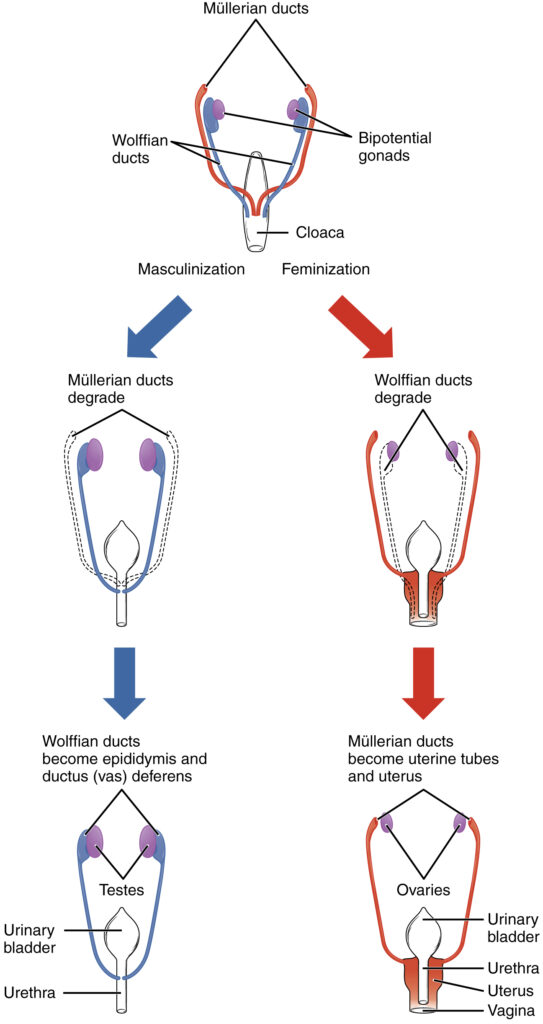
Pathways of Sexual Differentiation
| Pathway | Hormones/Factors | Outcomes |
|---|---|---|
| XY Chromosome (SRY gene) | Testosterone, MIF | Male internal and external genitalia |
| XX Chromosome (No SRY gene) | Lack of MIF, DHT | Female internal and external genitalia |
| 5α-Reductase Deficiency | Testosterone only | Male internal, ambiguous external genitalia |
| Absence of Sertoli Cells/MIF | Testosterone present | Both male and female internal genitalia |
Structures Derived in Male vs. Female Development
| Genital Structure | Male Development | Female Development |
|---|---|---|
| Mesonephric (Wolffian) Duct | Seminal vesicles, epididymis, ejaculatory duct, ductus deferens | Degenerates |
| Paramesonephric (Müllerian) Duct | Degenerates due to MIF | Fallopian tubes, uterus, proximal vagina |
| External Genitalia | Penis, scrotum | Clitoris, labia, distal vagina |
Mnemonics for Memorization
- “Leydig Leads” to male differentiation (internal and external).
- “Sertoli Shuts” down female differentiation (internal).
Points to Remember
- SRY Gene: Present on the Y chromosome, it triggers male differentiation.
- 5α-Reductase Deficiency: Leads to male internal genitalia with ambiguous external genitalia until puberty.
- Absence of Sertoli Cells or MIF: Causes the development of both male and female internal genitalia with male external genitalia.
Clinical Correlation
- 5α-Reductase Deficiency: Male internal genitalia with ambiguous external genitalia, which may masculinize at puberty.
- Absence of Sertoli Cells or MIF: Presence of both male and female internal genitalia due to lack of Müllerian duct suppression.