
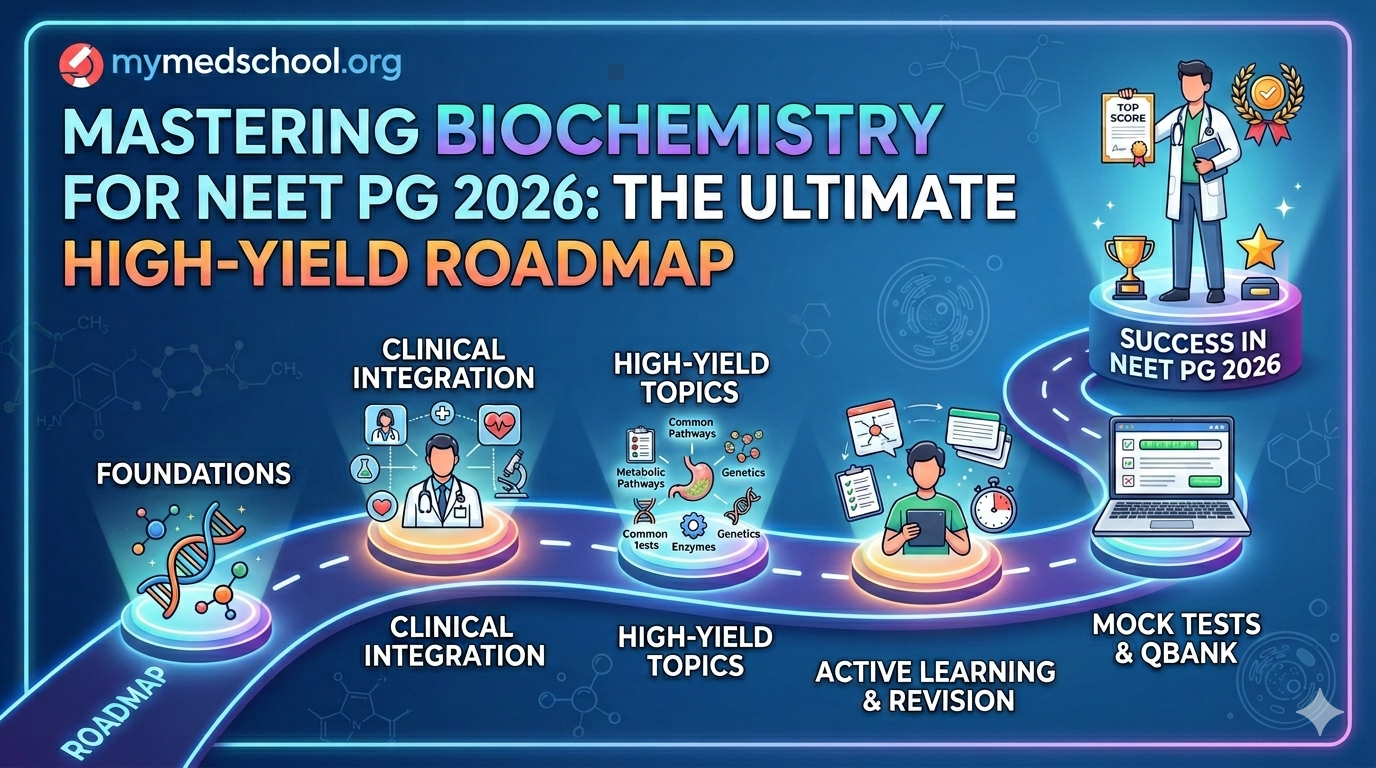
Biochemistry is often dismissed as a “memory-heavy” subject, but for the NEET PG exam, it is one of your most reliable scoring pillars. With 10–15% of the paper typically dedicated to this subject, mastering these concepts provides a foundational edge that translates directly into better performance in Pathology, Medicine, and Pediatrics.
For 2026, the exam trend continues to shift away from rote memorization and toward clinical integration. To help you stay ahead, I’ve structured this guide to turn your study sessions into a high-yield, active process.
All topics IN03 Biochemistry: 137
- Chromatin structure
- Nucleotides
- De novo pyrimidine and purine synthesis
- Purine salvage deficiencies
- Genetic code features
- DNA replication
- DNA repair
- Mutations in DNA
- Lac operon
- Functional organization of a eukaryotic gene
- Regulation of gene expression
- RNA processing (eukaryotes)
- RNA polymerases
- Introns vs exons
- Splicing of pre-mRNA
- tRNA
- Start and stop codons
- Protein synthesis
- Posttranslational modifications
- Chaperone protein
- Cell cycle phases
- Rough endoplasmic reticulum
- Smooth endoplasmic reticulum
- Cell trafficking
- Peroxisome
- Proteasome
- Cytoskeletal elements
- Microtubule
- Cilia structure
- Primary ciliary dyskinesia
- Sodium-potassium pump
- Collagen
- Collagen synthesis and structure
- Osteogenesis imperfecta
- Ehlers-Danlos syndrome
- Menkes disease
- Elastin
- Marfan syndrome
- Homocystinuria
- Polymerase chain reaction
- CRISPR/Cas9
- Blotting procedures
- Flow cytometry
- Microarrays
- Enzyme-linked immunosorbent assay
- Karyotyping
- Fluorescence in situ hybridization
- Molecular cloning
- Gene expression modifications
- Genetic terms
- Population genetics
- Hardy-Weinberg principle
- Disorders of imprinting
- Modes of inheritance
- Autosomal dominant diseases
- Autosomal recessive diseases
- Cystic fibrosis
- X-linked recessive diseases
- Muscular dystrophies
- Mitochondrial diseases
- Rett syndrome
- Fragile X syndrome
- Trinucleotide repeat expansion diseases
- Autosomal trisomies
- Genetic disorders by chromosome
- Robertsonian translocation
- Cri-du-chat syndrome
- Williams syndrome
- Essential fatty acids
- Vitamins: fat soluble
- Vitamins: water soluble
- Dietary supplementation
- Vitamin A
- Vitamin B1
- Vitamin B2
- Vitamin B3
- Vitamin B5
- Vitamin B6
- Vitamin B7
- Vitamin B9
- Vitamin B12
- Vitamin C
- Vitamin D
- Vitamin E
- Vitamin K
- Zinc
- Protein-energy malnutrition
- Ethanol metabolism
- Enzyme terminology
- Rate-determining enzymes of metabolic processes
- Metabolic compartmentation
- Summary of pathways
- Activated carriers
- Universal electron acceptors
- Hexokinase vs glucokinase
- Glycolysis regulation
- Regulation by fructose-2,6- bisphosphate
- Pyruvate dehydrogenase complex
- Pyruvate dehydrogenase complex deficiency
- Pyruvate metabolism
- TCA cycle
- Electron transport chain and oxidative phosphorylation
- Gluconeogenesis, irreversible enzymes
- Pentose phosphate pathway
- Glucose-6-phosphate dehydrogenase deficiency
- Disorders of fructose metabolism
- Disorders of galactose metabolism
- Sorbitol
- Lactase deficiency
- Amino acids
- Urea cycle
- Transport of ammonia by alanine
- Hyperammonemia
- Ornithine transcarbamylase deficiency
- Amino acid derivatives
- Catecholamine synthesis/tyrosine catabolism
- Phenylketonuria
- Maple syrup urine disease
- Alkaptonuria
- Homocystinuria
- Cystinuria
- Organic acidemias
- Glycogen regulation by insulin and glucagon/epinephrine
- Glycogen
- Glycogen storage diseases
- Lysosomal storage diseases
- Fatty acid metabolism
- Ketone bodies
- Fasted vs fed state
- Metabolic fuel use
- Fasting and starvation
- Lipid transport
- Key enzymes in lipid transport
- Major apolipoproteins
- Lipoprotein functions
- Abetalipoproteinemia
- Familial dyslipidemias
The Strategic Approach: Why Biochemistry Matters
Instead of treating Biochemistry as a collection of isolated facts, view it as the “molecular language” of medicine. When you understand the biochemical defect, the clinical presentation becomes logical rather than a set of symptoms to memorize.
1. Focus on Clinical Correlations
Questions are increasingly case-based. Don’t just memorize the enzyme deficiency—understand the resulting metabolic block and the patient’s symptoms.
- Pro-tip: When studying a pathway, always ask, “What happens if this enzyme is absent?” and “Which clinical condition mimics this?”
2. Leverage High-Yield Tools
You don’t need to reinvent the wheel. Utilize structured resources to maximize your retention:
- Visual Learning: Use flowcharts for complex pathways like the TCA cycle or the Urea cycle.
- Active Recall: Avoid passive reading. Use mymedschool.org to test yourself with high-yield practice questions immediately after completing a topic.
- The “Rule of 5”: When summarizing notes, group information into no more than five categories per subtopic to prevent cognitive overload.
-

NEET PG PSM: Question Bank (2021–Present)
-

NEET PG 2021 Question Bank
3 Tips for Effective Revision
- Iterative Learning: Your brain needs time to consolidate information. Study in 30-minute high-focus bursts followed by short reflections rather than long, multi-hour marathons.
- Build Your “Go-To” Journal: Instead of just highlighting your textbooks, create a personal notebook with your own mnemonics, enzyme-deficiency tables, and common PYQ pitfalls. This will be your most valuable asset in the final month before the exam.
- Analyze Trends: Treat previous year questions (PYQs) as your diagnostic tool. If you repeatedly get questions wrong in a specific area (e.g., lipid metabolism), go back to that chapter and prioritize it in your next review cycle.
Final Note: Biochemistry isn’t just about passing the exam; it’s about building the clinical intuition that will serve you throughout your residency. Stay consistent, stay clinical, and utilize the right tools to turn “must-learn” into “already known.”
Comments
2 responses to “Mastering Biochemistry for NEET PG 2026: The Ultimate High-Yield Roadmap”
Do you have the topic list for other subjects?
We have a complete course with all subject and topics. See NEET-PG course.