
Learning Objectives
Understand the three primary methods of Carbon Dioxide Transport in the blood. Master the biochemical reactions within the RBC, the significance of the Chloride Shift, and the physiological importance of the Haldane Effect for the USMLE Step 1.
1. The Three Forms of  Transport
Carbon dioxide is much more soluble in blood than oxygen, but it must still be managed carefully to maintain acid-base balance. Latex
| Form | Percentage | Mechanism |
|---|---|---|
Bicarbonate ( ) ) |
90% | enters RBCs, converted by Carbonic Anhydrase to . |
| Carbamino Compounds | 5% | binds to the N-terminus of globin (not heme). Forms  . . |
| Dissolved |
5% | Free dissolved directly in the plasma. |
2. The RBC Reaction and Chloride Shift
At the systemic tissues,
| Step | Reaction/Movement | Consequence |
|---|---|---|
| Conversion |  |
is converted into a soluble transport form. |
| Chloride Shift | leaves RBC;  enters RBC. enters RBC. |
Maintains electrical neutrality via the  exchanger. exchanger. |
| Osmotic Effect | Water follows into the RBC. |
Venous RBCs swell slightly, increasing venous hematocrit. |
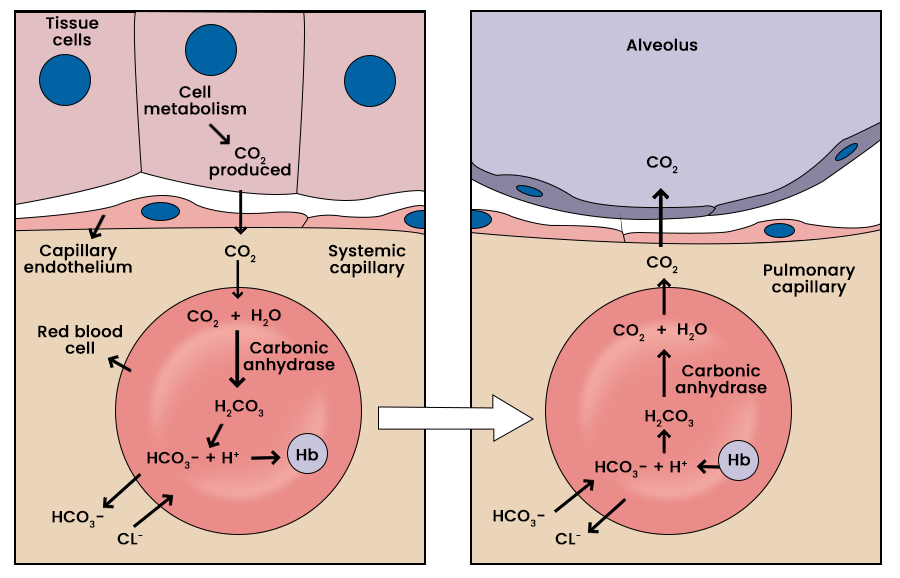
3. The Haldane Effect (In the Lungs)
The Haldane effect describes how the oxygenation status of hemoglobin affects its ability to carry
| Location | Event | Result |
|---|---|---|
| Pulmonary Capillaries |  binds to Hemoglobin. binds to Hemoglobin. |
Hemoglobin becomes more acidic and releases  . . |
| Equilibrium Shift | combines with to form  . . |
is produced and exhaled. |
Activity:
High-Yield Clinical Pearls:
- Bohr vs. Haldane: The Bohr Effect (tissues) is how
- Carbonic Anhydrase: This enzyme is inhibited by Acetazolamide, which interferes with
- Carbaminohemoglobin:
bind to the Iron in heme.
You must be logged in to post a comment.