
Learning Objectives
Master the structural and functional divisions of the Respiratory Tree. Understand the transition of epithelial cell types, the location of airway resistance, and the components of the Conducting vs. Respiratory zones for the USMLE Step 1.
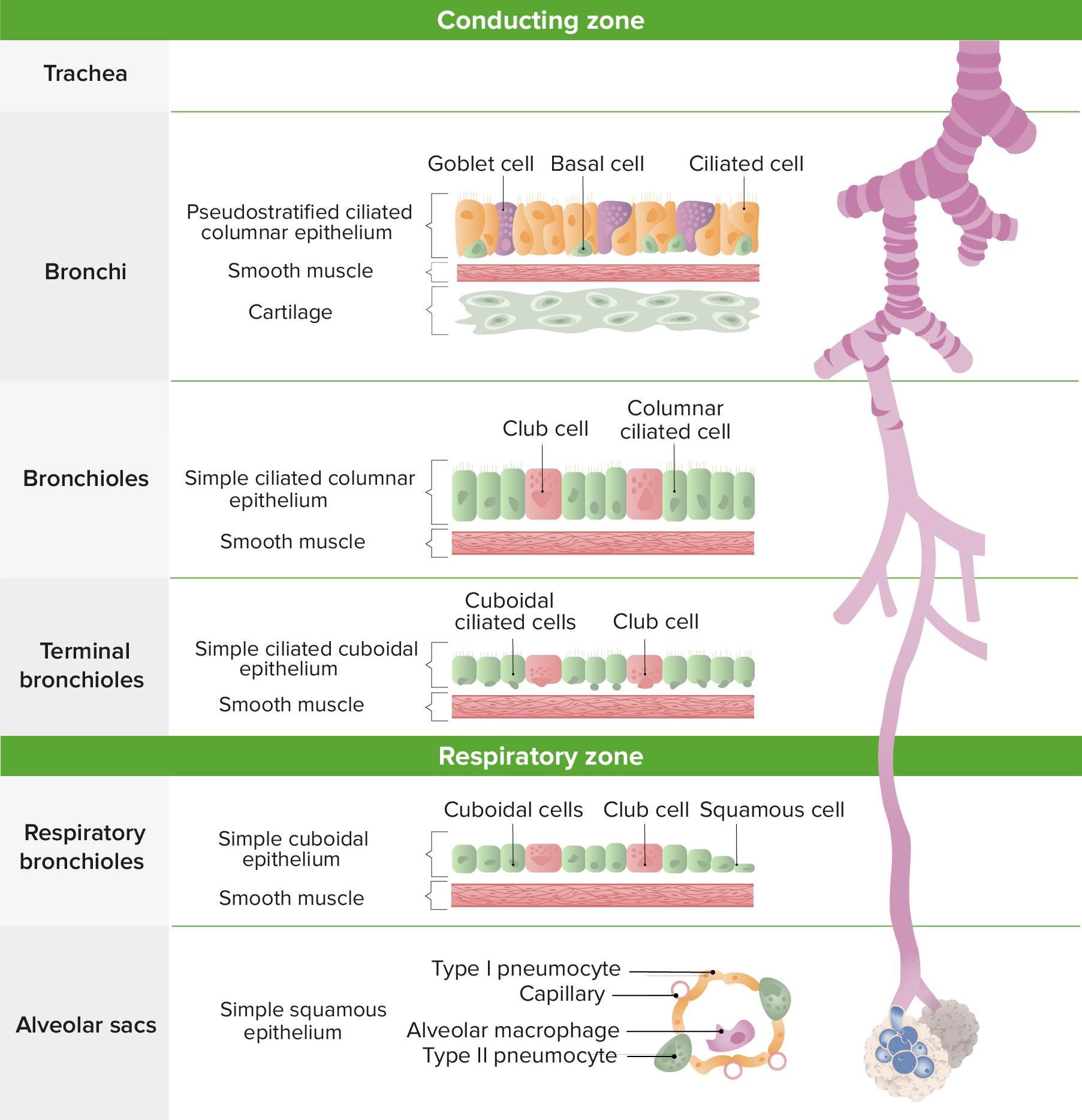
1. The Conducting Zone (Anatomic Dead Space)
The conducting zone extends from the nose to the terminal bronchioles. Its primary roles are to warm, humidify, and filter air; it does not participate in gas exchange.
| Structure | Histological Features | Clinical/Functional Note |
|---|---|---|
| Bronchi | Cartilage, goblet cells, and pseudostratified ciliated columnar cells. | Highest airway resistance occurs in large- to medium-sized bronchi. |
| Bronchioles | Smooth muscle; no cartilage or goblet cells. | Transition to simple ciliated cuboidal cells. |
| Terminal Bronchioles | Last part of the conducting zone. Contain Club cells. | Parallel arrangement leads to the lowest airway resistance. |
2. The Respiratory Zone (Gas Exchange)
This zone begins where gas exchange starts, extending from the respiratory bronchioles to the alveoli.
| Structure | Cellular Transition | Key Feature |
|---|---|---|
| Resp. Bronchioles | Mostly cuboidal; cilia terminate here. | First site of gas exchange. |
| Alveolar Ducts | Transition to simple squamous cells. | Smooth muscle becomes sparse. |
| Alveoli | Type I & II Pneumocytes; Alveolar Macrophages. | Type I (gas exchange); Type II (surfactant/stem cells). |
3. The Mucociliary Escalator
This vital defense mechanism clears debris and pathogens from the lungs.
| Component | Extent / Boundary |
|---|---|
| Cilia | Present from the trachea down to the respiratory bronchioles. |
| Goblet Cells | End at the bronchi (none in the bronchioles). |
| Smooth Muscle | Extends to the end of the terminal bronchioles. |
Activity:
High-Yield Clinical Pearls:
- Resistance Paradox: Even though individual small bronchioles are narrow, their massive total cross-sectional area (in parallel) means they contribute the least to total airway resistance.
- Where Cilia End: Cilia extend further down than goblet cells. This is crucial because if mucus were produced deep in the bronchioles without cilia to move it, the airways would clog.
- Dead Space: The volume of the conducting zone is the anatomic dead space (
).
You must be logged in to post a comment.