
Learning Objectives
Master the classification of Dizygotic vs. Monozygotic twins. Understand how the timing of monozygotic division dictates chorionicity and amnionicity, and memorize the high-yield “CAB” mnemonic for the USMLE Step 1.
1. Dizygotic (Fraternal) Twins
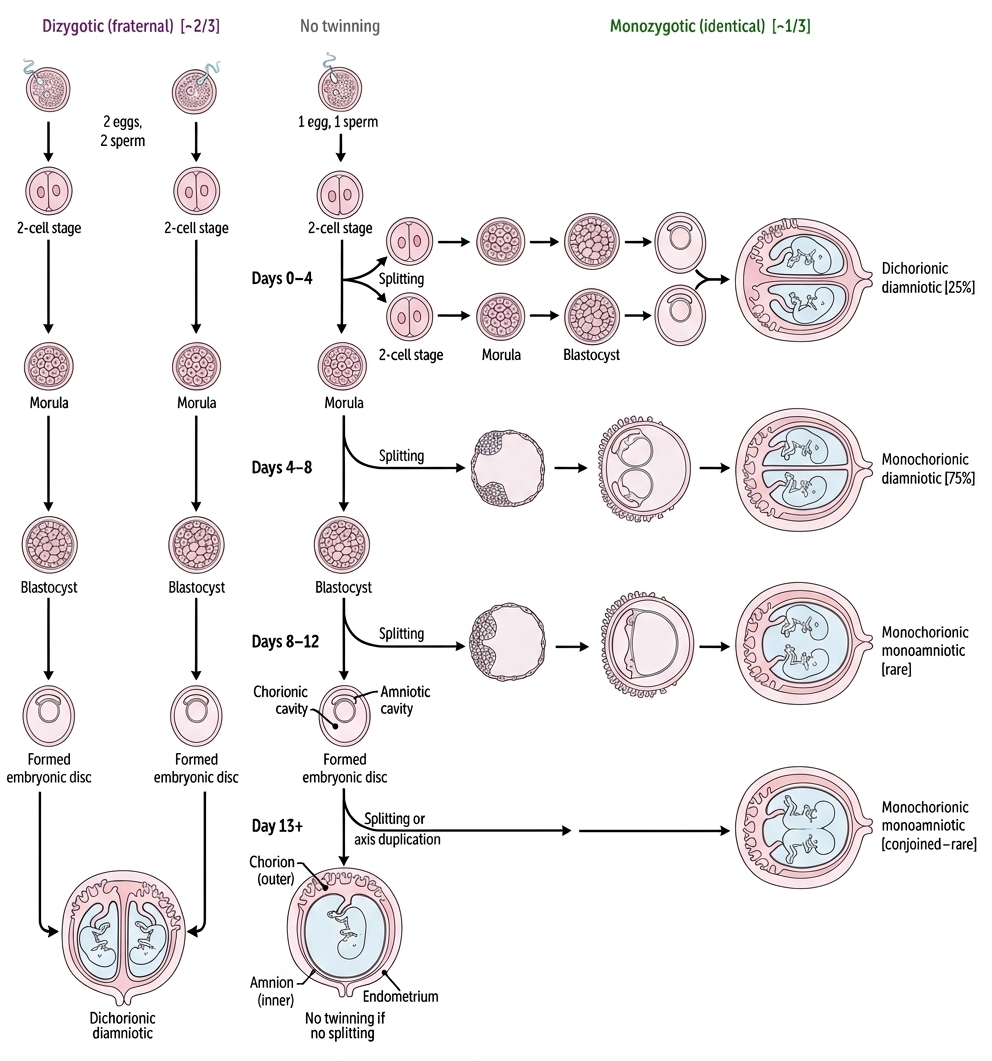
Dizygotic twins comprise approximately 2/3 of all twin pregnancies. They arise from two separate eggs fertilized by two different sperm.
| Feature | Characteristics |
|---|---|
| Zygosity | Always 2 zygotes. |
| Placentation | Dichorionic, Diamniotic (Di-Di): 2 separate placentas and 2 separate sacs. |
| Genetic Relatedness | Like any other siblings (share ~50% of genes). |
2. Monozygotic (Identical) Twins
Monozygotic twins arise from one fertilized egg (1 egg + 1 sperm) that splits. The timing of the split is the most critical factor for board exams.
| Splitting Day | Type | Shared Structures |
|---|---|---|
| Days 0–4 | Di-Di | Separate everything (2 Chorions, 2 Amnions). |
| Days 4–8 | Mo-Di | Shared Chorion (1 placenta, 2 sacs). Most common (75%). |
| Days 8–12 | Mo-Mo | Shared Chorion + Amnion (1 placenta, 1 sac). |
| Day 13+ | Conjoined | Shared Chorion, Amnion + Body. |
3. The High-Yield Mnemonic: SCAB / CA
The “CAB” mnemonic is essential for answering questions about what structures are shared based on the day of division.
| Letter | Shared Structure | USMLE Context |
|---|---|---|
| C | Chorion (Placenta) | Shared at 4–8 days. Most common MZ type. Risk of TTTS. |
| A | Amniotic (Sac) | Shared at 8–12 days. High risk of cord entanglement. |
| B | Body (Conjoined) | Shared at 13+ days. The embryonic disc has already formed. |
Activity:
High-Yield Clinical Pearls:
- The 4-8-12 Rule: Think of it in 4-day increments. 4 days (Di-Di), 8 days (Mo-Di), 12 days (Mo-Mo).
- TTTS Risk: Twin-Twin Transfusion Syndrome only occurs in Monochorionic (shared placenta) twins.
- Cord Entanglement: Monoamniotic (Mo-Mo) twins have a high risk of cord entanglement because they share the same sac.
You must be logged in to post a comment.