
Learning Objectives
- Identify the major types, causes, and diagnostic findings of neural tube defects (NTDs).
- Relate NTDs to embryologic development and failure of neural tube closure by the 4th week.
- Distinguish between spinal and cranial dysraphism classifications and clinical presentations.
1. Overview & Etiology
Neural tube defects (NTDs) are congenital malformations resulting from the failure of the neural tube to close completely by the 4th week of embryonic development.
- Maternal Folate Deficiency: A primary risk factor; prevention depends on adequate maternal folate intake before conception.
- Teratogenic Drugs: Antiepileptics such as valproate and carbamazepine interfere with folate metabolism.
2. Diagnostic Markers
During the 4th week, incomplete closure leads to either open NTDs (exposed tissue) or closed NTDs (skin intact).
| Test | Finding | Comment |
|---|---|---|
| Maternal Serum Alpha-Fetoprotein (AFP) |  in open NTDs |
AFP leaks from exposed neural tissue. |
| Amniotic Fluid Acetylcholinesterase (AChE) | in open NTDs |
Confirms open defect. |
| Ultrasound | Visualization of defects | Routine prenatal screening. |
3. Classification of NTDs
Spinal Dysraphism (Spinal NTDs)
| Type | Defect Category | Features | Key Clinical Points |
|---|---|---|---|
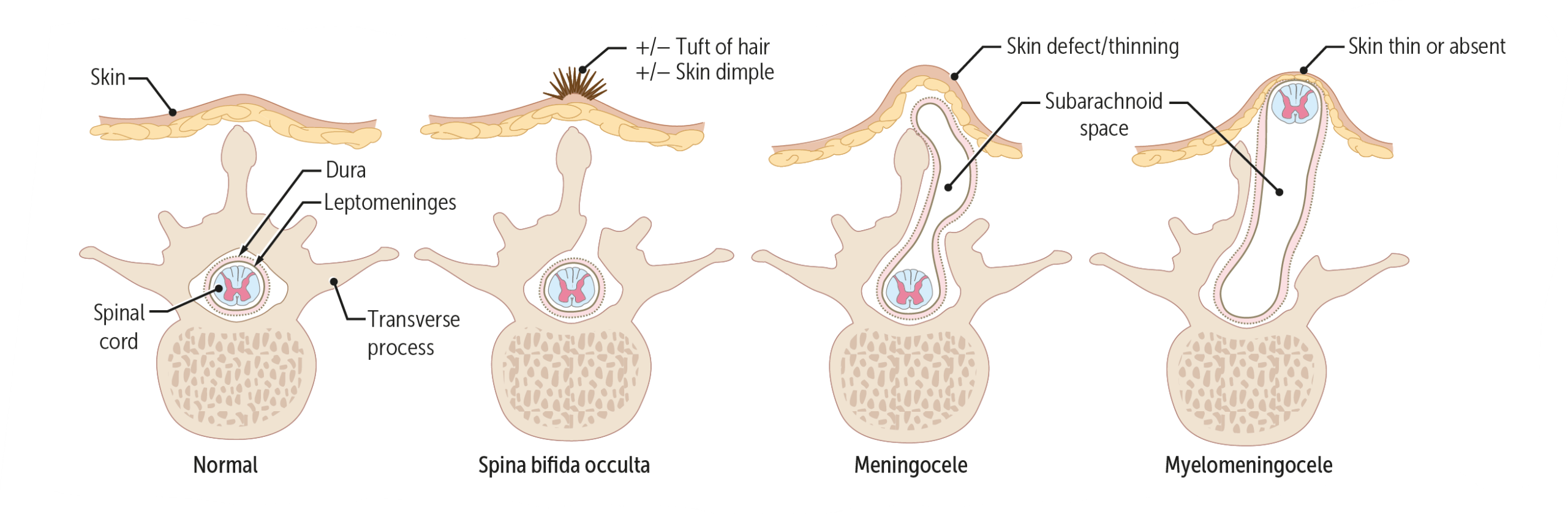
| Spina bifida occulta | Closed | Caudal neural tube fails to close, no herniation, dura intact. | A tuft of hair or a skin dimple over the defect. |
| Meningocele | Open | Herniation of meninges only. | Fluid-filled sac, no neural tissue. |
| Myelomeningocele | Open | Herniation of meninges + neural tissue (spinal cord/cauda equina). | Neurologic deficits below the lesion. |
| Myeloschisis | Open | Completely exposed neural tissue, no skin or meningeal covering. | The most severe form. |
Cranial Dysraphism (Cranial NTDs)
- Anencephaly: Failure of the rostral neuropore to close $\rightarrow$ absence of forebrain and open skull. Associated with polyhydramnios (decreased fetal swallowing) and is incompatible with life.
Clinical Notes & Correlations:
- Screening & Diagnosis: Elevated amniotic fluid AFP and AChE confirm an open neural tube defect.
- Teratogenic Risk: Avoid valproate and carbamazepine during early pregnancy due to high NTD risk.
Key Points & Memory Hooks:
Timeline: NTDs develop by week 4; prevention relies on early maternal folate.
Markers: AFP and AChE = open NTD.
Severity: Anencephaly involves absent brain and skull; spina bifida occulta presents as a bony defect with intact skin.
Timeline: NTDs develop by week 4; prevention relies on early maternal folate.
Markers:
AFP and AChE = open NTD.Severity: Anencephaly involves absent brain and skull; spina bifida occulta presents as a bony defect with intact skin.
You must be logged in to post a comment.