
Learning Objectives
- Explain the molecular basis of Achondroplasia involving the FGFR3 mutation.
- Differentiate between the effects on endochondral and membranous ossification.
- Identify the genetic inheritance pattern and associated risk factors like paternal age.
- Recognize the clinical phenotype of short-limbed dwarfism.
1. Pathophysiology & Bone Growth
Achondroplasia is the most common cause of dwarfism. It is specifically a disorder of the epiphyseal plate (growth plate).
- Endochondral Ossification: There is a total failure of longitudinal bone growth. Because long bones (arms/legs) rely on a cartilage scaffold, they remain short.
- Membranous Ossification: This process is unaffected. Because the bones of the skull (calvarium) and face form directly from mesenchyme without cartilage, they grow normally.
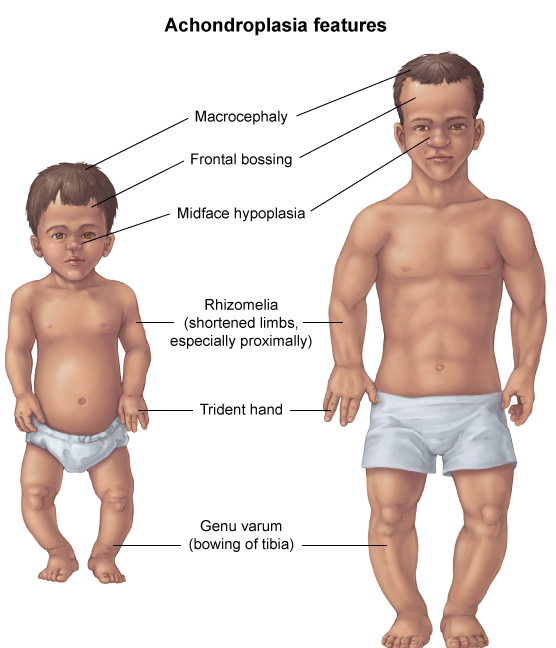
- Clinical Result: Disproportionate dwarfism—short limbs with a large head (macrocephaly) relative to the body.
2. Molecular Genetics
The condition is caused by a specific gain-of-function mutation in the Fibroblast Growth Factor Receptor 3 (FGFR3) gene on chromosome 4.
- The “Paradox”: Under normal conditions, FGFR3 inhibits bone growth. In achondroplasia, the receptor is constitutively active (always “on”). This constant signaling inhibits the proliferation of chondrocytes (cartilage cells), preventing bone lengthening.
- Inheritance:
- Autosomal Dominant: It has full penetrance.
- Lethality: Homozygosity (
) is lethal in utero or shortly after birth due to respiratory failure (tiny chest cavity).
- Sporadic Mutations: > 85% of cases are new mutations (de novo), often associated with advanced paternal age.
Clinical Notes & Step 1 Pearls:
- Paternal Age: While advanced maternal age is linked to chromosomal nondisjunction (e.g., Down Syndrome), advanced paternal age is linked to single-gene autosomal dominant mutations like Achondroplasia.
- Intellect: Patients with achondroplasia have normal life expectancy and normal intelligence.
- Physical Findings: Look for trident hand (space between 3rd and 4th fingers) and lumbar lordosis.
Activity: Achondroplasia Fact Check
Quick Mnemonics:
FGFR3: Failed Growth of Femur and Radius.
Endochondral: Ends the growth of long bones.
FGFR3: Failed Growth of Femur and Radius.
Endochondral: Ends the growth of long bones.
You must be logged in to post a comment.