
Learning Objectives
- Differentiate between Costochondritis and life-threatening chest pain.
- Identify the tendons and diagnostic tests for De Quervain tenosynovitis.
- Explain the pathophysiology and “5 P’s” of Limb Compartment Syndrome.
- Contrast the clinical presentations of Plantar Fasciitis, IT Band Syndrome, and Shin Splints.
1. Upper Body & Hand Conditions
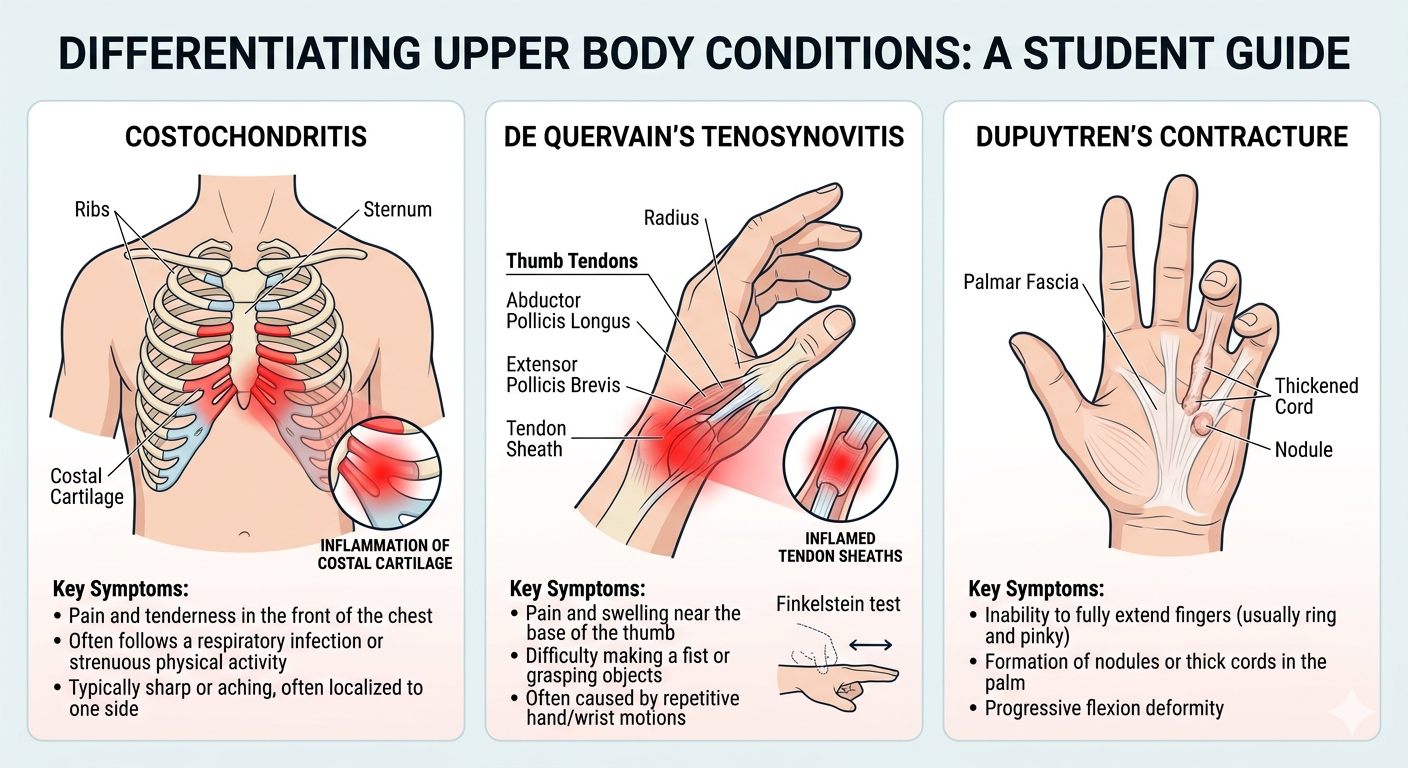
Costochondritis
Inflammation of the junctions where ribs meet the sternum.
- Presentation: Sharp, positional chest pain that worsens with deep inspiration or palpation.
- Clinical Pearl: Always a “diagnosis of exclusion.” You must rule out MI or PE first, especially since it mimics their presentation.
De Quervain Tenosynovitis
Noninflammatory thickening of the Abductor Pollicis Longus (APL) and Extensor Pollicis Brevis (EPB) tendons.
- Test: Finkelstein test (pain at the radial styloid when stretching thumb tendons).
- Risk: New mothers (lifting babies) and “thumb” texters.
Dupuytren Contracture
Fibroblastic proliferation and thickening of the palmar fascia.
- Presentation: Inability to fully extend the ring and little fingers.
- Demographic: Most common in males > 50 of Northern European descent.
2. Lower Limb & Overuse Injuries
| Condition | Key Pathophysiology | Clinical “Trigger” |
|---|---|---|
| Iliotibial (IT) Band Syndrome | Friction of the IT band against the lateral femoral epicondyle. | Lateral knee pain in runners. |
| Medial Tibial Stress Syndrome | Bone resorption outpaces formation in the tibial cortex (Shin splints). | Diffuse shin tenderness in military recruits/runners. |
| Plantar Fasciitis | Inflammation of the plantar aponeurosis. | Heel pain is worse with the first steps in the morning. |
3. Medical Emergencies & Diagnostics
Limb Compartment Syndrome
A surgical emergency where increased pressure within a fascial compartment leads to muscle and nerve ischemia.
- Causes: Long bone fractures (tibia), reperfusion injury, or crush injuries.
- The 5 P’s: Pain (out of proportion), Pallor, Paresthesia, Pulselessness, Paralysis.
- Note: Pulselessness and paralysis are late signs of irreversible damage.
Ganglion Cyst vs. Tumor
- Ganglion Cyst: Mucin-filled swelling, usually on the dorsal wrist.
- Diagnostic Trick: It transilluminates with light. Solid tumors do not.
Clinical Notes & Step 1 Pearls:
- TMJ Disorders: Often present as unilateral facial pain or “earache” (otalgia) that worsens with chewing. Associated with teeth grinding (bruxism).
- Rhabdomyolysis: In compartment syndrome, muscle necrosis releases myoglobin, which can lead to Acute Tubular Necrosis (ATN) in the kidneys.
Activity: MSK Differential Challenge
Quick Mnemonics:
De Quervain: Think “D” for Digital (texting) and Dealing with a baby.
Plantar Fasciitis: Think “F” for First steps in the morning.
5 P’s: The most important is Pain out of proportion to the exam.
You must be logged in to post a comment.