
Learning Objectives
- Differentiate between Muscle Spindles and Golgi Tendon Organs (GTO) by location and function.
- Explain the monosynaptic stretch reflex and the role of inhibitory interneurons.
- Identify the specific sensory axons (Ia, II, Ib) involved in proprioceptive pathways.
- Correlate muscle spindle activity with the Deep Tendon Reflex (DTR).
1. Proprioceptor Comparison
Proprioceptors provide the Central Nervous System (CNS) with constant feedback regarding muscle length and tension to maintain posture and prevent injury.
| Feature | Muscle Spindle | Golgi Tendon Organ (GTO) |
|---|---|---|
| Location | Body of the muscle. | Muscle tendons. |
| Sensed Variable | Muscle Length and speed of stretch. | Muscle Tension. |
| Sensory Fibers | Type Ia and II. | Type Ib. |
| Primary Response | Contraction of agonist muscle (Stretch Reflex). | Inhibition of agonist muscle (Tension protection). |
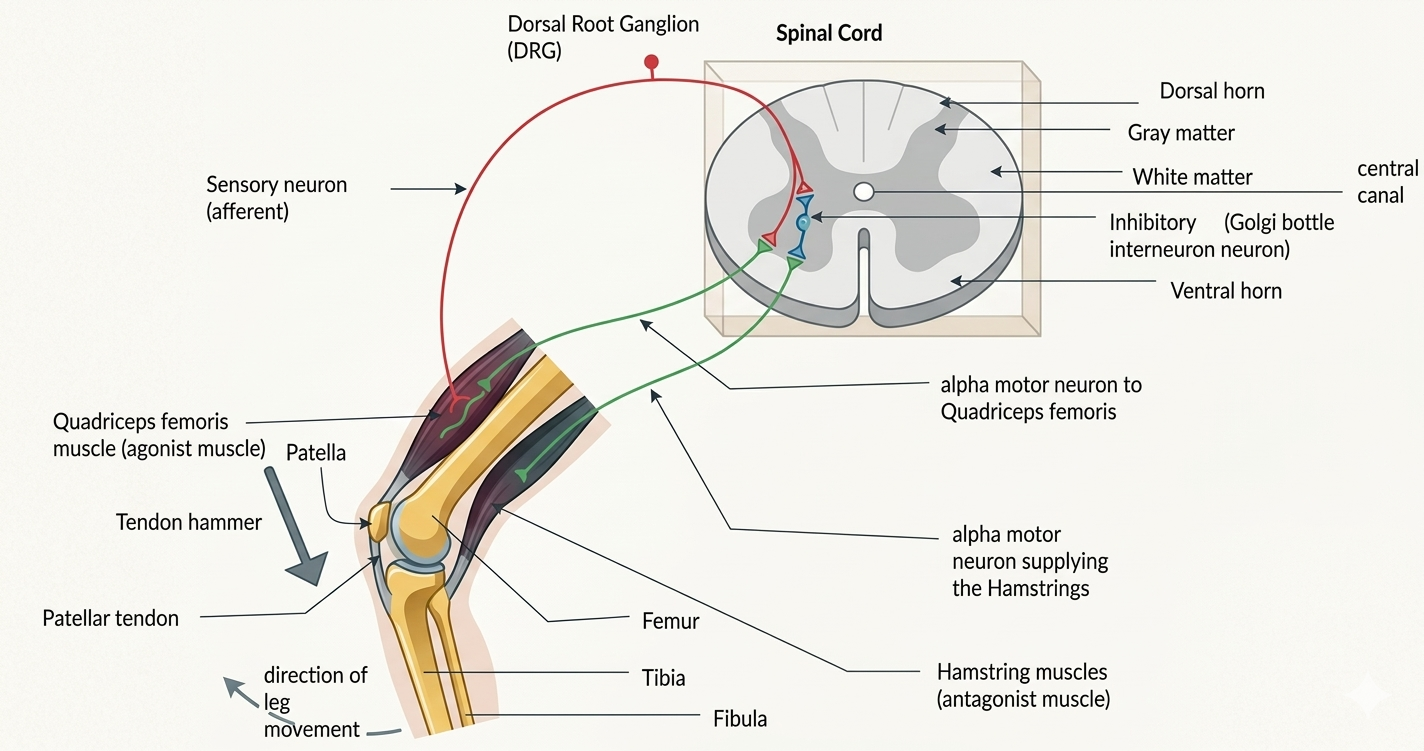
2. Reflex Pathways
The Stretch Reflex (Muscle Spindle)
When a muscle is suddenly stretched (e.g., striking the patellar tendon):
- Afferent: Signal travels via Ia and II fibers to the Dorsal Root Ganglion (DRG).
- Efferent: Direct activation of the alpha (
) motor neuron leading to contraction of the agonist muscle.
- Reciprocal Inhibition: Simultaneously, an inhibitory interneuron is activated to inhibit the antagonist muscle.
The Golgi Tendon Reflex (GTO)
When muscle tension becomes dangerously high:
- Afferent: Signal travels via Ib fibers to the DRG.
- Efferent: Activation of an inhibitory interneuron in the spinal cord.
- Action: Inhibition of the agonist
Clinical Notes & Step 1 Pearls:
- Alpha-Gamma Coactivation: During voluntary contraction, the CNS sends signals to both alpha (extrafusal) and gamma (intrafusal) motor neurons. This keeps the muscle spindle “taut” and sensitive even when the muscle is shortened.
- DTR Grading: Reflexes are graded 0–4. A grade of 2+ is normal. Hyperreflexia (3+ or 4+) often indicates an Upper Motor Neuron (UMN) lesion.
- Clasp-Knife Response: A sudden release of resistance during passive stretching of a spastic limb, largely mediated by the Golgi Tendon Organ.
Activity: Reflex Arc Identification
Quick Mnemonics:
Spindle: Measures Stretch (S for S).
Golgi: Measures Tension (T for T).
Ib Fiber: Is for Bone (where the tendon connects).
You must be logged in to post a comment.