
Learning Objectives
- Trace the sequence of events from the motor neuron action potential to muscle contraction.
- Explain the mechanical coupling between DHPR and Ryanodine Receptors (RR).
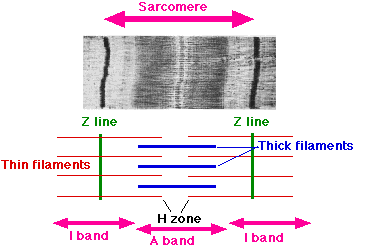
- Apply the Sliding Filament Theory to identify which sarcomere bands shorten during contraction.
- Define the roles of ATP and Calcium in the cross-bridge cycle.
1. Excitation-Contraction Coupling
The process begins at the Neuromuscular Junction (NMJ) and moves deep into the muscle fiber via T-tubules.
- Presynaptic: Action potential opens voltage-gated
channels $\rightarrow$ ACh release.
- Postsynaptic: ACh binds to receptors
muscle cell depolarization.
- T-Tubules: Depolarization travels deep into the cell. This induces a conformational change in the Dihydropyridine receptor (DHPR).
- Calcium Release: DHPR is mechanically coupled to the Ryanodine receptor (RR). When DHPR shifts, RR opens, releasing
2. The Crossbridge Cycle
Once
| Step | Molecular Action | Result |
|---|---|---|
| Unmasking | binds to Troponin C. |
Tropomyosin shifts, exposing actin-binding sites. |
| Binding | Myosin head binds to actin. | Crossbridge forms;  is released. is released. |
| Power Stroke | Myosin pulls the thin filament. | Sarcomere shortens; ADP is released. |
| Detachment | New ATP binds to myosin. | Myosin head releases actin. |
| Cocking | ATP is hydrolyzed to ADP + . |
Myosin head returns to high-energy “cocked” position. |
3. Sarcomere Dynamics
During contraction, the thick (myosin) and thin (actin) filaments slide past each other.
- Shortens: The H band, the I band, and the distance between Z lines.
- Stays Constant: The A band (Always the same).
Clinical Notes & Corrections:
- Rigor Mortis: After death, ATP is no longer produced. Without a new ATP molecule to bind, the myosin head cannot detach from actin, causing permanent muscle stiffness.
- Malignant Hyperthermia: Caused by a mutation in the Ryanodine receptor (RR). Exposure to certain anesthetics causes excessive
- Relaxation: The SERCA pump uses ATP to move
Activity: Muscle Contraction Step-Challenge
Memory Hooks:
HI, I’m shortZ: H and I bands shorten, as do Z lines.
A band: Always the same.
ATP Detaches: You need ATP to say “Bye-Bye” to actin.
You must be logged in to post a comment.