
Learning Objectives
Master the timeline of Fetal Erythropoiesis and the biochemical transition from embryonic to adult hemoglobin. Understand why Fetal Hemoglobin (HbF) has a higher oxygen affinity than adult hemoglobin and identify the specific globin chains involved in each developmental stage.
1. Timeline of Erythropoiesis Sites
The location of red blood cell production shifts throughout gestation. A classic way to remember this sequence is the mnemonic: “Young Liver Synthesizes Blood.”
| Site | Time Period | Key Note |
|---|---|---|
| Yolk sac | 3–8 weeks | First site of blood formation. |
| Liver | 6 weeks–birth | The major site during the second trimester. |
| Spleen | 10–28 weeks | Contributes alongside the liver. |
| Bone marrow | 18 weeks to adult | Becomes the primary site by the third trimester. |

2. Hemoglobin Development & Composition
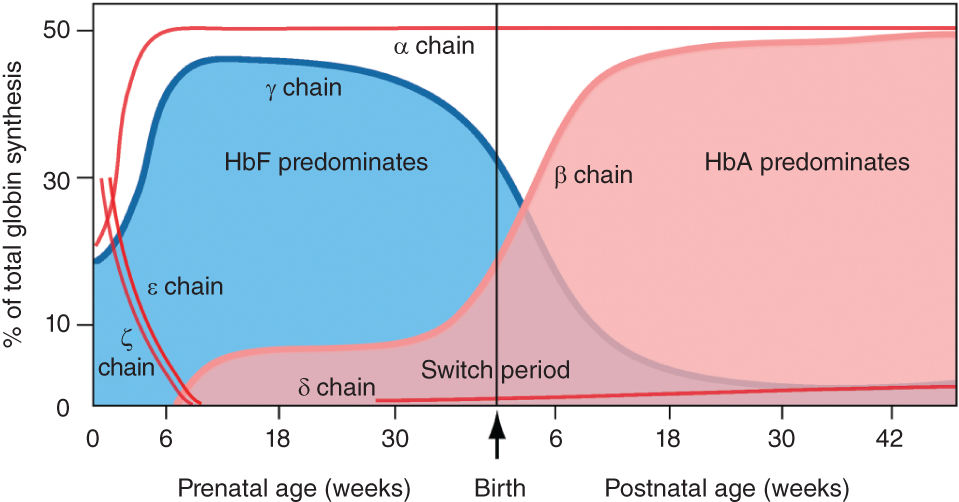
As the site of production changes, so does the type of hemoglobin synthesized. Hemoglobin is a tetramer composed of two pairs of globin chains.
| Hemoglobin Type | Chain Composition | Stage |
|---|---|---|
| Embryonic |  (Zeta) and $\epsilon$ (Epsilon) (Zeta) and $\epsilon$ (Epsilon) |
Early embryo (Gower types). |
| Fetal (HbF) |  (Alpha/Gamma) (Alpha/Gamma) |
Major form during fetal life. |
| Adult (HbA1) |  (Alpha/Beta) (Alpha/Beta) |
Dominant after 6 months of life. |
| Adult (HbA2) |  (Alpha/Delta) (Alpha/Delta) |
Small amounts in adults (~2–3%). |
3. Oxygen Affinity: HbF vs. HbA
The fetus must “steal” oxygen from maternal blood. This is achieved because HbF has a higher affinity for 
Activity:
4. The “Switch” Logic
A high-yield concept for the USMLE is knowing which chains persist and which disappear.
Alpha (

Activity
High-Yield Mnemonics & Tips:
- Young Liver Synthesizes Blood: Yolk sac
Liver
- HbF vs. 2,3-BPG: Just remember that 2,3-BPG makes hemoglobin “let go” of oxygen. Because HbF doesn’t like 2,3-BPG, it doesn’t let go easily—meaning it has a higher affinity.
- Beta Thalassemia: Since $Layex \beta$-globin isn’t the main chain until after birth, patients with $\beta$-thalassemia are usually asymptomatic until about 6 months of age, when HbF levels drop.
You must be logged in to post a comment.