
Learning Objectives
- Detail the design, purpose, and methodological features of clinical therapeutic trials in human research.
- Compare analytical approaches used in clinical trials, including intention-to-treat, as-treated, and per-protocol analyses.
- Examine the five distinct phases of clinical development (Preclinical, Phase 0, Phase 1, Phase 2, Phase 3, and Phase 4) utilizing the mnemonic “Can I SWIM?”.
1. Clinical Trials & Trial Design Features
Experimental studies comparing interventions benefit immensely from rigorous blinding, randomization, and specialized analytical frameworks to minimize bias and confounding.
| Trial Concept / Design | Methodological Details & Execution | Purpose & Significance |
|---|---|---|
| Blinding Levels | Single-blind (subject masked); Double-blind (subject and researcher masked); Triple-blind (subject, researcher, and data analyst masked). | Eliminates placebo effects, observation bias, and evaluation bias. |
| Crossover Trial | Subjects receive a sequence of  treatments with a randomized order and a washout period in between. |
Allows subjects to serve as their own controls, reducing confounding variability. |
| Intention-to-Treat Analysis | All subjects are analyzed based on their original random assignment (“once randomized, always analyzed”). | Avoids bias from attrition and noncompliance; preserves randomization benefits. |
| As-Treated & Per-Protocol | As-treated analyzes by treatment actually received. Per-protocol excludes those failing to complete assigned treatment. |  Risk of bias due to loss of random assignment benefits. |
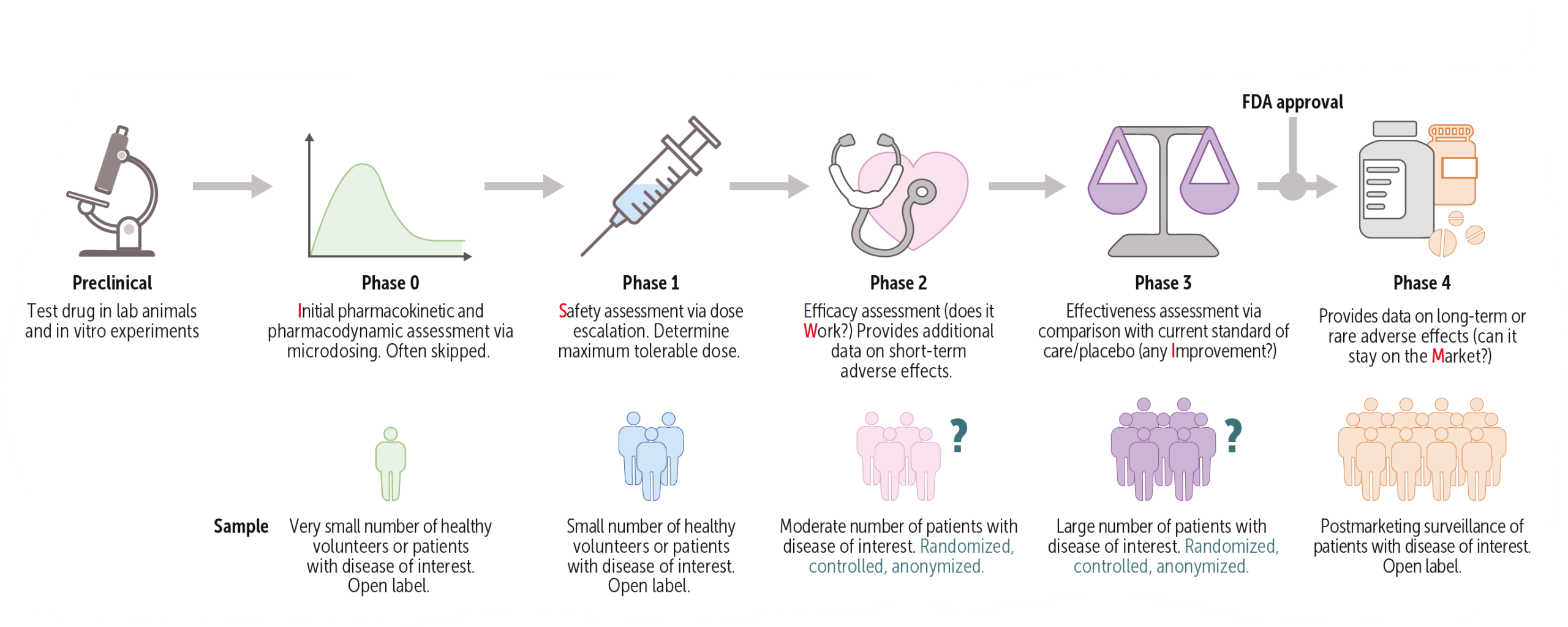
2. Phases of Clinical Development (“Can I SWIM?”)
Drug testing moves systematically from laboratory testing through postmarketing surveillance to establish safety, pharmacokinetics, efficacy, and effectiveness.
| Phase | Study Population & Design | Primary Focus & Question Answered |
|---|---|---|
| Preclinical | Laboratory animals and in vitro experiments. | Initial toxicity and basic pharmacological profile testing. |
| Phase 0 | Very small number of healthy volunteers or patients (microdosing). Open label. | Initial pharmacokinetic and pharmacodynamic assessment (often skipped). |
| Phase 1 (Can) | Small number of healthy volunteers or patients. Open label. | Safety assessment via dose escalation. Determines maximum tolerable dose. |
| Phase 2 (I) | Moderate number of patients with disease of interest. Randomized, controlled, anonymized. | Efficacy assessment (does it work?) and short-term adverse effects. |
| Phase 3 (SWIM – S) | Large number of patients with disease of interest. Randomized, controlled, anonymized. | Effectiveness assessment vs. standard of care/placebo (any improvement?). Leads to FDA approval. |
| Phase 4 (SWIM – M) | Postmarketing surveillance of patients with disease of interest. Open label. | Long-term or rare adverse effects (can it stay on the market?). |
Clinical Integration & Analysis Rules:
- Intention-to-Treat Preservation: Preserves the power of randomization by avoiding confounding due to patient dropouts or switching treatments, though it can slightly dilute the measured magnitude of a drug’s therapeutic effect.
- FDA Approval Milestone: Successful completion of Phase 3 trials provides the pivotal evidence required for regulatory submission and formal drug approval.
- Postmarketing Vigilance: Phase 4 is crucial for uncovering rare adverse reactions that require massive sample sizes or years of broad population exposure to detect.
Key Points & Memory Hooks:
The SWIM Mnemonic: Can (Phase 1: Safety) I (Phase 2: Efficacy) SWIM (Phase 3: Effectiveness / Phase 4: Market surveillance).
Analysis Golden Rule: Always prefer Intention-to-Treat to prevent attrition bias in clinical trial reporting.
The SWIM Mnemonic: Can (Phase 1: Safety) I (Phase 2: Efficacy) SWIM (Phase 3: Effectiveness / Phase 4: Market surveillance).
Analysis Golden Rule: Always prefer Intention-to-Treat to prevent attrition bias in clinical trial reporting.
You must be logged in to post a comment.