
Learning Objectives
- Identify the four metabolic pathways for pyruvate utilization.
- Match each pathway to its specific B-vitamin cofactor.
- Understand the physiological context (aerobic vs. anaerobic) for each fate.
1. The Metabolic Crossroad
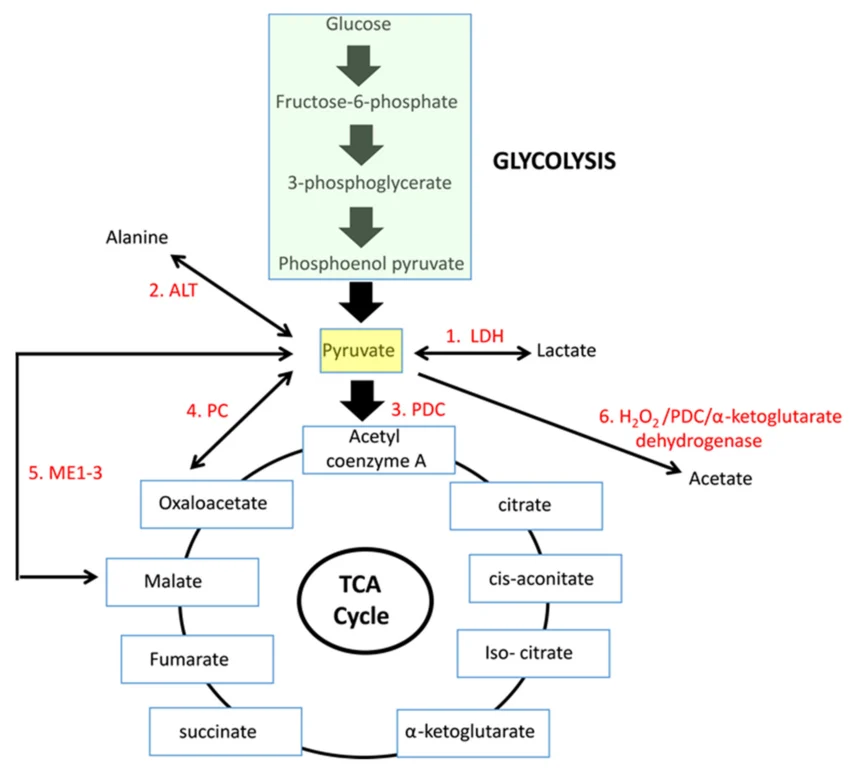
Pyruvate sits at a central junction in metabolism. Its destination is determined by the cell’s energy needs, oxygen availability, and tissue type.
| Enzyme | Cofactor | Product & Purpose |
|---|---|---|
| Alanine Aminotransferase (ALT) | B6 (Pyridoxine) | Alanine: Carries amino groups from muscle to liver (Cahill cycle). |
| Pyruvate Carboxylase | B7 (Biotin) | Oxaloacetate: Replenishes the TCA cycle (anaplerosis) or starts Gluconeogenesis. |
| Pyruvate Dehydrogenase (PDH) | B1, B2, B3, B5, Lipoic Acid | Acetyl-CoA: Transitions to the TCA cycle for ATP production (Aerobic). |
| Lactic Acid Dehydrogenase (LDH) | B3 (Niacin/NAD+) | Lactate: End of anaerobic glycolysis; regenerates NAD+ to keep glycolysis running. |
Biochemical Correlation: Anaerobic Tissues
Certain tissues rely primarily on LDH because they either lack mitochondria (RBCs) or operate in low-oxygen environments. High-yield examples include: RBCs, WBCs, Kidney Medulla, Lens/Cornea of the eye, and Sertoli cells in the testes.
2. Cofactor Review
- B6 (ALT): Essential for all transamination reactions.
- B7 (Carboxylase): Remember that most carboxylases require Biotin.
- B3 (LDH): Used as NAD+ to accept electrons, allowing glycolysis to continue in the absence of O2.
Activity
Clinical Correlate: Lactic Acidosis
In states of shock or severe hypoxia, the electron transport chain shuts down. Pyruvate is forced exclusively through the LDH pathway. This leads to a buildup of lactic acid, contributing to a high anion gap metabolic acidosis.
Activity
You must be logged in to post a comment.