
Learning Objectives
- Understand the role of the bifunctional enzyme (PFK-2/FBPase-2) in metabolic switching.
- Explain how hormonal signals (Insulin vs. Glucagon) alter enzyme phosphorylation status.
- Master the direction of flux between Glycolysis and Gluconeogenesis based on F-2,6-BP levels.
1. The Metabolic Switch: Fructose-2,6-BP
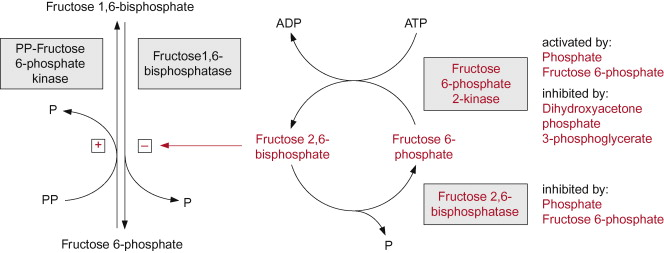
Fructose-2,6-bisphosphate (F-2,6-BP) is the most potent allosteric activator of PFK-1 and an inhibitor of FBPase-1. It acts as a signaling molecule that dictates whether the cell should burn glucose or make it.
2. The Bifunctional Enzyme
PFK-2 and FBPase-2 are actually two domains of the same enzyme. Their activity is determined by their phosphorylation state, which is controlled by the cAMP/Protein Kinase A (PKA) pathway.
| State | Hormonal Signal | Enzyme Status | Metabolic Result |
|---|---|---|---|
| Fasting | ↑ Glucagon → ↑ cAMP → ↑ PKA | Phosphorylated: FBPase-2 Active PFK-2 Inactive |
↓ F-2,6-BP ↑ Gluconeogenesis |
| Fed | ↑ Insulin → ↓ cAMP → ↓ PKA | Dephosphorylated: PFK-2 Active FBPase-2 Inactive |
↑ F-2,6-BP ↑ Glycolysis |
Biochemical Correlation: Reciprocal Regulation
By using a single bifunctional enzyme, the cell ensures that Glycolysis and Gluconeogenesis are never fully active at the same time. This prevents a “futile cycle” where the cell would waste ATP to synthesize and then immediately break down the same glucose molecule.
Activity
Activity
You must be logged in to post a comment.