
Core Principles
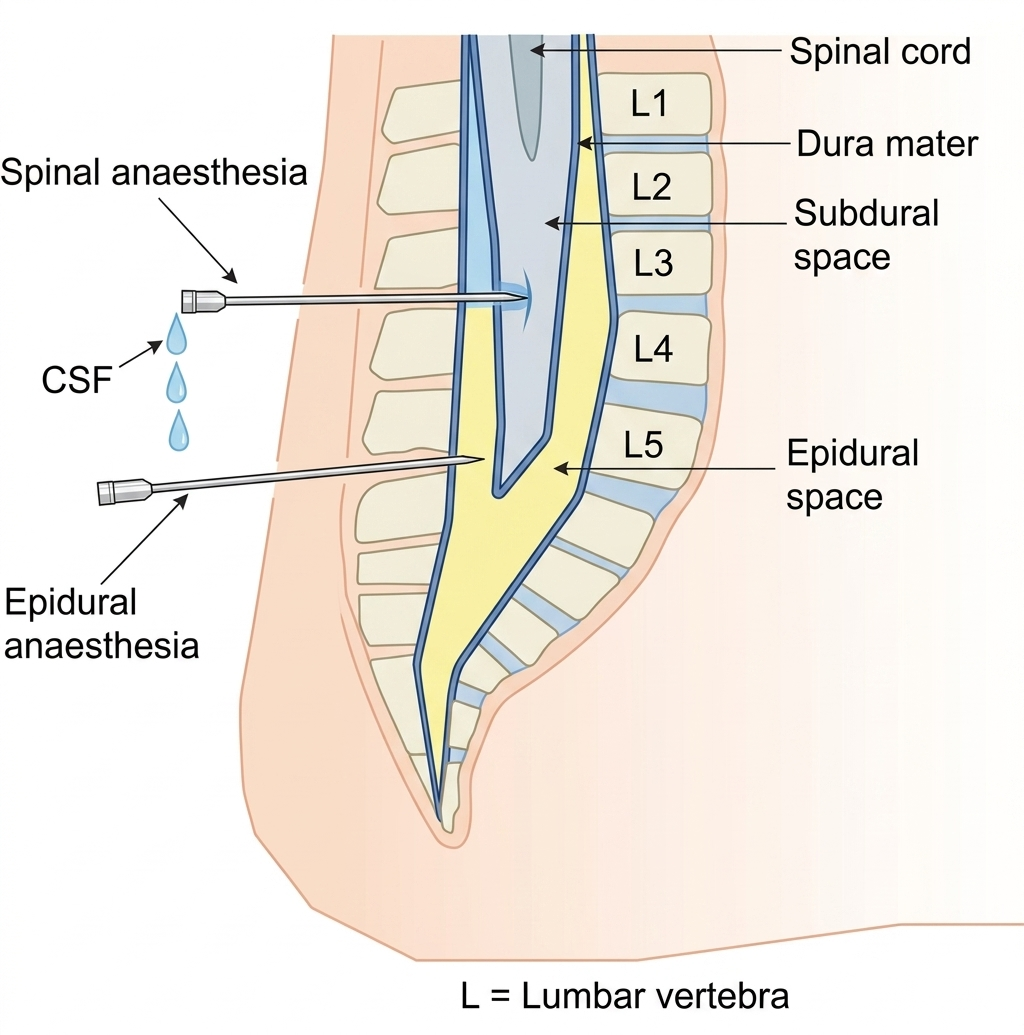
- Definition: A form of neuraxial regional anaesthesia involving the injection of local anaesthetic (with or without opioids) into the subarachnoid space.
- Anatomical Landmark: The needle must be inserted below L1/L2 (typically L3–L4 or L4–L5) to avoid injury to the conus medullaris.
- Mechanism: Provides motor, sensory, and autonomic (sympathetic) blockade.
- Blockade order: Thin unmyelinated C-fibres (pain) are blocked first; thick myelinated A-alpha motor neurons are blocked moderately; small preganglionic sympathetic fibers are blocked last.
Clinical Indications
- Primary Use: Surgeries below the umbilicus, including orthopaedic (pelvis, hip, knee), vascular (legs), urology (TURP), and gynaecology (hysterectomy, C-section).
- Caesarean Section: Preferred technique as it avoids the risks of general anaesthesia and failed intubation, and allows the mother to be conscious.
- Respiratory Compromise: Favoured in patients with severe COPD to avoid intubation/ventilation consequences.
- Paediatrics: Useful in children with difficult airways or increased respiratory risks.
Contraindications
- Absolute: Patient refusal, local infection at the injection site, bleeding disorders/systemic anticoagulation (risk of spinal epidural hematoma), severe aortic stenosis, increased intracranial pressure, space-occupying brain lesions, and allergy.
- Relative: Ehlers–Danlos syndrome or other conditions causing resistance to local anaesthetics.
Risks and Complications
- Common/Minor: Mild hypotension, bradycardia, nausea/vomiting, and transient neurological symptoms.
- Post-Dural-Puncture Headache (PDPH): Strongly associated with needle size/type. A 26-gauge atraumatic needle (e.g., Braun Atraucan) is recommended to lower the risk.
- Serious/Rare: Cauda equina syndrome, nerve injuries, cardiac arrest, severe hypotension, spinal epidural hematoma, and epidural abscess/meningitis.
Key Technical Concepts
- Baricity: The density of the anaesthetic solution relative to CSF.
- Hyperbaric (made denser with glucose) is most commonly chosen because its spread is predictably controlled by tilting the patient.
- Positioning: Sitting, lateral decubitus, and prone (jackknife).
Spinal vs. Epidural Anaesthesia
| Feature | Spinal Anaesthesia | Epidural Anaesthesia |
|---|---|---|
| Site | Subarachnoid space (CSF) | Epidural space |
| Dose | Small (1.5–3.5 mL) | Large (10–20 mL) |
| Onset | Rapid (~5 minutes) | Slower (~25–30 minutes) |
| Catheter | Usually single-shot | Indwelling catheter for redosing |
| Block Type | Profound motor/sensory block | Band of nerve root blockade |
For high-yield clinical resources and free medical questions, visit mymedschool.org.
You must be logged in to post a comment.