
Paraneoplastic Syndromes: Systemic Manifestations of Malignancy
Paraneoplastic syndromes are symptom complexes that develop in cancer patients but cannot be directly attributed to local tumor invasion, mechanical compression, or distant metabolic injury from metastatic lesions. Instead, they are driven by ectopic hormone/cytokine secretion or an autoimmune cross-reaction. Crucially, these syndromes often manifest before a primary malignancy is diagnosed, serving as highly valuable clinical clues for early detection.
1. Pathophysiological Classification
Paraneoplastic processes generally operate through two main biochemical mechanisms: ectopic hormone production or tumor-triggered autoimmune cross-reactivity.
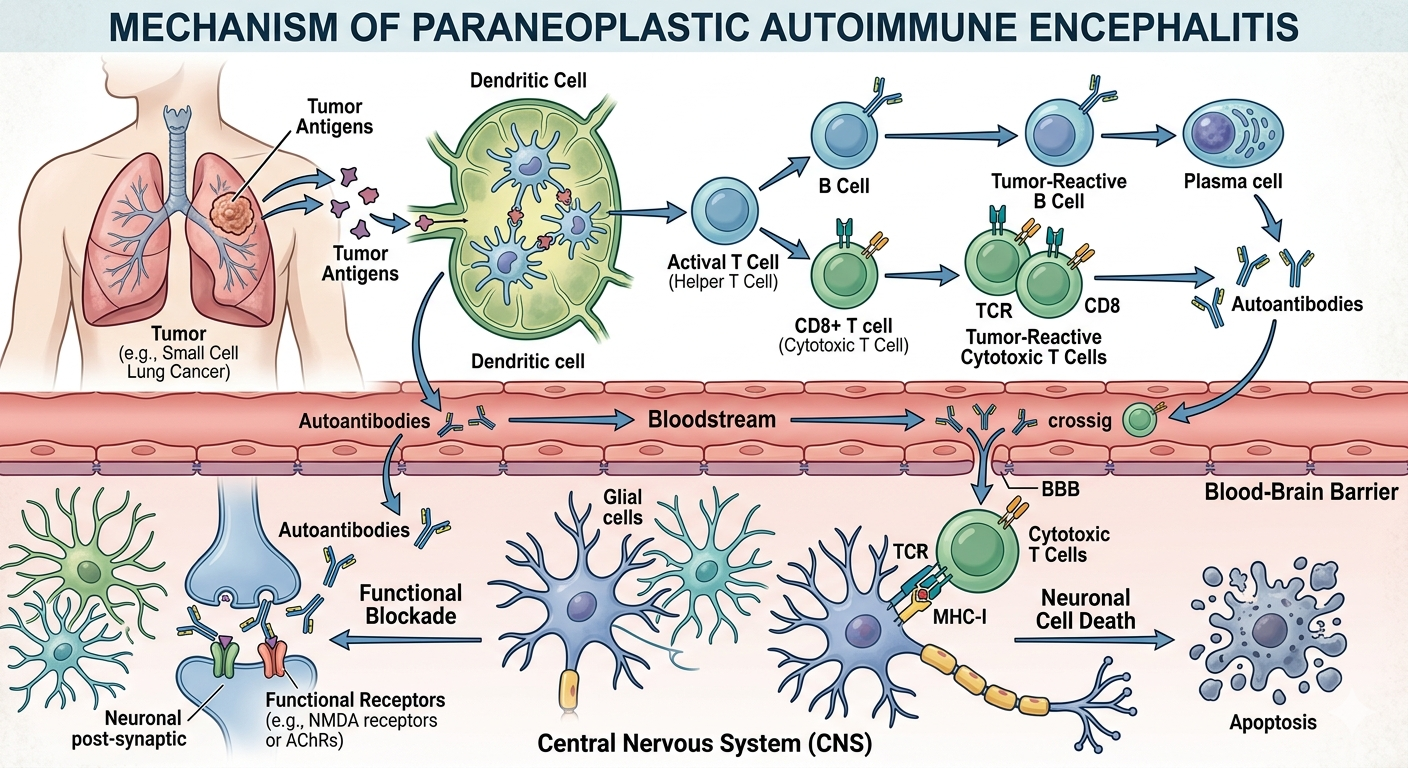
Autoimmune mechanism of neuro-paraneoplastic disorders: Antigens shared between neoplastic cells and the nervous system cause the immune system to misidentify and attack healthy neurons.
| Syndrome Category | Mediator / Causal Factor | Key Clinical Features & Pathophysiology |
|---|---|---|
| SIADH | Ectopic Antidiuretic Hormone (ADH) | Excessive water reabsorption in renal collecting ducts. Presents as euvolemic hyponatremia with high urine osmolality. Classically associated with Small Cell Lung Carcinoma (SCLC). |
| Cushing Syndrome | Ectopic ACTH (or pro-opiomelanocortin) | Drives bilateral adrenal hyperplasia and massive cortisol production. Presents with hypokalemic metabolic alkalosis, hypertension, and classic Cushingoid features. Driven by SCLC or bronchial carcinoid tumors. |
| Hypercalcemia of Malignancy | PTHrP (PTH-related peptide) | Mimics PTH by activating osteoclasts and increasing renal calcium reabsorption. Serum PTH is suppressed. Characteristically tied to Squamous Cell Carcinomas (lung, head/neck, cervix) and renal cell carcinoma. |
| Polycythemia | Ectopic Erythropoietin (EPO) | Stimulates uncontrolled erythrocyte production in bone marrow. Associated with Renal Cell Carcinoma, Hepatocellular Carcinoma, Hemangioblastoma, and Uterine Leiomyoma (“Real Heavy Home Runs”). |
| Lambert-Eaton Myasthenic Syndrome | Antibodies against P/Q-type voltage-gated Ca²⁺ channels | Autoantibodies block presynaptic calcium influx, preventing acetylcholine release at the neuromuscular junction. Causes proximal muscle weakness that improves with repeated use. Highly associated with Small Cell Lung Carcinoma (SCLC). |
| Myasthenia Gravis | Antibodies against postsynaptic ACh receptors | Autoantibodies drive complement-mediated destruction of receptors. Weakness flattens and worsens with repeated use, involving extraocular muscles early (ptosis, diplopia). Associated with Thymoma. |
2. High-Yield Neurological and Hematological Phenotypes
Specific multi-system paraneoplastic signs require strict clinical recognition due to their highly predictive patterns:
- Paraneoplastic Cerebellar Degeneration:
Caused by the immune-mediated destruction of Purkinje cells via autoantibodies. Classically driven by Anti-Yo antibodies in ovarian and breast cancers, or Anti-Hu antibodies in small cell lung cancer. Presents as subacute, progressive bilateral cerebellar ataxia, dysarthria, and nystagmus. - Trousseau Syndrome (Migratory Thrombophlebitis):
Tumor cells release tissue factor and mucins that systematically activate the coagulation cascade, causing recurrent, migrating venous thromboses in unusual locations (e.g., superficial veins of the arms and chest). This sign is highly indicative of underlying Pancreatic Adenocarcinoma or other mucin-secreting adenocarcinomas. - Hypertrophic Osteoarthropathy (HOA):
Characterized by symmetric painful periostitis of the distal long bones, digital clubbing, and joint effusions. When presenting suddenly in an adult, it points directly toward underlying pulmonary pathology, most notably Lung Adenocarcinoma. - Opsoclonus-Myoclonus Syndrome:
An autoimmune cross-reaction causing rapid, involuntary, multi-directional conjugate eye movements (“dancing eyes”) accompanied by chaotic muscle jerking (“dancing feet”). In pediatric populations, this presentation demands an immediate diagnostic workup for an underlying Neuroblastoma.
You must be logged in to post a comment.