
Learning Objectives
- Identify the major functional classes of cellular RNA—ribosomal RNA (rRNA), transfer RNA (tRNA), messenger RNA (mRNA), heterogeneous nuclear RNA (hnRNA / pre-mRNA), small nuclear RNA (snRNA), and ribozymes.
- Compare the relative cellular abundance, subcellular localization, structural architecture, and half-life characteristics of each RNA species.
- Explain the specific molecular roles of each RNA class across post-transcriptional RNA processing (capping, polyadenylation, spliceosome-mediated intron removal) and ribosomal protein translation (peptidyl transferase catalysis and codon–anticodon decoding).
RNA molecules execute diverse structural, informational, regulatory, and catalytic roles across the nucleus and cytoplasm. While messenger RNA carries the genetic blueprint for polypeptide assembly, non-coding RNAs—including rRNA, tRNA, snRNA, and catalytic ribozymes—form the molecular machinery required to process transcripts and synthesize proteins.
Activity
Major Classes of Cellular RNA
| RNA Class | Subcellular Location | Primary Molecular Function | Structural & High-Yield Notes |
|---|---|---|---|
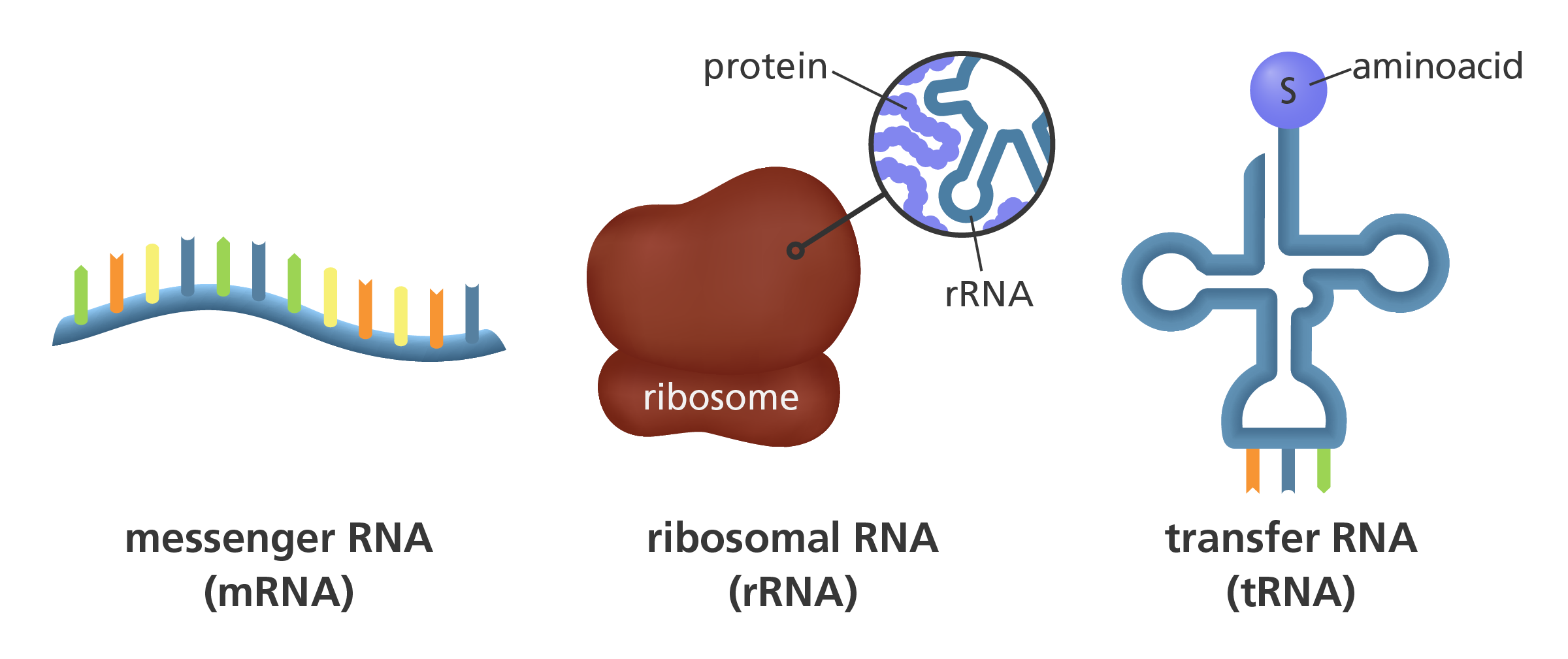
| Ribosomal RNA (rRNA) | Cytoplasm (ribosomes); synthesized in nucleolus (except 5S rRNA) | Combines with ribosomal proteins to form ribosomal subunits; provides structural scaffolding and catalyzes peptide bond formation (peptidyl transferase). | Most abundant RNA type (~80% of total cellular RNA); acts as a catalytic ribozyme during translation. |
| Transfer RNA (tRNA) | Cytoplasm | Adaptor molecule that delivers specific activated amino acids to the ribosome and decodes mRNA codons via complementary base pairing. | Second most abundant RNA type (~15%); characteristic cloverleaf secondary structure (L-shaped 3D) featuring an anticodon loop and a 3′ CCA acceptor stem. |
| Messenger RNA (mRNA) | Nucleus (synthesis & maturation) → Cytoplasm (translation) | Carries genetic coding information from nuclear DNA to cytoplasmic ribosomes as the template for polypeptide synthesis. | Only RNA type that is translated; highly heterogeneous in size/sequence; possesses the shortest half-life among RNA classes. |
| Heterogeneous Nuclear RNA (hnRNA / pre-mRNA) | Nucleus only (eukaryotes) | Primary eukaryotic RNA transcript synthesized directly by RNA Polymerase II; serves as the immature precursor to mature mRNA. | Contains both non-coding introns and coding exons; undergoes 5′ capping, 3′ polyadenylation, and splicing before nuclear export. |
| Small Nuclear RNA (snRNA) | Exclusively nuclear | Associates with nuclear proteins to form snRNPs (spliceosome), catalyzing the excision of introns from pre-mRNA. | Autoantibodies against snRNP proteins (anti-Smith [anti-Sm] antibodies) are highly specific for Systemic Lupus Erythematosus (SLE). |
| Ribozymes | Nucleus & cytoplasm (prokaryotes and eukaryotes) | Catalytic RNA molecules possessing intrinsic enzymatic activity without requiring protein cofactors for catalysis. | Catalyze self-splicing (Group I/II introns), site-specific RNA cleavage (RNase P), and peptide bond formation (23S/28S rRNA peptidyl transferase). |
Activity
Comparative Quick-Reference Summary
| RNA Type | Relative Abundance | Primary Location | Core Function |
|---|---|---|---|
| rRNA | Most abundant (~80%) | Cytoplasm (ribosomes) | Ribosome structure & peptidyl transferase catalysis |
| tRNA | Second most abundant (~15%) | Cytoplasm | Amino acid transport & codon decoding |
| mRNA | Variable (~5%, shortest half-life) | Nucleus → Cytoplasm | Coding template for protein synthesis |
| hnRNA | Nuclear transient precursor | Nucleus only | Pre-mRNA containing introns |
| snRNA | Nuclear regulatory | Nucleus only | Spliceosome-mediated intron removal |
| Ribozymes | Specialized catalytic | Nucleus & Cytoplasm | Enzymatic RNA cleavage, self-splicing & peptide bond formation |
High-Yield Differential Clues & Diagnostic Pearls
Board-Exam Pattern Recognition Rules
- Abundance vs. Half-Life Hierarchy: Cellular RNA abundance follows the order rRNA > tRNA > mRNA (“Rampant, Tiny, Minimal”). Conversely, mRNA has the shortest half-life, so cells can rapidly adjust protein synthesis rates in response to changing environmental or hormonal signals.
- The Ribosome Is a Ribozyme: Peptide bond formation in the peptidyl transferase center of the large ribosomal subunit (23S rRNA in prokaryotes; 28S rRNA in eukaryotes) is catalyzed directly by rRNA itself—not by ribosomal proteins—making the ribosome the most abundant biological ribozyme.
- Clinical Autoimmune Link (Anti-Smith Antibodies): In Systemic Lupus Erythematosus (SLE), patients frequently develop autoantibodies directed against small nuclear ribonucleoproteins (anti-Sm antibodies targeting snRNA-protein complexes), impairing pre-mRNA splicing and providing a highly specific diagnostic marker for SLE.
Key Points & Memory Hooks:
- Core Rule: rRNA is most abundant and catalyzes peptide bond formation; tRNA is second most abundant with a cloverleaf structure delivering amino acids; mRNA is the only translated RNA and has the shortest half-life; hnRNA is intron-containing nuclear pre-mRNA; and snRNA forms the spliceosome to excise introns.
- Memory Hook: Abundance Order = “R-T-M” (rRNA [80%] > tRNA [15%] > mRNA [5%, Massive variety, Minimal half-life]); “snRNA = Splices Nuclear RNA”!
You must be logged in to post a comment.