
Learning Objectives
- Trace the nine sequential molecular steps of semiconservative, bidirectional DNA replication—from origin recognition and helicase unwinding through leading/lagging strand synthesis, primer removal, proofreading, ligation, and supercoil relief.
- Contrast leading strand (continuous, single primer) versus lagging strand (discontinuous Okazaki fragments, multiple primers) synthesis across bidirectional replication forks.
- Summarize the specialized functions of eukaryotic DNA polymerases (
) and correlate topoisomerase inhibitors (fluoroquinolones, etoposide, teniposide) with their enzymatic targets.
- Explain the end-replication problem, the reverse transcriptase mechanism of telomerase (hTRT) in extending 3′ chromosomal ends, and its clinical significance in stem cells, aging, and cancer immortality.
DNA replication is a highly coordinated, semiconservative, and bidirectional process ensuring that every daughter cell inherits an exact copy of the parental genome. While prokaryotic and eukaryotic cells share identical core enzymatic logic, differences in genome size, chromosome linearity, and specialized polymerases govern their distinct regulatory mechanisms.
The Nine Sequential Steps of DNA Replication
| Replication Step | Molecular & Enzymatic Mechanism | Prokaryotic vs. Eukaryotic Notes |
|---|---|---|
| 1. Origin Recognition | Initiator proteins recognize and bind specific AT-rich consensus sequences at the origin of replication (Ori), locally melting the duplex. | • Prokaryotes: Single origin (OriC) • Eukaryotes: Multiple origins per linear chromosome |
| 2. Helicase Unwinding | Helicase hydrolyzes ATP to break hydrogen bonds between complementary bases, creating an expanding replication bubble bounded by two replication forks. | Proceeds bidirectionally outward from each origin. |
| 3. ssDNA Stabilization | Single-Stranded DNA Binding Proteins (SSB) coat separated single strands to prevent premature re-annealing and protect against endonuclease digestion. | Called SSB in prokaryotes and RPA in eukaryotes. |
| 4. Primer Synthesis | Primase (a specialized RNA polymerase) synthesizes a short RNA primer (~10 nucleotides) providing a free  group required by DNA polymerases. |
DNA polymerases cannot initiate strand synthesis de novo. |
| 5. DNA Polymerase Extension ($5′ \rightarrow 3’$) | • Leading Strand: Synthesized continuously toward the advancing replication fork (requires only one primer). • Lagging Strand: Synthesized discontinuously away from the fork as short Okazaki fragments (each fragment requires a new primer). |
Each fork contains 1 leading + 1 lagging strand → two of each per replication origin. Driven by Pol III (prokaryotes) or Pol  (eukaryotes). |
| 6. Primer Removal & Replacement | RNA primers are excised and replaced with deoxyribonucleotides to ensure a pure DNA duplex. | • Eukaryotes: RNase H degrades RNA primers; DNA polymerase fills the gap. • Prokaryotes: DNA Pol I removes primers via  exonuclease and fills gaps. |
| 7. Proofreading | Replicative DNA polymerases use  exonuclease activity to detect, excise, and replace mismatched nucleotides immediately upon insertion. |
Present in both prokaryotic and eukaryotic replicative polymerases; maintains ultra-low error rates. |
| 8. DNA Ligase Sealing | DNA ligase catalyzes the final covalent phosphodiester bond sealing nicks between adjacent Okazaki fragments into a continuous strand. | Completes the intact sugar-phosphate backbone. |
| 9. Topoisomerase II / DNA Gyrase Action | Relieves positive supercoils accumulating ahead of the advancing helicase by creating transient double-strand breaks and introducing negative supercoils. | • Fluoroquinolones (ciprofloxacin, levofloxacin) inhibit bacterial DNA gyrase (bactericidal). • Etoposide & teniposide inhibit eukaryotic Topoisomerase II (anticancer). |
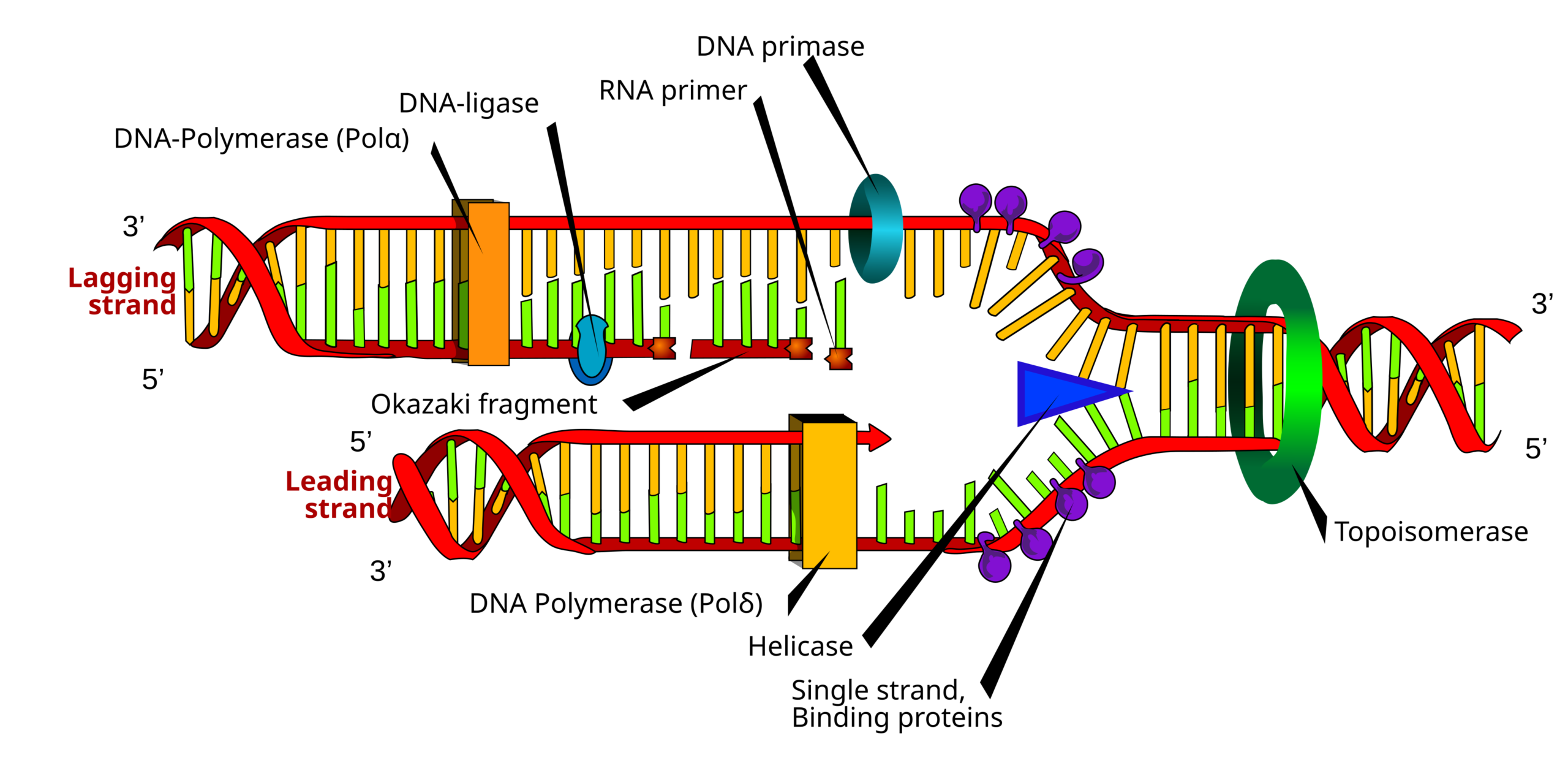
Activity
Eukaryotic DNA Polymerases Summary
| Eukaryotic Polymerase | Primary Cellular & Catalytic Function |
|---|---|
DNA Pol  |
Initiator polymerase; complexes with primase to synthesize the RNA primer plus a short initial DNA segment to begin synthesis. |
DNA Pol  |
Primary replicative enzyme for the lagging strand (Okazaki fragments), also capable of leading strand synthesis; possesses proofreading. |
DNA Pol  |
Primary enzyme for continuous leading strand synthesis and DNA repair; can functionally substitute for Pol . |
DNA Pol  |
Specialized nuclear repair enzyme mediating base excision repair (BER) throughout the cell cycle. |
DNA Pol  |
Exclusively replicates and repairs mitochondrial DNA (mtDNA). |
Telomeres, Telomerase & Reverse Transcriptase
Solving the End-Replication Problem
- The End-Replication Problem: Because DNA polymerases synthesize exclusively
end of newly synthesized linear lagging strands leaves a gap that cannot be filled—causing telomeres (repetitive TTAGGG sequences capping eukaryotic chromosomes) to progressively shorten with each division.
- Telomerase Characteristics: A specialized ribonucleoprotein enzyme complex that prevents chromosomal shortening:
- Cellular Distribution: Active in embryonic cells, germ cells, and adult stem cells, but absent or silenced in most differentiated somatic cells (contributing to cellular senescence/aging).
- Mechanism of Action: Carries an internal RNA template and utilizes reverse transcriptase activity (hTRT / TERT) to bind and extend the
end of the parental DNA strand, allowing primase and DNA polymerase to complete the complementary strand.
- Clinical Relevance (Cancer Immortality): Over
of human cancers pathologically reactivate telomerase, preventing telomere attrition and conferring limitless replicative potential (“cellular immortality”).
- Reverse Transcriptase Distribution: An RNA-dependent DNA polymerase (
) found in three major biological contexts:
- Retroviruses (e.g., HIV)
- Human telomerase (hTRT)
- Retrotransposons (“jumping genes” that transpose via an RNA intermediate)
High-Yield Differential Clues & Diagnostic Pearls
Board-Exam Pattern Recognition Rules
- Which Strand End Does Telomerase Extend? A classic USMLE trap asks whether telomerase extends the
- Fluoroquinolone Mechanism of Action: Fluoroquinolones (ciprofloxacin, levofloxacin) bind and inhibit prokaryotic DNA gyrase (Topoisomerase II) and Topoisomerase IV, preventing the relief of positive supercoils ahead of the replication fork and inducing lethal double-stranded DNA breaks (bactericidal).
- Replication Fork Counting Rule: Every single origin of replication generates a replication bubble with two bidirectional forks; because each fork has one leading strand and one lagging strand, every origin produces 2 leading strands and 2 lagging strands.
Key Points & Memory Hooks:
- Core Rule: DNA replication proceeds $5′ \rightarrow 3’$ continuously on the leading strand and discontinuously (Okazaki fragments) on the lagging strand; DNA Pol I (prokaryotes) or RNase H (eukaryotes) removes RNA primers; DNA gyrase/Topoisomerase II relieves positive supercoils; and telomerase (hTRT) uses an internal RNA template and reverse transcriptase activity to extend $3’$ chromosomal ends.
- Memory Hook: “Telomerase Lengthens the 3′ End using an Internal RNA Template”; “Reverse Transcriptase Trio: Retroviruses, hTRT (Telomerase), and Retrotransposons”!
You must be logged in to post a comment.