
Learning Objectives
- Compare and contrast DNA polymerases and RNA polymerases across synthesized product, nucleotide substrates, primer requirements, and $3′ \rightarrow 5’$ exonuclease proofreading fidelity.
- Describe the coordinated functions of core replication fork enzymes and accessory factors: helicase, single-stranded binding proteins (SSB / RPA), topoisomerases I & II, primase, RNase H / FEN1, DNA ligase, sliding clamps (PCNA / $\beta$-clamp), and clamp loaders (RFC / $\gamma$-complex).
- Differentiate the specialized roles of eukaryotic DNA polymerases ($\text{Pol }\alpha, \delta, \varepsilon, \gamma, \beta, \lambda$) and prokaryotic DNA polymerases ($\text{Pol I}$ and $\text{Pol III}$).
- Correlate replication enzymes with clinically relevant pharmacological targets (e.g., irinotecan, topotecan, fluoroquinolones, etoposide, doxorubicin).
High-fidelity DNA replication requires the orchestrated action of both DNA and RNA polymerases alongside specialized unwinding, stabilizing, priming, and ligating enzymes. While both polymerase classes read DNA templates $3′ \rightarrow 5’$ and elongate nascent chains exclusively in the $5′ \rightarrow 3’$ direction, key differences in initiation and error correction govern their distinct roles at the replication fork.
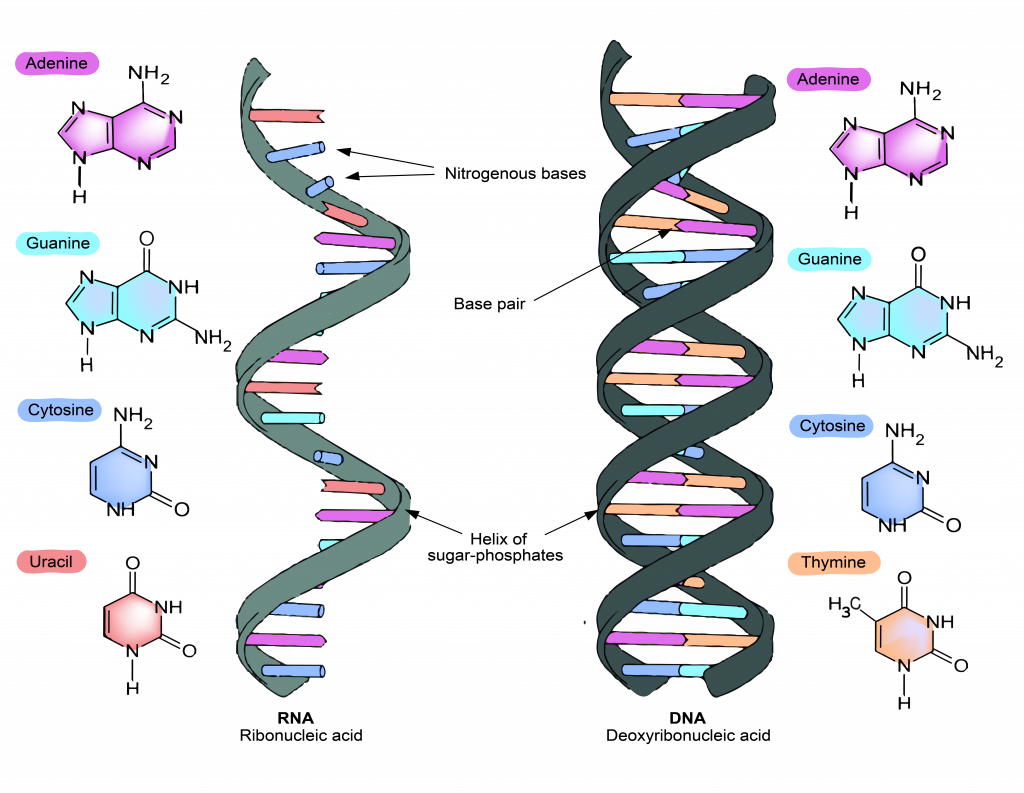
Comparison of DNA Polymerase vs. RNA Polymerase
| Feature | DNA Polymerase | RNA Polymerase |
|---|---|---|
| Synthesized Product | DNA (elongates  ). |
RNA (elongates ). |
| Template & Direction Read | Reads DNA template in the  direction. |
Reads DNA template in the direction. |
| Nucleotide Substrates | Deoxyribonucleoside triphosphates: dATP, dGTP, dCTP, dTTP. | Ribonucleoside triphosphates: ATP, GTP, CTP, UTP. |
| Primer Requirement | Requires a pre-existing primer with a free  group (cannot initiate synthesis de novo). |
No primer required (capable of initiating nucleic acid synthesis de novo). |
| Proofreading & Fidelity | Possesses exonuclease proofreading activity → high replication fidelity. |
Lacks proofreading → higher error rate tolerated (transient RNA transcripts). |
Activity
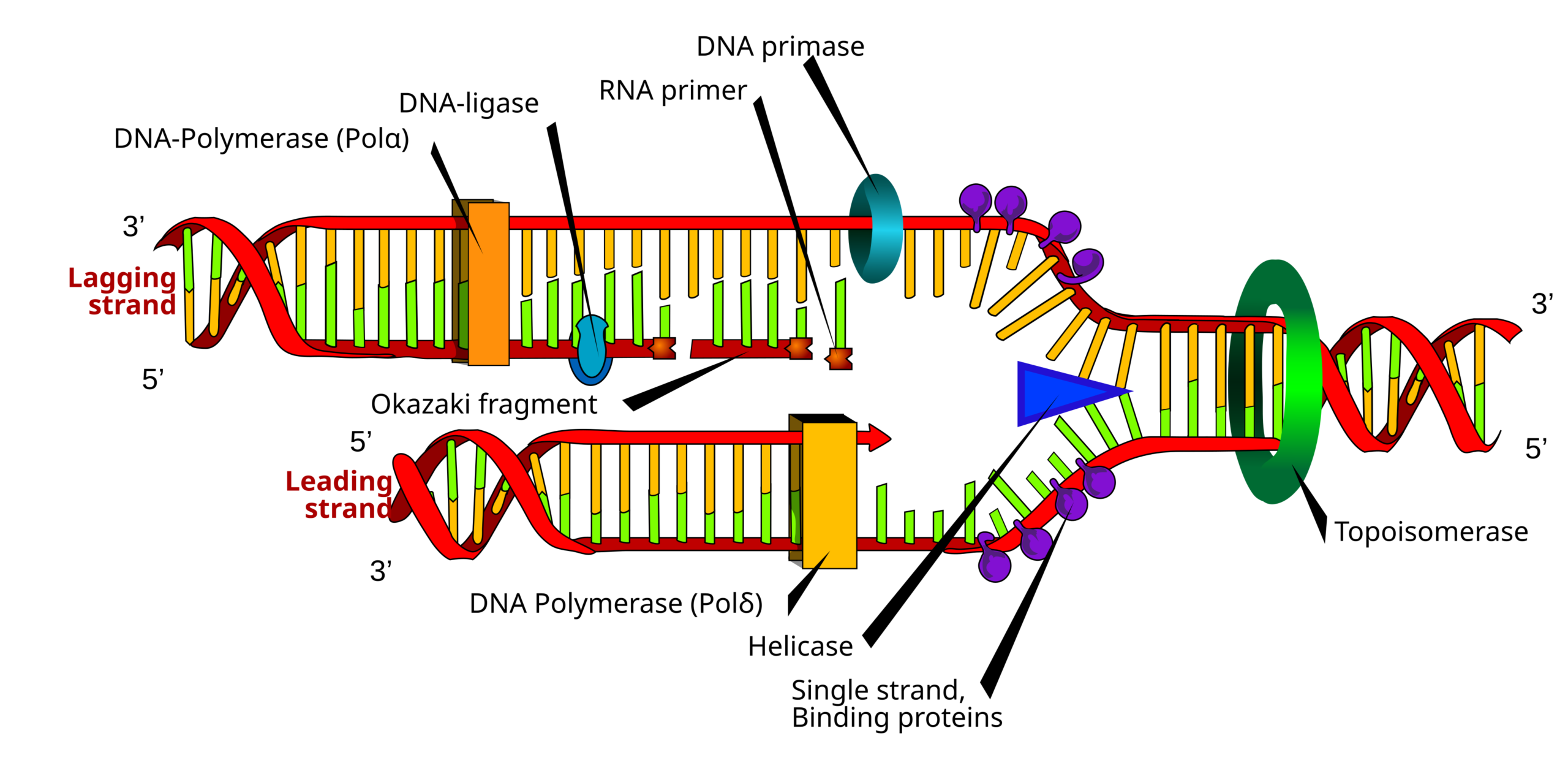
Core Replication Fork Enzymes & Accessory Proteins
| Enzyme / Factor | Biochemical Mechanism & Function | Clinical & Molecular Notes |
|---|---|---|
| Helicase | Unwinds double-stranded DNA (dsDNA) at the replication fork by breaking hydrogen bonds between base pairs (ATP-dependent). | Mutations in RecQ-family helicases cause genomic instability syndromes (e.g., Bloom syndrome, Werner syndrome). |
| Single-Stranded Binding Proteins (SSB / RPA) | Bind cooperatively to separated single-stranded DNA (ssDNA), preventing premature re-annealing and protecting ssDNA from nucleolytic degradation. | SSB in prokaryotes; Replication Protein A (RPA) in eukaryotes. |
| Topoisomerase I | Cuts a single DNA strand to relieve positive supercoils and torsional stress ahead of the replication fork (ATP-independent). | Pharmacological target of camptothecin derivatives: irinotecan and topotecan. |
| Topoisomerase II (Bacterial DNA Gyrase) |
Cuts both DNA strands to relieve supercoiling and untangle interlocked daughter DNA molecules (ATP-dependent). | Target of fluoroquinolones (bacterial DNA gyrase), etoposide, and doxorubicin (eukaryotic Topoisomerase II). |
| Primase | Specialized RNA polymerase that synthesizes short RNA primers, providing a free group for DNA polymerase elongation. |
In eukaryotes, functions as an integral subunit of the DNA Pol  –primase complex. |
| RNase H & FEN1 | Excise and remove RNA primers from newly synthesized Okazaki fragments on the lagging strand in eukaryotes. | RNase H degrades RNA hybridized to DNA; FEN1 (Flap Endonuclease 1) cleaves displaced  RNA/DNA flaps. |
| DNA Ligase | Catalyzes formation of the final covalent phosphodiester bond to seal nicks and join adjacent Okazaki fragments into a continuous strand. | Requires ATP in eukaryotes (or  in bacteria). |
| Sliding Clamp (PCNA / $\beta$-clamp) |
Ring-shaped protein encircling DNA that tethers DNA polymerase to the template, dramatically increasing processivity. | PCNA (Proliferating Cell Nuclear Antigen) in eukaryotes;  -clamp in prokaryotes. |
| Clamp Loader (RFC / $\gamma$-complex) |
ATP-dependent protein complex that opens and loads the ring-shaped sliding clamp onto primer-template junctions. | RFC (Replication Factor C) in eukaryotes;  -complex in prokaryotes. |
Eukaryotic vs. Prokaryotic DNA Polymerases
| Organism Group | Polymerase | Specialized Catalytic & Biological Role |
|---|---|---|
| Eukaryotes | DNA Pol |
Forms a complex with primase to synthesize the RNA primer plus a short initial DNA segment (initiates both leading and lagging strands; lacks proofreading). |
DNA Pol  |
Primary enzyme for lagging strand synthesis (Okazaki fragments) and DNA repair; possesses proofreading exonuclease activity. |
|
DNA Pol  |
Primary enzyme for continuous leading strand synthesis; possesses $3′ \rightarrow 5’$ proofreading exonuclease activity. | |
| DNA Pol |
Dedicated exclusively to mitochondrial DNA (mtDNA) replication and repair (targeted as an off-target toxicity by nucleoside reverse transcriptase inhibitors [NRTIs]). | |
DNA Pol &  |
Specialized repair polymerases mediating base excision repair (BER) and non-homologous end joining (NHEJ). | |
| Prokaryotes | DNA Pol III | Main high-speed prokaryotic replication enzyme (elongates both leading and lagging strands ); possesses exonuclease proofreading. |
| DNA Pol I | Removes RNA primers using its unique exonuclease activity and fills resulting gaps with DNA (also has proofreading). |
Activity
High-Yield Differential Clues & Diagnostic Pearls
Board-Exam Pattern Recognition Rules
- Why DNA Polymerase Cannot Initiate Synthesis Without Primase: DNA polymerases require a base-paired primer with an exposed
- Prokaryotic DNA Pol I Dual Exonuclease Domains: Prokaryotic DNA Pol I is the only enzyme with both
- Mitochondrial Toxicity of HIV NRTIs: Nucleoside/nucleotide reverse transcriptase inhibitors (e.g., zidovudine, stavudine) can cross-inhibit human DNA Pol
Key Points & Memory Hooks:
- Core Rule: Both DNA and RNA polymerases synthesize
- Memory Hook: Eukaryotic Pols: “
You must be logged in to post a comment.