
Learning Objectives
- Understand the organization and functions of thalamic nuclei, categorized into sensory relay, motor relay, and associative/limbic groups.
- Detail specific nuclear inputs, outputs, and functions (e.g., VPL, VPM, LGN, MGN, VA, VL, AN, DM, and IL).
- Examine clinical correlations such as Thalamic Syndrome (Dejerine–Roussy syndrome), neuropsychiatric disorders, and movement disorders.
- Explore therapeutic interventions including Deep Brain Stimulation (DBS) targeting structures like the VIM nucleus.
1. Functional Anatomy of Thalamic Nuclei
The thalamus is a paired subcortical structure positioned atop the brainstem, serving as the master relay station for sensory, motor, and associative pathways.
| Category & Nucleus | Key Inputs | Outputs | Primary Function |
|---|---|---|---|
| VPL (Ventral Posterolateral) | Spinothalamic & dorsal columns | Primary somatosensory cortex | Body somatosensory processing (touch, pain, temp, proprioception). |
| VPM (Ventral Posteromedial) | Trigeminal & gustatory pathways | Primary somatosensory cortex | Facial sensory relay and taste transmission. |
| LGN & MGN | Retina (LGN); Inferior colliculus (MGN) | Visual cortex (LGN); Auditory cortex (MGN) | Dedicated visual (LGN) and auditory (MGN) relay stations. |
| VA & VL (Motor Relay) | Basal ganglia & cerebellum | Primary motor cortex | Movement planning, motor control, and coordination. |
| AN, DM & IL (Associative/Limbic) | Cingulate & Prefrontal cortices; Widespread | Limbic and cortical networks | Emotion, memory, executive decision-making, arousal, and pain modulation. |
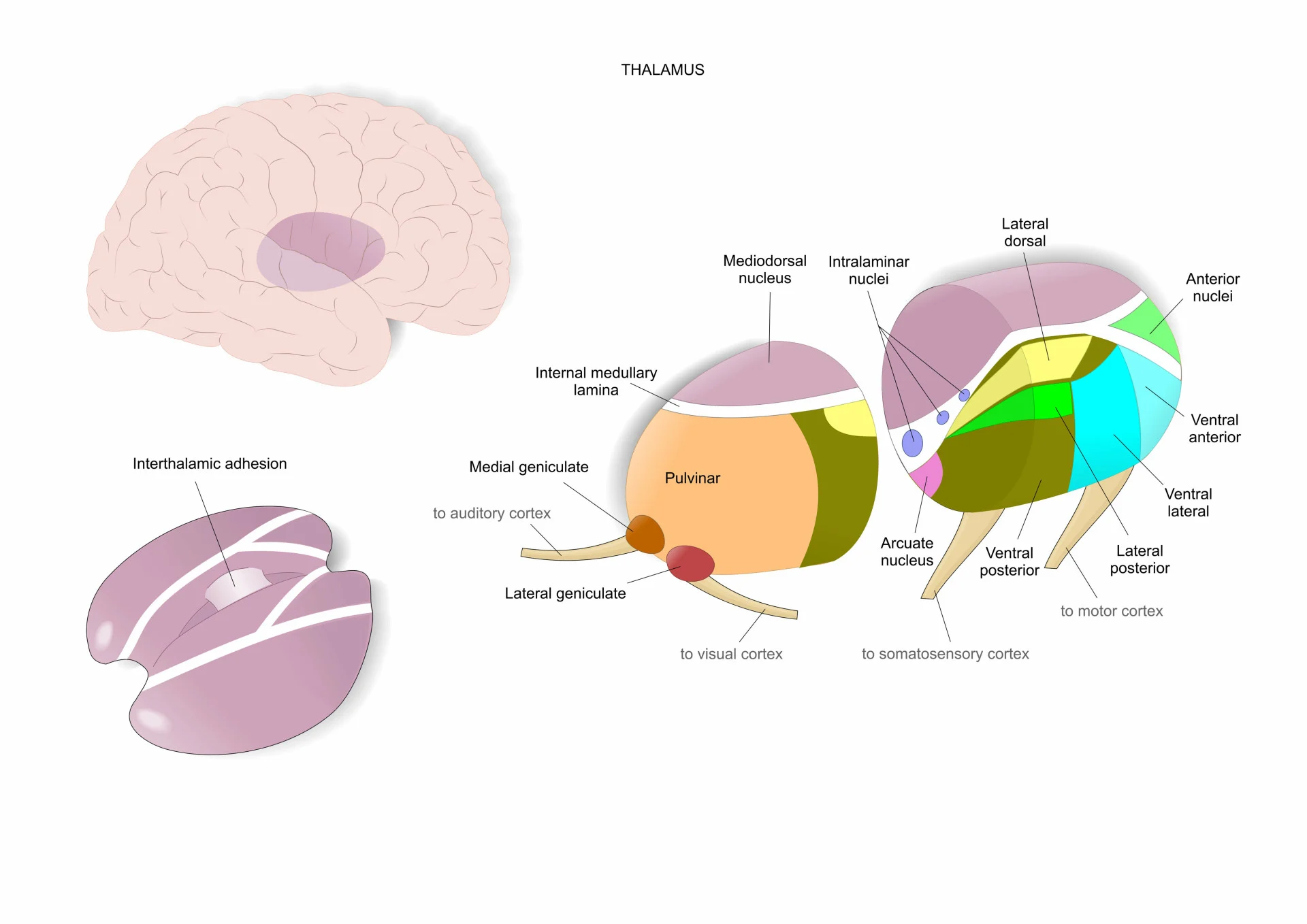
Clinical Notes & Therapeutics:
- Thalamic Syndrome (Dejerine–Roussy Syndrome): Typically resulting from posterior cerebral artery (PCA) strokes affecting the thalamus, characterized by contralateral sensory loss followed by intractable pain and dysesthesias.
- Neuropsychiatric & Movement Disorders: Mediodorsal (DM) and intralaminar nuclear dysfunction correlates with schizophrenia and mood disorders, while VA/VL pathology contributes to Parkinsonian features and tremors.
- Deep Brain Stimulation (DBS): Targeting thalamic sub-nuclei (e.g., ventral intermediate or VIM nucleus) provides effective symptom relief in medication-resistant essential tremor and advanced epilepsy.
Key Points & Memory Hooks:
Geniculate Rule: LGN is for Light (vision); MGN is for Music (hearing).
VPL vs. VPM: VPL brings sensory from the body PLust (Legs/Body), while VPM brings sensory from the Puss (Face/Mouth).
Painful Paradox: Thalamic strokes destroy sensory relay gates yet paradoxically trigger burning, central post-stroke pain syndromes.
You must be logged in to post a comment.