
Learning Objectives
- Explain the anatomical course, tributaries, and functional significance of the venous drainage systems of the head and neck.
- Differentiate between the structural courses and clinical correlations of the internal, external, and anterior jugular veins.
- Analyze the structural contents, tributary networks, and infection pathways associated with the dural venous sinuses and cavernous sinus.
Jugular Veins & Drainage Pathways
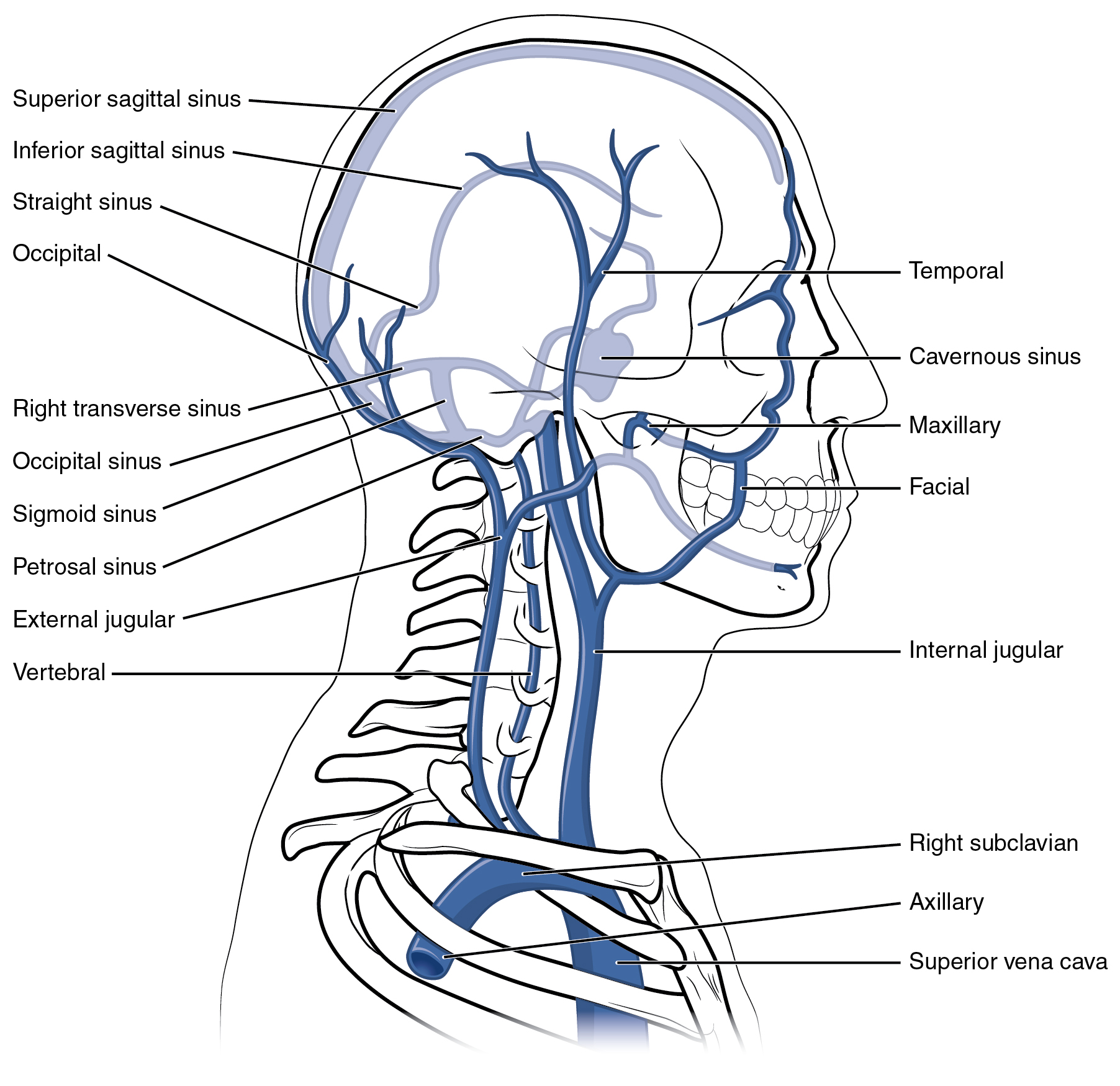
The venous system of the head and neck collects deoxygenated blood and returns it to the heart. It is broadly organised into venous drainage of the brain/meninges, scalp/face, and the neck. The three main jugular veins collectively drain the entire region:
| Jugular Vein | Formation & Anatomical Course | Clinical & Surgical Significance |
|---|---|---|
| External Jugular Vein (EJV) | Formed by posterior auricular and posterior retromandibular veins; descends superficial to the SCM | Superficial location risks air embolism if severed, as investing fascia holds the vein wall open. |
| Internal Jugular Vein (IJV) | Continuation of the sigmoid sinus from the jugular foramen; descends within the carotid sheath | Used to estimate right atrial pressure (JVP) due to direct continuity with the heart. |
| Anterior Jugular Veins | Paired veins draining the anterior neck; connected by the jugular venous arch | Descend along the midline to empty into the subclavian vein; highly variable course. |
Tributaries & Dural Venous Sinuses
Venous return from deep structures and cranial components relies on specialized channels and tributary networks:
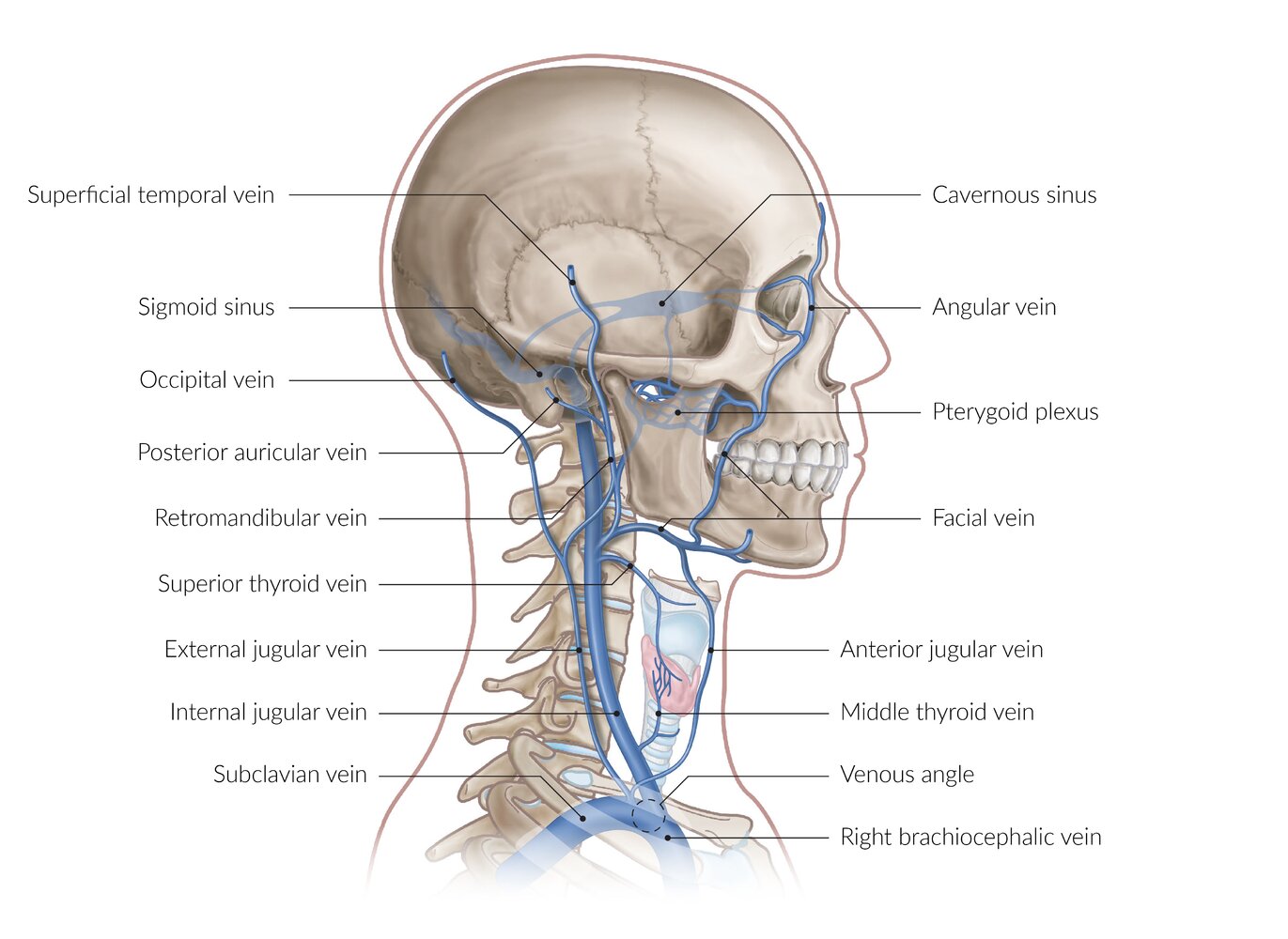
- IJV Tributaries: Receives facial, lingual, occipital, superior thyroid, and middle thyroid veins, draining the anterior face, larynx, pharynx, esophagus, and neck muscles.
- Dural Venous Sinuses: Lie between layers of the dura mater, collecting venous blood from the brain and skull to empty directly into the IJV.
- Cavernous Sinus Relationships: Located on either side of the sphenoid body. Encloses the internal carotid artery and abducens nerve (
), while the lateral wall houses
,
,
, and
.
Clinical Relevance – Venous Trauma & Cavernous Sinus Thrombosis
Vascular Risks & Infection Propagation
- EJV Severance & Air Embolism: Because the vein is bound to investing fascia, a laceration fails to collapse, allowing air to be sucked into the circulation and risking fatal embolism. Immediate pressure is vital.
- Jugular Venous Pressure (JVP): Because there are no valves between the IJV and the right atrium, pulsations accurately reflect cardiac pressure changes.
- Cavernous Sinus Thrombosis: Facial infections can spread via valveless facial and ophthalmic veins into the cavernous sinus, putting enclosed cranial nerves at severe risk.
Key Points & Memory Hooks:
- Core Rule: The cavernous sinus is the only dural venous sinus containing a major artery (ICA) and multiple traversing cranial nerves.
- Memory Hook: Danger Triangle of the Face—pimples popped here can seed infection straight back into the valveless cavernous sinus!
You must be logged in to post a comment.