
Learning Objectives
- Describe the origin, course, and bifurcation of the carotid and vertebral systems supplying the head and neck.
- Identify the major branches of the external carotid artery (ECA) and trace the functional targets of the internal carotid artery (ICA).
- Analyze the clinical relevance of carotid sinus hypersensitivity, scalp bleeding mechanics, middle meningeal artery tears, and carotid atherosclerosis.
Carotid Arteries & Bifurcation Anatomy
The head and neck receive most of their blood supply from the carotid arteries and the vertebral arteries, with the carotid system supplying the majority of both superficial and deep structures. Both common carotid arteries ascend the neck lateral to the trachea and esophagus without giving off branches:
| Vascular Structure | Anatomical Origin & Course | Clinical & Surgical Significance |
|---|---|---|
| Right Common Carotid | Arises from the brachiocephalic trunk near the right sternoclavicular joint | Ascends through the root of the neck within the carotid sheath. |
| Left Common Carotid | Arises directly from the arch of the aorta | Has a longer thoracic course before entering the neck. |
| Carotid Bifurcation | Occurs at the level of $C_4$ (upper thyroid cartilage) in the carotid triangle | Divides into the External Carotid Artery (ECA) and Internal Carotid Artery (ICA). |
Carotid Sinus, Body & External Carotid Artery (ECA)
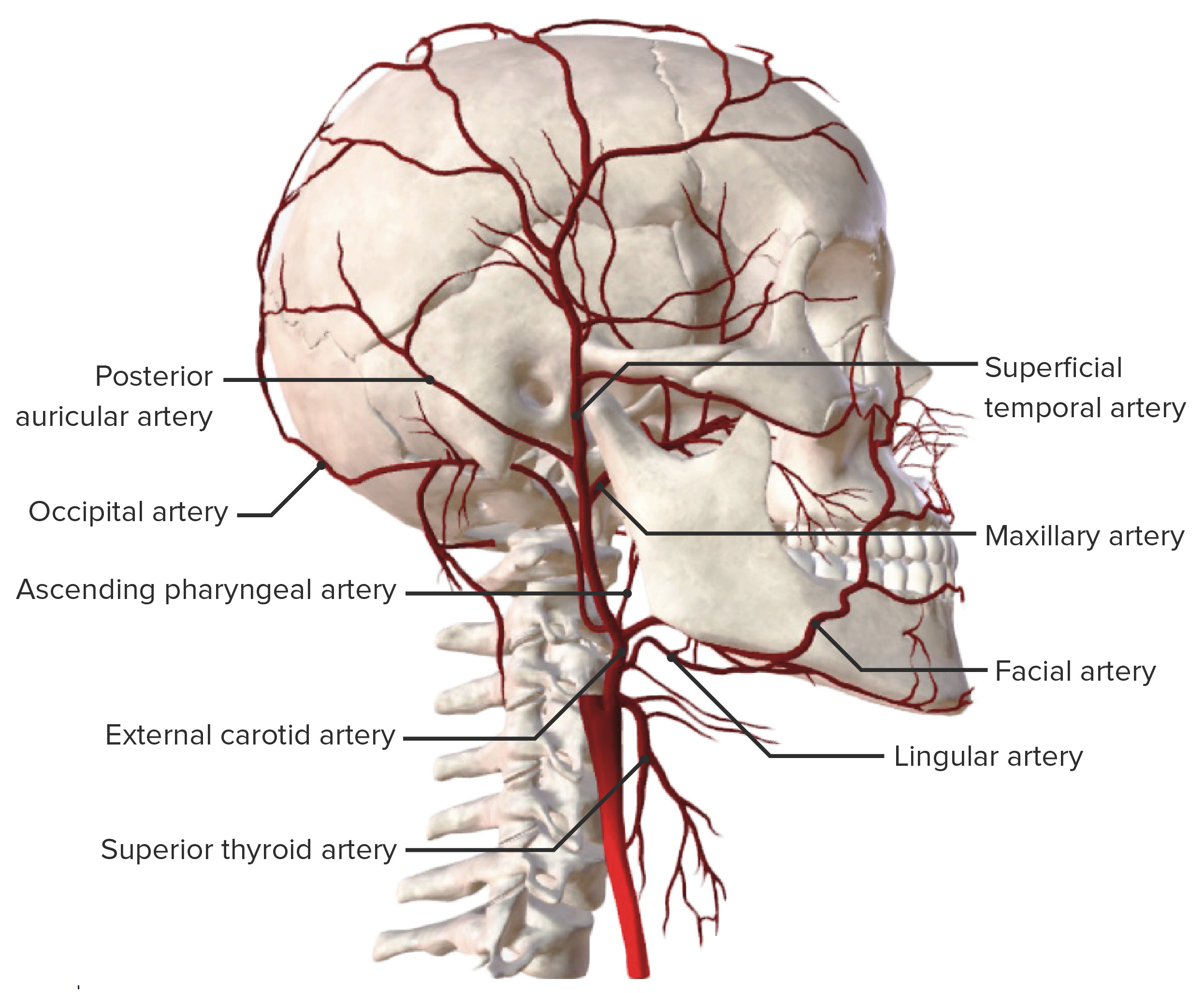
Specialized receptors at the bifurcation monitor systemic parameters, while the ECA supplies structures external to the cranium:
- Carotid Sinus & Body: The carotid sinus is a dilation containing baroreceptors detecting blood pressure (innervated by $CN\ IX$), while the carotid body acts as a peripheral chemoreceptor sensing oxygen content. Hypersensitivity can cause bradycardia, hypotension, and syncope.
- ECA Course & Terminus: Passes posterior to the mandibular neck and anterior to the ear, terminating in the parotid gland as the superficial temporal and maxillary arteries.
- Main Branches (6): Superior thyroid, lingual, facial, ascending pharyngeal, occipital, and posterior auricular arteries (with facial, maxillary, and superficial temporal being major clinical branches).
Internal Carotid Artery (ICA) & Cranial Supply
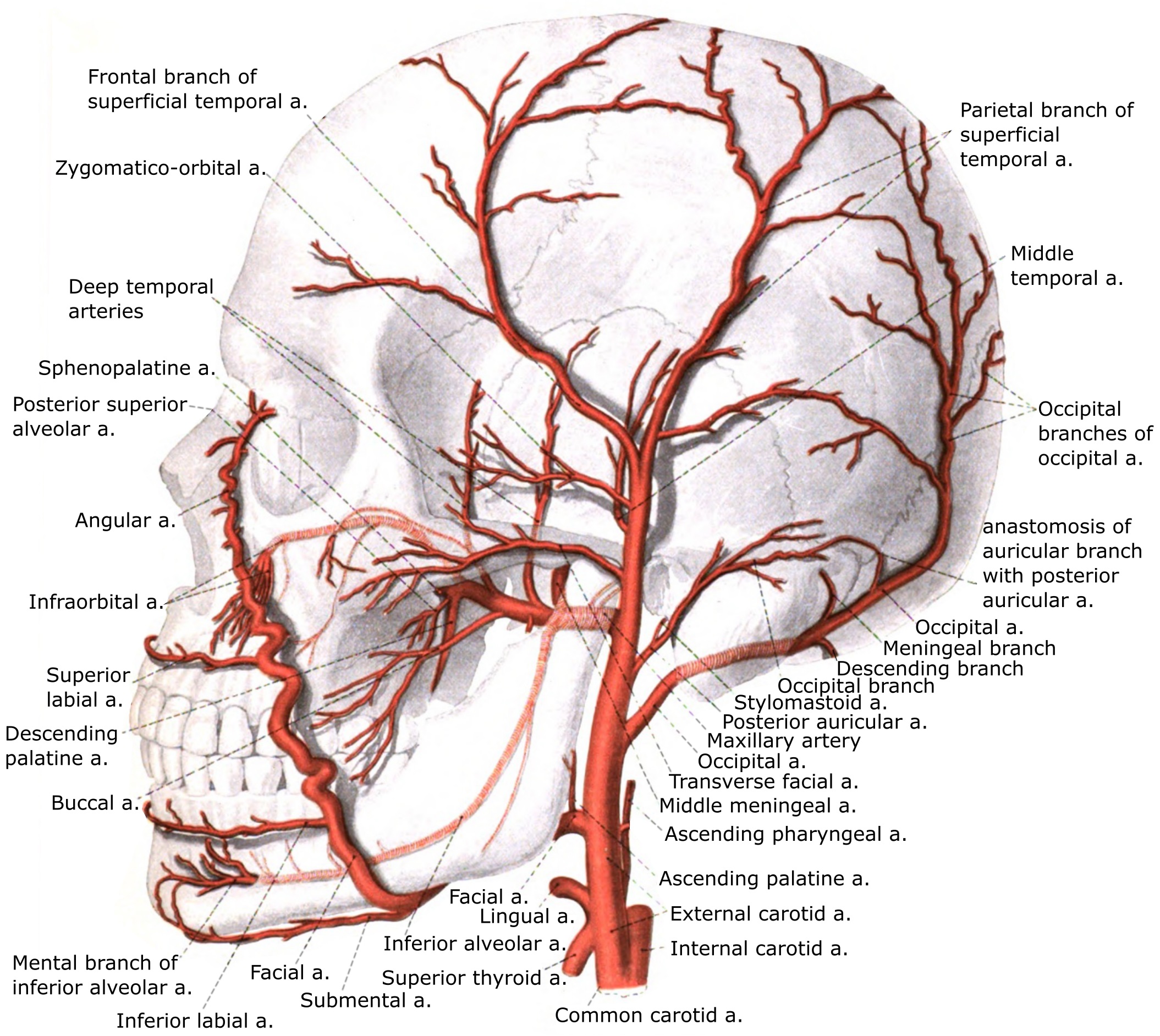
The internal carotid artery provides critical intracranial vascularization:
- Cervical Course: Gives off no branches in the neck and enters the skull through the carotid canal.
- Primary Targets: Supplies the brain, brainstem, eyes, and forehead.
- Carotid Atherosclerosis: The carotid sinus region is prone to atheroma due to turbulent flow. ICA stenosis causes dizziness, weakness, headache, or stroke, and is diagnosed via carotid Doppler and treated via carotid endarterectomy.
Clinical Relevance – Bleeding, Hematomas & Vascular Risks
Trauma Pathologies & Hemodynamic Management
- Scalp Lacerations: Bleed heavily due to tightly bound arteries in dense connective tissue that cannot constrict, alongside numerous anastomoses and tension from frontalis/occipitalis muscles.
- Extradural (Epidural) Haematoma: Pterion fractures can tear the middle meningeal artery (a maxillary artery branch), leading to headache, seizures, vomiting, and bradycardia requiring surgical drainage.
- Carotid Sinus Hypersensitivity: Minimal external pressure can trigger profound vagal-mediated bradycardia and syncope, making routine carotid palpation hazardous in affected patients.
Key Points & Memory Hooks:
- Core Rule: Neither the common carotid artery nor the internal carotid artery gives off any branches in the neck.
- Memory Hook: ECA feeds the Exterior (face/neck), while ICA dives Inside to feed the brain!
You must be logged in to post a comment.