
Learning Objectives
- Understand the role of the Parasympathetic Nervous System (PNS) as the “rest and digest” craniosacral division maintaining homeostasis.
- Differentiate between preganglionic and postganglionic fibers, highlighting their origins (brainstem and S2-S4), long myelinated vs. short unmyelinated structures, and exclusive use of acetylcholine.
- Identify regional innervation pathways including cranial nerves III, VII, IX, X, and the pelvic splanchnic nerves.
- Examine systemic organ responses and clinical correlations such as truncal vagotomy for peptic ulcer disease.
1. Components & Neuronal Organization
The parasympathetic nervous system (PNS) functions alongside the SNS to support restorative processes and conserve energy during periods of relaxation.
| Component | Characteristics & Function |
|---|---|
| Pre-ganglionic Fibers | Long, myelinated fibers originating in the brainstem and S2-S4 spinal cord. Release acetylcholine. |
| Peripheral Ganglia | Located close to or directly within target organs (ciliary, otic, pterygopalatine, submandibular). |
| Post-ganglionic Fibers | Short, unmyelinated fibers transmitting signals from peripheral ganglia to effector organs. Release acetylcholine. |
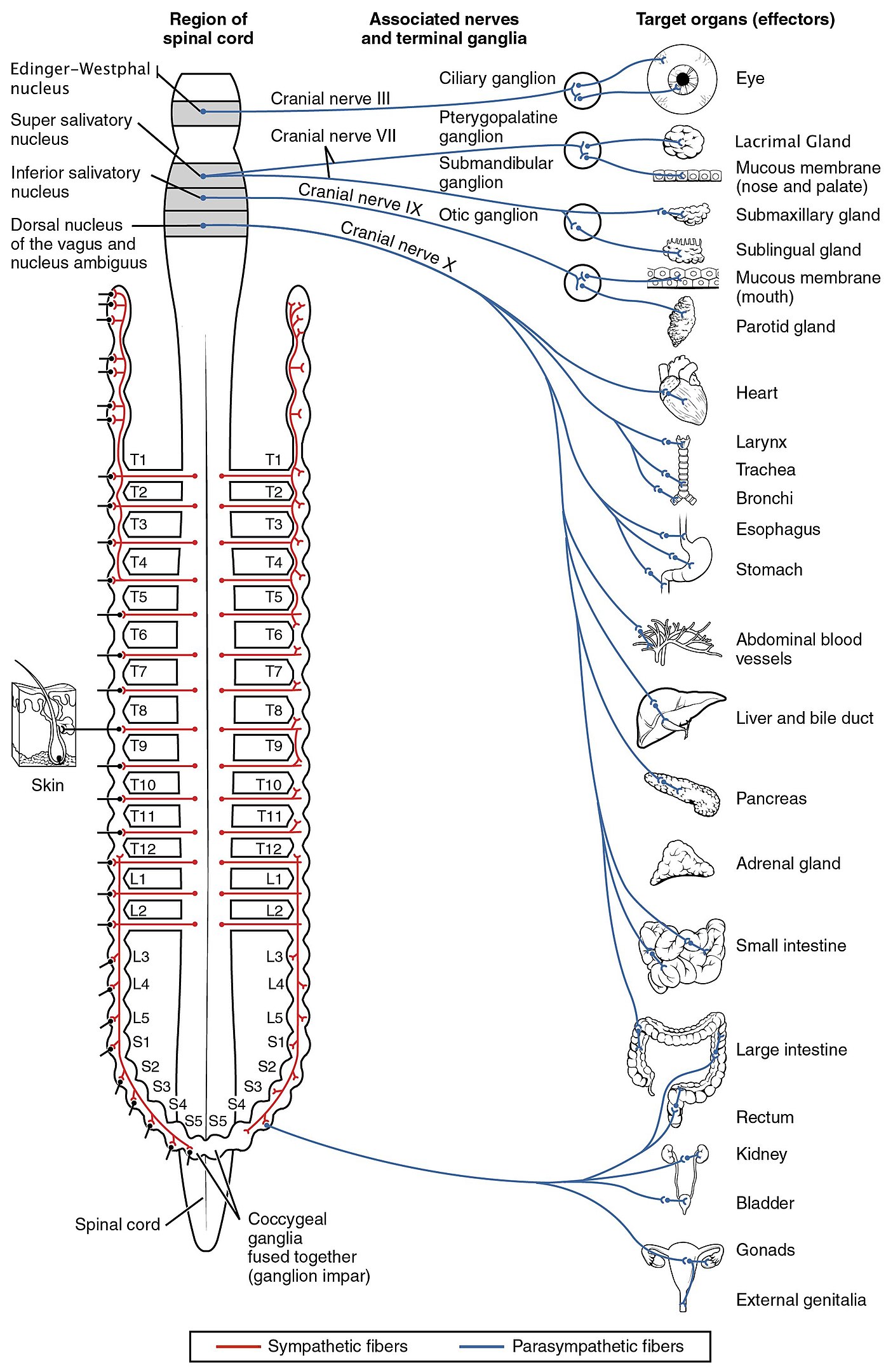
2. Parasympathetic Outflow & Innervation
Known as the craniosacral division, the PNS is organized into cranial and sacral pathways:
- Head and Neck: Managed by cranial nerves III, VII, IX, and X utilizing specialized ganglia (ciliary, pterygopalatine, otic, and submandibular).
- Thoracoabdominal Viscera (Vagus Nerve CN X): Accounts for approximately 75% of parasympathetic outflow, supplying thoracic viscera and most of the GI tract.
- Pelvic Splanchnic Nerves: Arising from S2-S4 anterior rami, supplying the distal colon, rectum, bladder, and reproductive organs.
3. Systemic Parasympathetic Actions
- Eyes & Glands: Pupil constriction (miosis); stimulation of lacrimal and salivary gland secretion.
- Cardiorespiratory: Decreased heart rate and reduced airway diameter (bronchoconstriction).
- Digestive: Increased activity, sphincter dilation, glycogen synthesis, and digestive enzyme secretion.
- Urinary & Reproductive: Bladder contraction, internal sphincter relaxation, penile/clitoral erection, vaginal lubrication, and uterine relaxation.
Clinical Notes & Pearls: Truncal Vagotomy
- Procedure & Indication: Historically performed by severing the vagal supply to the stomach to reduce acid secretion in refractory peptic ulcer disease.
- Complications: Impaired smooth muscle coordination leads directly to gastroparesis (delayed gastric emptying).
Key Points & Memory Hooks:
The Craniosacral Rule: Outflow is strictly limited to cranial nerves III, VII, IX, X, and sacral segments S2-S4.
Exclusive Neurotransmitter: Unlike the SNS, acetylcholine is utilized at both preganglionic and postganglionic synapses.
The Vagal Giant: CN X single-handedly carries 75% of all parasympathetic traffic to visceral organs.
You must be logged in to post a comment.