
Learning Objectives
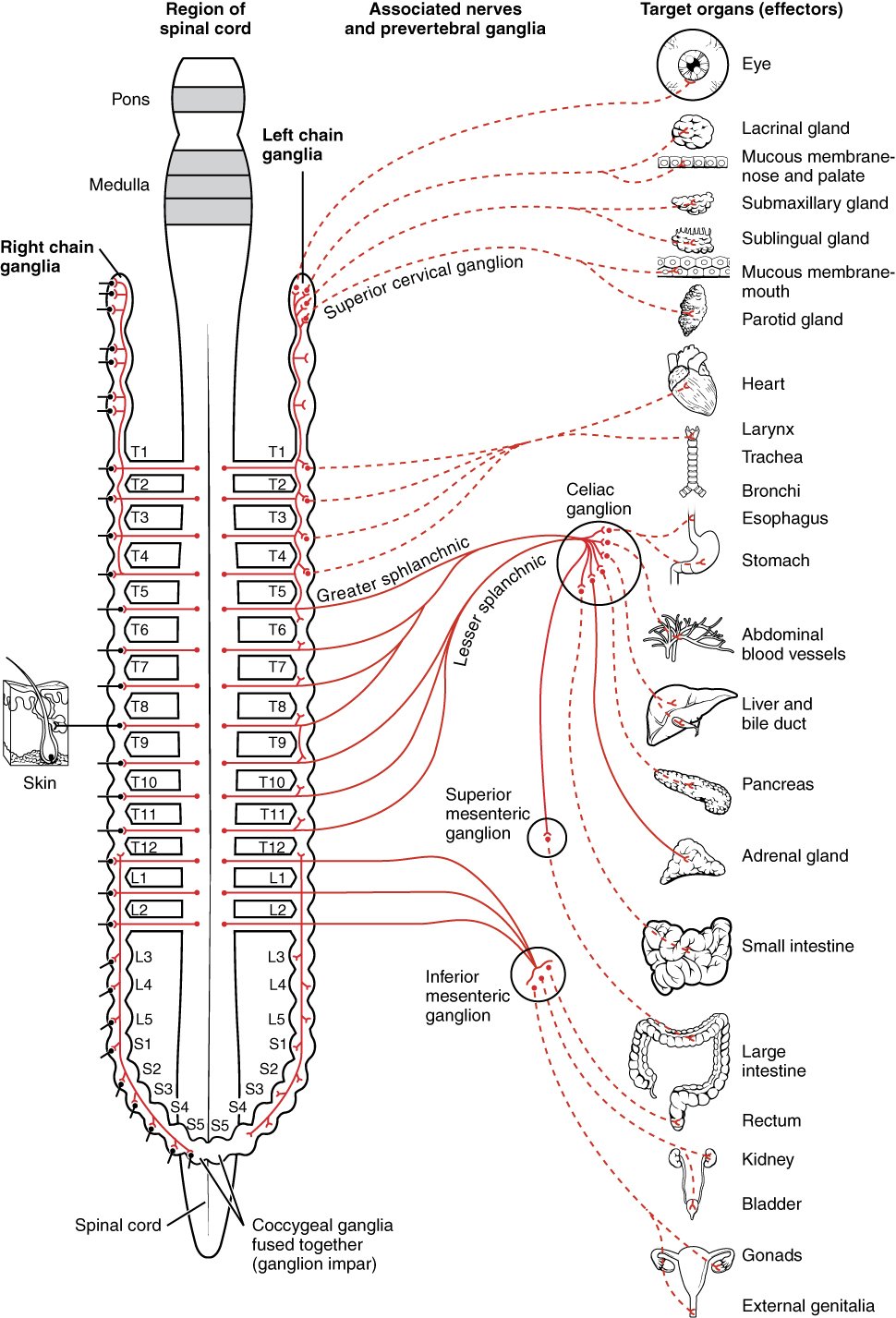
- Understand the role of the Sympathetic Nervous System (SNS) in mediating the “fight or flight” response and maintaining homeostasis alongside the PNS.
- Differentiate between pre-ganglionic and post-ganglionic fibers, including their origins, length, myelination, and neurotransmitter release.
- Identify the regional organization and ganglion counts of the sympathetic chain spanning from the skull base to the coccyx.
- Examine systemic organ responses and life-threatening clinical emergencies such as autonomic dysreflexia in spinal cord injuries.
1. Components & Neuronal Organization
The sympathetic nervous system (SNS) is one of the two primary divisions of the autonomic nervous system, dominating during stress to prepare the body for action.
| Component | Characteristics & Function |
|---|---|
| Pre-ganglionic Fibers | Short, myelinated fibers originating in the thoracic and lumbar spinal cord (T1-L2). Release acetylcholine. |
| Peripheral Ganglia | Synapse sites include the sympathetic trunks (alongside the vertebral column) and prevertebral ganglia (anterior to the abdominal aorta, controlling abdominopelvic organs). |
| Post-ganglionic Fibers | Long, unmyelinated fibers carrying signals to target organs. Release noradrenaline (except at sweat glands and erector pili muscles, which release acetylcholine). |
2. Sympathetic Chain Regions
The sympathetic trunk is organized into distinct anatomical regions from the skull base to the coccyx:
| Region | Number of Ganglia |
|---|---|
| Cervical | 3 (Superior, middle, inferior) |
| Thoracic | 11 to 12 |
| Lumbar | 4 |
| Sacral | 4 to 5 |
| Coccygeal | 1 (Ganglion impar) |
3. Systemic Sympathetic Actions
- Eyes: Pupil dilation (mydriasis).
- Skin: Sweat secretion and erector pili contraction.
- Cardiovascular: Increased heart rate, vasodilation in skeletal muscles, and vasoconstriction in the gastrointestinal tract.
- Respiratory: Bronchodilation.
- Digestive: Decreased motility, stimulation of glycogenolysis and gluconeogenesis.
- Urinary & Reproductive: Renin secretion, bladder relaxation, male ejaculation, and variable uterine effects.
Clinical Notes & Pearls: Autonomic Dysreflexia
- Definition: An exaggerated, unregulated sympathetic response occurring in spinal cord injury (SCI) patients above the T6 level.
- Triggers: Noxious stimuli below the injury (e.g., bladder distension, fecal impaction) where afferent signals cannot pass the SCI level.
- Presentation & Risks: Unchecked reflex leads to widespread vasoconstriction, sustained severe hypertension, and high stroke risk requiring immediate medical attention.
Key Points & Memory Hooks:
Outflow Segments: Thoracolumbar system originates strictly from T1 to L2.
The Cholinergic Exception: Postganglionic fibers release noradrenaline, except at sweat glands and erector pili muscles (which use acetylcholine).
Emergency Threshold: Autonomic dysreflexia is a critical clinical emergency triggered in injuries above T6.
You must be logged in to post a comment.