
Heart Sounds: Physiology and Pathology
Understanding heart sounds is essential for identifying valvular and structural heart defects. Focus on the timing, location, and the underlying mechanical event for each sound.
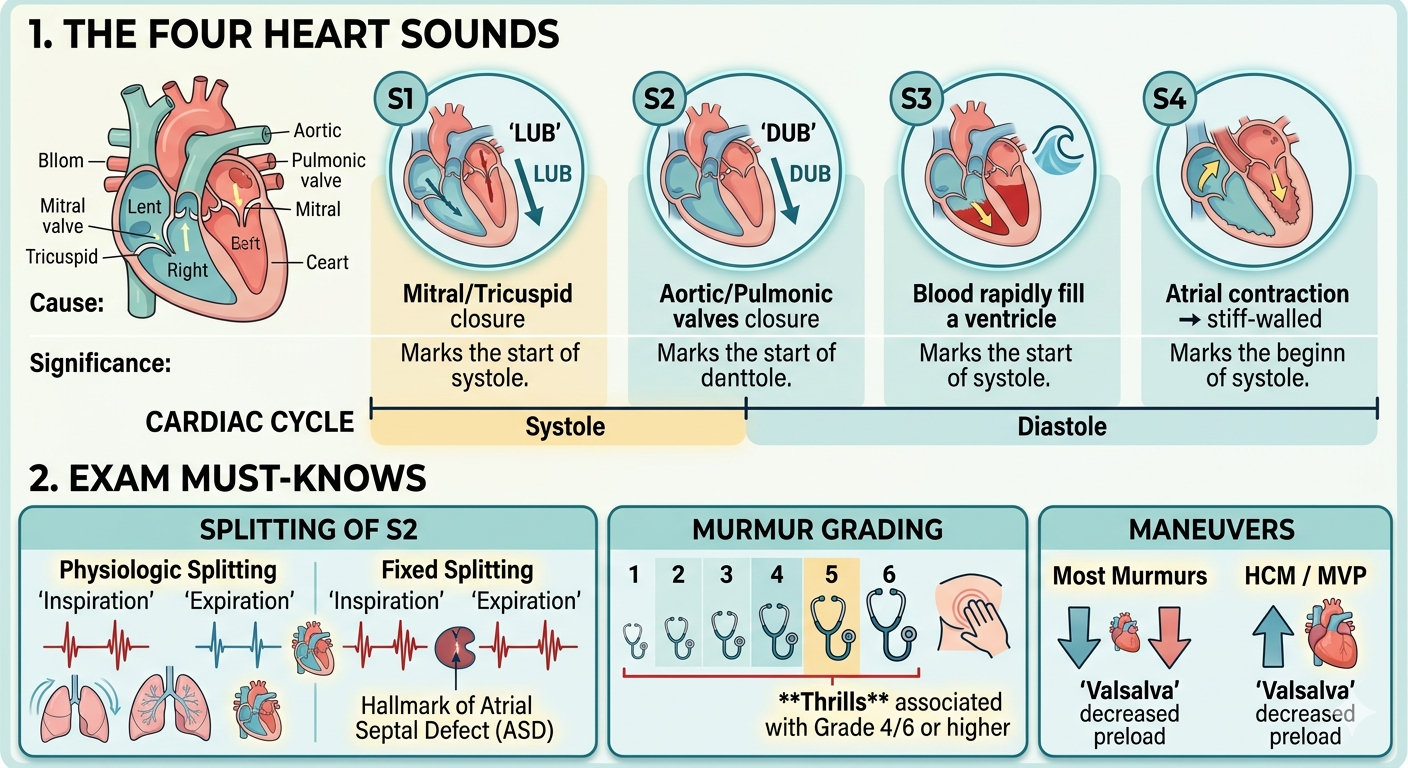
1. The Four Heart Sounds
| Sound | Cause | Significance |
|---|---|---|
| S1 (Lub) | Mitral/Tricuspid closure | Marks the start of systole. |
| S2 (Dub) | Aortic/Pulmonic closure | Mark’s end of systole. |
| S3 | Rapid ventricular filling | Pathologic in older adults; suggests volume overload/CHF. |
| S4 | Atrial kick into a stiff ventricle | Always pathologic; suggests decreased compliance (hypertrophy/HTN). |
2. Exam Must-Knows
- Splitting of S2: Physiologic splitting occurs during inspiration (increased venous return to the right heart delays pulmonic closure). Fixed splitting is a hallmark of Atrial Septal Defect (ASD).
- Murmur Grading: Remember that thrills are associated with Grade 4/6 or higher murmurs.
- Maneuvers: Valsalva (decreased preload) decreases most murmurs, except Hypertrophic Cardiomyopathy (HCM) and Mitral Valve Prolapse (MVP).
Pathology Board Hint: For boards: S3 = Volume overload; S4 = Pressure overload (stiff ventricle). If you hear a “snap” in early diastole, think Mitral Stenosis. If you hear a “click,” think Mitral Valve Prolapse or an Ejection Click (aortic/pulmonic stenosis).
You must be logged in to post a comment.