
The Compton Effect (Compton Scattering)
1. Definition
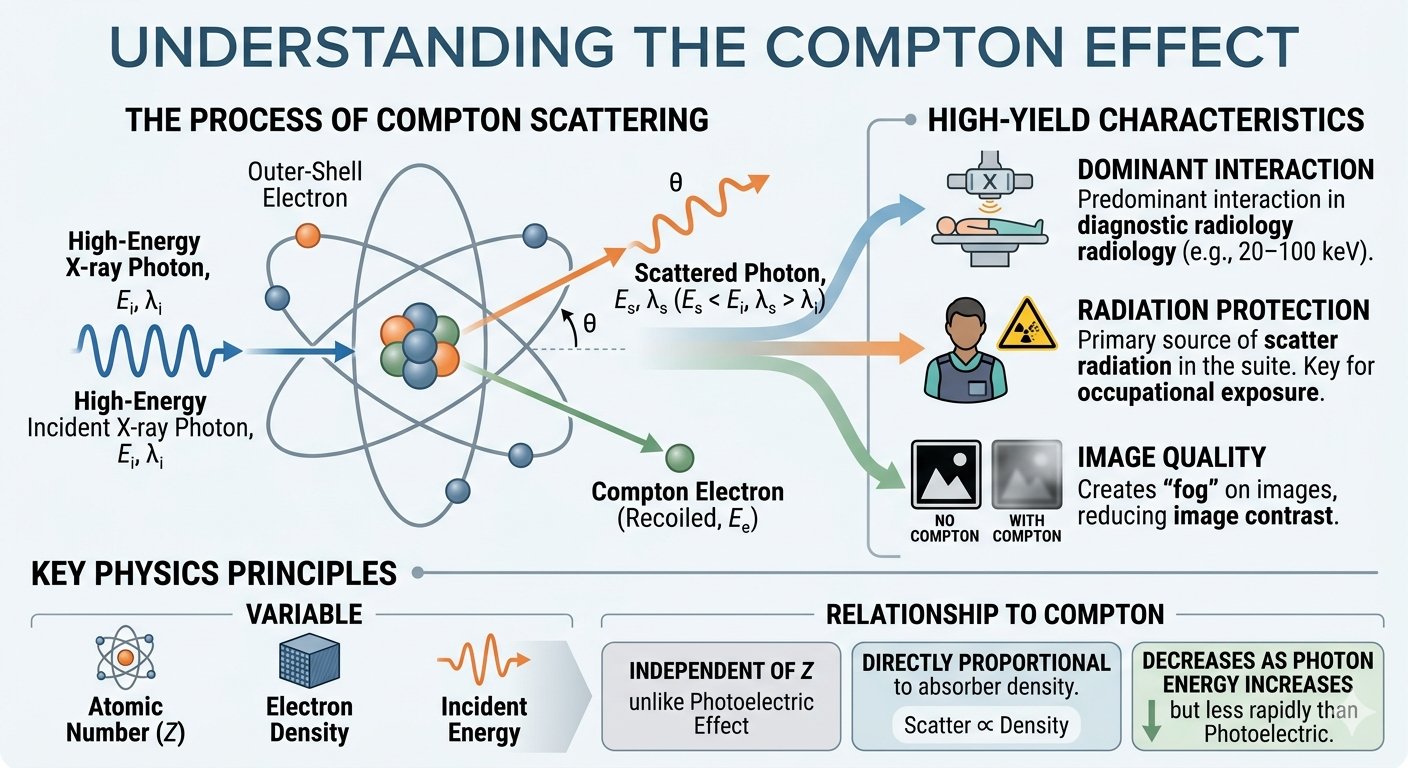
The Compton effect is the interaction of an incident X-ray photon with an outer-shell electron of an atom. The photon transfers some of its energy to the electron (which is ejected as a Compton electron), while the photon itself is scattered at a different angle with lower energy (longer wavelength).
2. High-Yield Characteristics
- Dominant Interaction: It is the predominant interaction in diagnostic radiology imaging (energy range 20–100 keV).
- Radiation Protection: It is the primary source of scatter radiation in the radiology suite, which contributes to occupational exposure for staff.
- Image Quality: It is responsible for creating “fog” on the image, reducing overall image contrast.
3. Key Physics Principles
| Variable | Relationship to Compton |
|---|---|
| Atomic Number (Z) | Independent of Z (unlike the Photoelectric Effect). |
| Electron Density | Directly proportional to the density of the absorber. |
| Incident Energy | Decreases as photon energy increases, but less rapidly than the photoelectric effect. |
4. Exam Pearls
- Contrast/Fog: Compton scattering is the enemy of image contrast. Grids are used in radiography specifically to remove these scattered photons before they reach the receptor.
- Board Exam Focus: Remember that Compton scattering is independent of atomic number (Z), meaning it occurs equally in bone and soft tissue of similar density.
- Comparison: Contrast this with the Photoelectric Effect, which is highly dependent on
and is responsible for the “good” differential absorption between bone and soft tissue.
You must be logged in to post a comment.