
Learning Objectives
Master the mechanism of action of Leflunomide as a Disease-Modifying Antirheumatic Drug (DMARD). Understand how its inhibition of pyrimidine synthesis specifically targets rapidly dividing immune cells, and recognize its critical teratogenic and hepatic contraindications.
1. Mechanism: Pyrimidine Synthesis Inhibition
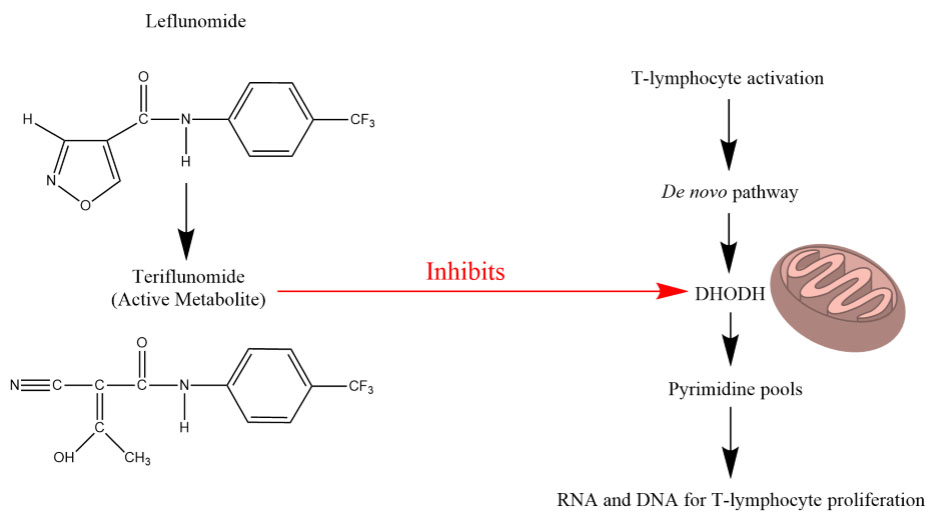
Leflunomide is a prodrug that is converted into its active metabolite, which reversibly inhibits dihydroorotate dehydrogenase. This enzyme is essential for the de novo synthesis of uridine monophosphate (UMP), a precursor for pyrimidines.
| Biochemical Target | Cellular Consequence |
|---|---|
| Dihydroorotate Dehydrogenase | Arrests the cell cycle in the G1 phase. |
| T-Cell Proliferation | Suppressed; lymphocytes are unable to replicate their DNA without pyrimidines. |
2. Clinical Use: Chronic Inflammatory Arthritis
Leflunomide is primarily utilized as a long-term treatment to slow the progression of joint destruction in autoimmune conditions. It is often used as an alternative for patients who do not tolerate Methotrexate.
| Indication | Clinical Goal |
|---|---|
| Rheumatoid Arthritis | Reduces signs/symptoms and inhibits structural damage. |
| Psoriatic Arthritis | Management of both skin manifestations and joint inflammation. |
3. Adverse Effects and Toxicity
Leflunomide has a very long half-life (several weeks) due to enterohepatic circulation, making its adverse effects and teratogenicity particularly dangerous.
| Adverse Effect | Monitoring / Management |
|---|---|
| Hepatotoxicity | Regular monitoring of LFTs is required. |
| Teratogenicity | Strictly contraindicated in pregnancy. Requires a washout (Cholestyramine) if pregnancy is desired. |
| Hypertension | Requires regular blood pressure checks. |
| Diarrhea | Most common gastrointestinal side effect. |
Activity:
High-Yield Mnemonics & Tips:
- Mechanism: Leflunomide = Left-side of the pyrimidine pathway (it blocks an early step).
- Washout: Because of the long half-life, patients who want to become pregnant must take Cholestyramine to clear the drug from their system quickly.
- Step 1 Context: Compare this to Methotrexate (blocks dihydrofolate reductase) and Mycophenolate (blocks IMP dehydrogenase for purines). Leflunomide is the Pyrimidine equivalent.
You must be logged in to post a comment.