
Learning Objectives
- Categorize the primary hip muscles by their mechanical actions (flexion, extension, etc.).
- Identify the dual roles of muscles like the Gluteus medius and Iliopsoas.
- Connect hip abductor weakness to clinical gait abnormalities (Trendelenburg sign).
1. Sagittal Plane: Flexors and Extensors
These muscles drive the forward and backward movement of the thigh.
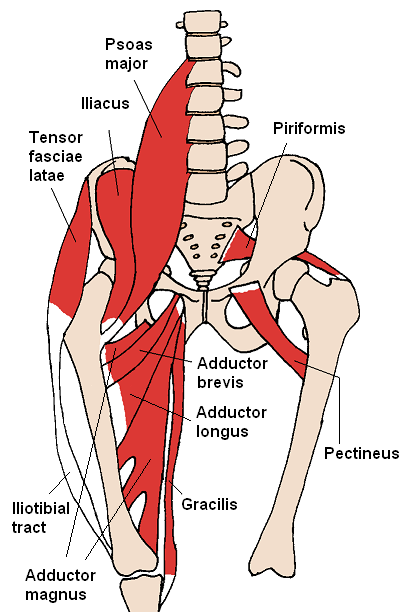
- Flexors: Iliopsoas (Iliacus + Psoas), Rectus femoris, Tensor fascia lata (TFL), Pectineus, and Sartorius.
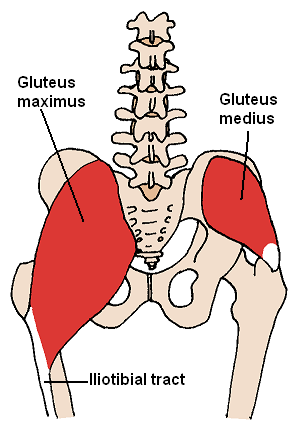
- Extensors: Gluteus maximus and the hamstrings (Semitendinosus, Semimembranosus, and Long head of Biceps femoris).
2. Frontal Plane: Abductors and Adductors
Abductors are critical for pelvic stability during walking.
- Abductors: Gluteus medius and Gluteus minimus.
- Clinical: Weakness in these muscles (Superior Gluteal Nerve injury) leads to the Trendelenburg gait, where the pelvis drops toward the unaffected side.
- Adductors: Adductor magnus, longus, and brevis.
Activity:
3. Rotational Mechanics
Many hip muscles have secondary roles in rotating the femur within the acetabulum.
| Action | Primary Muscles |
|---|---|
| Internal Rotation | Gluteus medius, Gluteus minimus, TFL. |
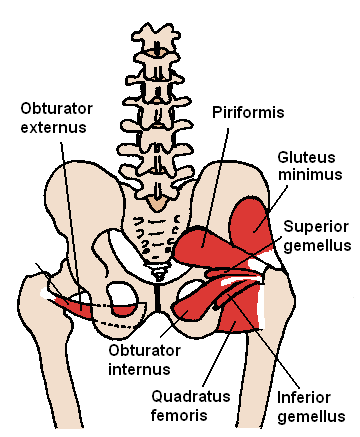
| External Rotation | Iliopsoas, Gluteus maximus, Piriformis, Obturator internus/externus. |
Clinical Notes & Corrections:
- Piriformis Syndrome: The Piriformis (an external rotator) can compress the sciatic nerve, leading to pain that mimics a herniated disc.
- Iliopsoas: This is the most powerful flexor of the hip. In a “psoas abscess,” patients often hold the hip in a flexed, externally rotated position for comfort.
Activity: Hip Muscle Action Match
Memory Hooks:
Gluteus Maximus: The Great Extender (used for climbing stairs).
Medius/Minimus: The Middle and Small ones Abduct and Rotate In.
Sartorius: The “Tailor’s muscle” (Flexion, Abduction, External Rotation—sitting cross-legged).
You must be logged in to post a comment.