
Learning Objectives
Master the pharmacodynamic concepts of Efficacy and Potency. Learn to interpret dose-response curves, understand the significance of 

1. Efficacy ()
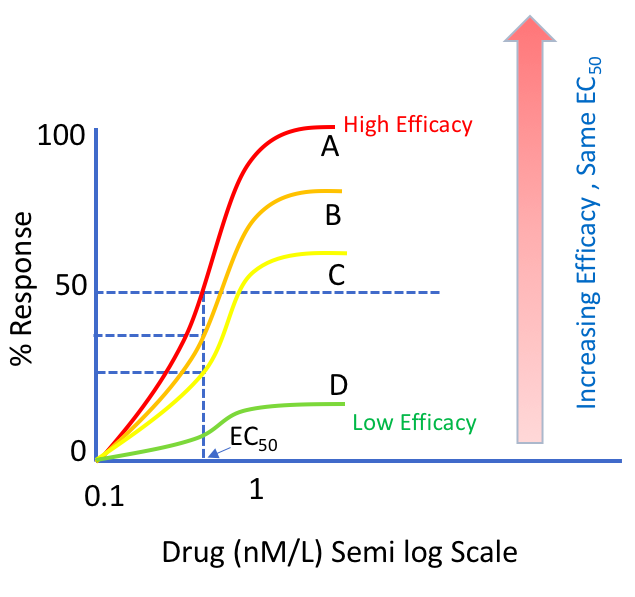
Efficacy represents the maximal effect a drug can produce, also known as its intrinsic activity. It is determined by the nature of the drug-receptor interaction.
| Feature | Details |
|---|---|
| Graphical Marker | Represented by the Y-axis value (). |
| Relationship |  Y-value = Efficacy. Y-value = Efficacy. |
| Comparison | Partial agonists have lower efficacy than full agonists, regardless of how much drug is given. |
| Independence | Efficacy is unrelated to potency. A drug can be highly efficacious but require a high dose (low potency). |
2. Potency ()
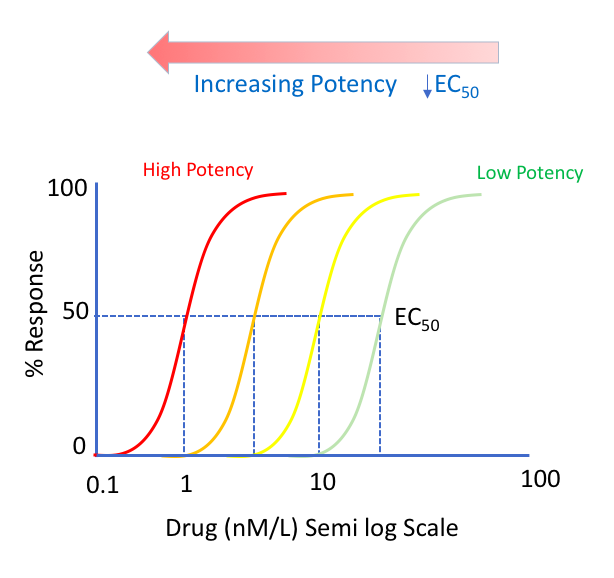
Potency refers to the amount of drug required to produce a specific effect (usually 
| Feature | Details |
|---|---|
| Graphical Marker | Represented by the X-axis value (). |
| Relationship |  (left shift) = Potency. (left shift) = Potency. |
| Definition |  = Effective Concentration. = Effective Concentration. |
| Independence | Potency is unrelated to efficacy. A very potent drug may only produce a small maximal effect. |
3. Comparative Analysis Summary
| Change in Curve | Pharmacodynamic Meaning |
|---|---|
| Shift to the Left | Potency ( ) |
| Shift to the Right | Potency ( ) |
| Shift Upward | Efficacy ( ) |
| Shift Downward | Efficacy ( ) |
Activity:
High-Yield Clinical Pearls:
- Clinical Importance: Efficacy is generally more clinically important than potency. We care more about how well a drug works (maximal effect) than how small the pill is (potency).
- Partial Agonists: These can act as antagonists in the presence of a full agonist because they compete for receptors but have lower intrinsic activity (efficacy).
- Potency Calculation: If Drug A has a
mg and Drug B has an
mg, Drug A is
You must be logged in to post a comment.