
Learning Objectives
Master the quantitative principles of Pharmacokinetics. Understand how the body processes drugs through absorption, distribution, metabolism, and excretion (ADME), and learn to calculate key parameters like bioavailability, volume of distribution, and clearance for the USMLE Step 1.
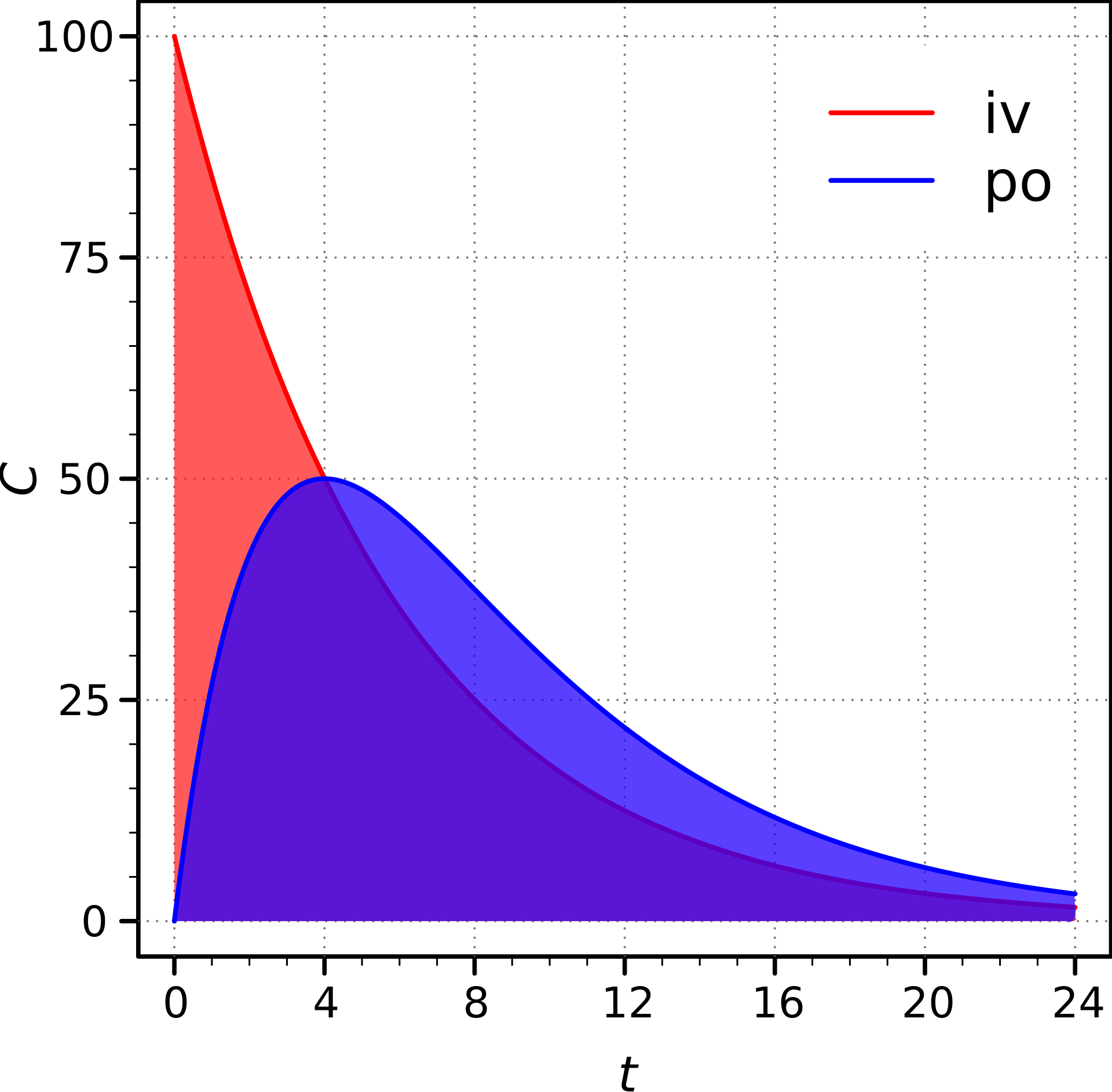
1. Bioavailability ( )
)
Bioavailability is the fraction of an administered dose that reaches the systemic circulation in an unchanged form.
| Route | Bioavailability () |
Reasoning |
|---|---|---|
| Intravenous (IV) | 100% ( ) ) |
Bypasses absorption and first-pass metabolism. |
| Oral (PO) | < 100% ( ) ) |
Incomplete absorption and first-pass metabolism (liver). |

2. Volume of Distribution ( )
)
| Level |
Compartment | Drug Characteristics |
|---|---|---|
| Low | Intravascular (Plasma) | Large/charged molecules; highly protein-bound. |
| Medium | Extracellular Fluid (ECF) | Small, hydrophilic (polar) molecules. |
| High | All tissues (including fat) | Small, lipophilic molecules; tissue-bound. |

3. Clearance ($CL$)
Clearance is the volume of plasma from which a drug is completely removed per unit of time.
| Parameter | Details |
|---|---|
| Formula |  |
| Impairment | Occurs with defects in cardiac, hepatic, or renal function. |
| Dialysis | Hemodialysis is most effective for drugs with low . |
Activity:
4. Half-life ( ) and Steady State
The half-life determines how long it takes for a drug to reach a steady state or be eliminated.
| Concept | Key Values |
|---|---|
| Steady State Rule | Takes 4–5 half-lives to reach steady state (and to be “cleared”). |
| 90% Level | Takes 3.3 half-lives to reach 90% of steady state. |
| Elimination Table | 1 = 50% left; 2 = 25% left; 3 = 12.5% left; 4 = 6.25% left. |

Activity
Activity
High-Yield Clinical Pearls:
- Protein Binding: Liver and kidney disease decrease plasma protein (albumin). This increases the free fraction of the drug, effectively increasing the
- The
- Loading vs Maintenance:
is used to calculate the Maintenance Dose.
You must be logged in to post a comment.