
Learning Objectives
- Identify the clotting factors and proteins that require Vitamin K for maturation.
- Explain the mechanism of gamma-carboxylation and its inhibition by Warfarin.
- Recognize the clinical presentation and prevention of Hemorrhagic Disease of the Newborn.
- Distinguish Vitamin K deficiency from other coagulation disorders using PT/aPTT labs.
1. Biochemical Function: The Carboxylation Step
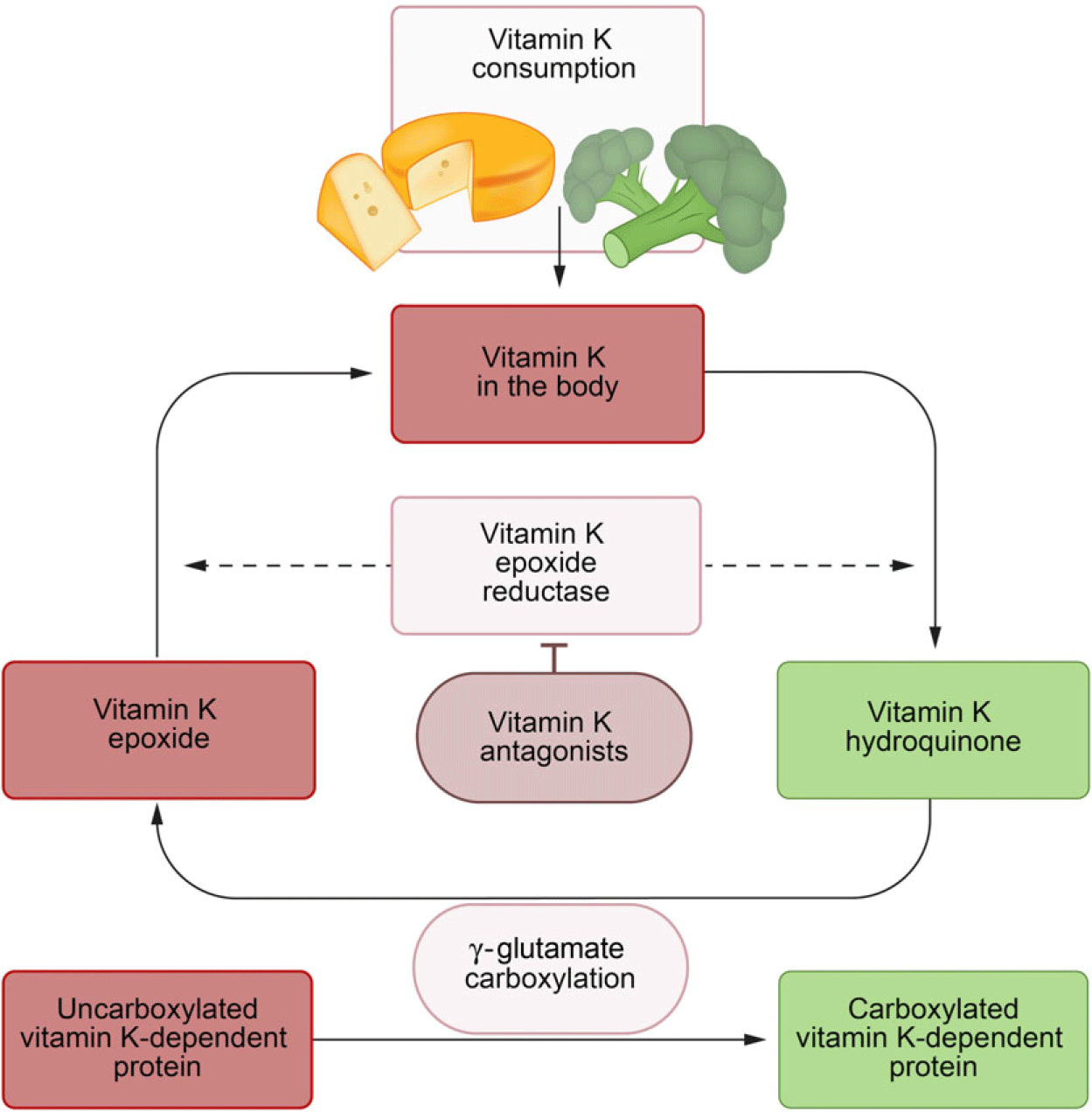
Vitamin K (Phylloquinone/Menaquinone) acts as a critical cofactor for the 
- Activation: Vitamin K must be in its reduced form to act as a cofactor. It is activated by the enzyme Epoxide Reductase.
- Warfarin Mechanism: Warfarin inhibits Epoxide Reductase, preventing the recycling of Vitamin K and thus halting the synthesis of functional clotting factors.
High-Yield Mnemonics:
- K is for Koagulation.
- Factors 10, 9, 7, 2 (1972) + Proteins C and S.
2. Neonatal Physiology & Deficiency
Neonates are uniquely predisposed to Vitamin K deficiency due to three main factors:
- Sterile Intestines: They lack the gut microbiota necessary to synthesize Vitamin K.
- Poor Placental Transfer: Very little Vitamin K crosses the placenta.
- Breast Milk: Human milk is a poor source of Vitamin K (and Vitamin D).
Memory Hook: Breast-fed infants don’t know about Vitamins D and K.
3. Clinical Findings & Lab Correlation
Deficiency leads to a bleeding diathesis known as Hemorrhagic Disease of the Newborn (or Vitamin K Deficiency Bleeding – VKDB).
| Lab Parameter | Result in Deficiency | Reasoning |
|---|---|---|
| Prothrombin Time (PT) | Increased (Prolonged) | Factor VII has the shortest half-life and is affected first. |
| aPTT | Increased (Prolonged) | Factors IX, X, and II are part of the intrinsic/common pathways. |
| Bleeding Time | Normal | Platelet function and primary hemostasis are unaffected. |
Secondary Causes: Prolonged use of broad-spectrum antibiotics (killing gut flora) or advanced liver disease (inability to utilize Vitamin K).
Activity
Activity
You must be logged in to post a comment.