
Learning Objectives
- Identify the directionality and semiconservative nature of DNA replication.
- Distinguish between the roles of DNA Polymerase I and III in prokaryotes.
- Master the clinical correlations of Topoisomerase inhibitors and Helicase mutations.
- Understand the function of Telomerase in eukaryotes and its role in aging/cancer.
1. The Replication Fork & Machinery
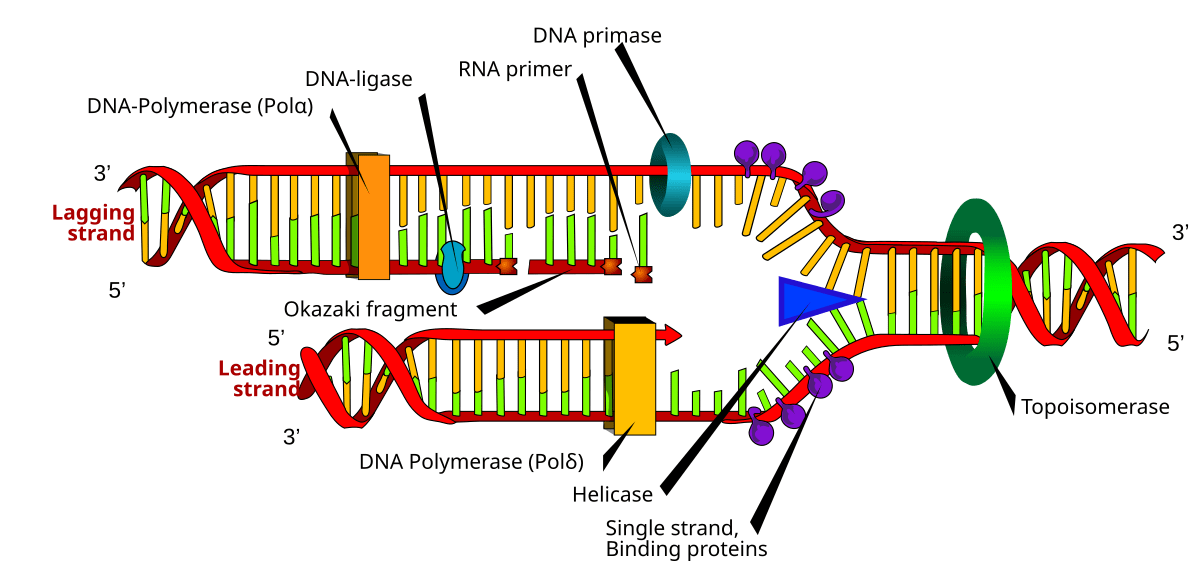
DNA replication occurs in the 5′ → 3′ direction (5ynth3sis). It is semiconservative, meaning each new daughter strand is paired with one original parent strand.
| Enzyme | Function | Clinical Note |
|---|---|---|
| Helicase | Unwinds the DNA template at the fork. | Deficient in Bloom syndrome (BLM gene). |
| SSB Proteins | Prevents reannealing or nuclease degradation. | Stabilizes single strands. |
| Topoisomerases | Relieves supercoils via single (I) or double (II) strand breaks. | Targeted by Fluoroquinolones (prokaryotes) and Etoposide (eukaryotes). |
| Primase | Makes RNA primer to provide a 3′-OH group. | Essential for DNA Pol III to start. |
2. Prokaryotic DNA Polymerases
Prokaryotes utilize two main polymerases for elongation and cleanup:
- DNA Polymerase III: The primary elongator. It synthesizes the leading strand and Okazaki fragments.
- Has 3′ → 5′ exonuclease activity for proofreading.
- DNA Polymerase I: The “cleanup” crew. It excises the RNA primer using 5′ → 3′ exonuclease and replaces it with DNA.
3. Telomerase: Eukaryotes Only
Since eukaryotic chromosomes are linear, they shorten with each round of replication. Telomerase prevents this loss.
- Mechanism: An RNA-dependent DNA polymerase (reverse transcriptase).
- Sequence: Adds TTAGGG repeats to the 3′ ends.
- Mnemonic: Telomerase TAGs for Greatness and Glory.
- Clinical: Upregulated in Cancer; downregulated in Aging/Progeria.

4. Clinical Pharmacology Summary
- Topoisomerase I Inhibitors: Irinotecan, Topotecan.
- Topoisomerase II Inhibitors: Etoposide, Teniposide.
- Chain Terminators: Drugs like Zidovudine (AZT) lack a 3′-OH group, preventing the addition of the next nucleotide.
Activity
You must be logged in to post a comment.