
Learning Objective
By the end of this lesson, students should be able to: Describe the external and internal anatomy of the midbrain, identify its major structures and nuclei, and understand its vascular supply.
Overview
The midbrain (or mesencephalon) is the most superior portion of the brainstem, connecting the forebrain with the pons and cerebellum. Despite being the smallest brainstem region (about 2 cm long), it serves as a crucial relay center for visual, auditory, and motor control pathways.
External Anatomy
The midbrain passes through the tentorial notch of the tentorium cerebelli and is divided into two major parts:
- Tectum (posterior to the cerebral aqueduct)
- Contains four rounded elevations known as the colliculi (the corpora quadrigemina):
- Superior colliculi – involved in visual reflexes.
- Inferior colliculi – involved in auditory processing.
- Each colliculus connects laterally via the quadrigeminal brachium:
- Superior brachium → connects to the retina via the superior colliculus.
- Inferior brachium → connects the inferior colliculus to the medial geniculate body.
- The trochlear nerve (CN IV) emerges just below the inferior colliculi.
- Contains four rounded elevations known as the colliculi (the corpora quadrigemina):
- Cerebral Peduncles (anterior and lateral)
- Connect the cerebral hemispheres to the pons.
- Separated by the interpeduncular fossa, which contains the posterior perforated substance (small perforating vessels).
- The oculomotor nerve (CN III) exits between the peduncles.
- The optic tracts curve around the superior border of the midbrain.

Internal Anatomy
Two transverse sections are typically examined:
- Level of the Inferior Colliculus
- Crus cerebri (anterior):
- Contains descending fibers:
- Frontopontine (medial)
- Corticospinal
- Corticobulbar (corticonuclear)
- Temporopontine (posterolateral)
- Substantia nigra: Divides the cerebral peduncle into anterior and posterior regions.
- Pars compacta (dopaminergic, posterior)
- Pars reticulata (anterior)
- Tegmentum (posterior to substantia nigra): Contains:
- Periaqueductal gray matter (around the cerebral aqueduct)
- Mesencephalic nucleus of CN V and trochlear nucleus (CN IV)
- Decussation of the superior cerebellar peduncles
- Medial longitudinal fasciculus (MLF)
- Four lemnisci – medial, spinal, trigeminal, lateral
- Inferior colliculus in the tectum region
- Crus cerebri (anterior):
- Level of the Superior Colliculus
- Red nuclei: Prominent paired nuclei involved in motor coordination.
- Decussation of the rubrospinal tract: Lies anterior to the red nucleus.
- Oculomotor nucleus (CN III): Replaces the trochlear nucleus.
- Superior colliculi replace the inferior colliculi in the tectum.
- The lateral lemniscus terminates below this level.
- Reticular formation surrounds the red nuclei.
Vasculature
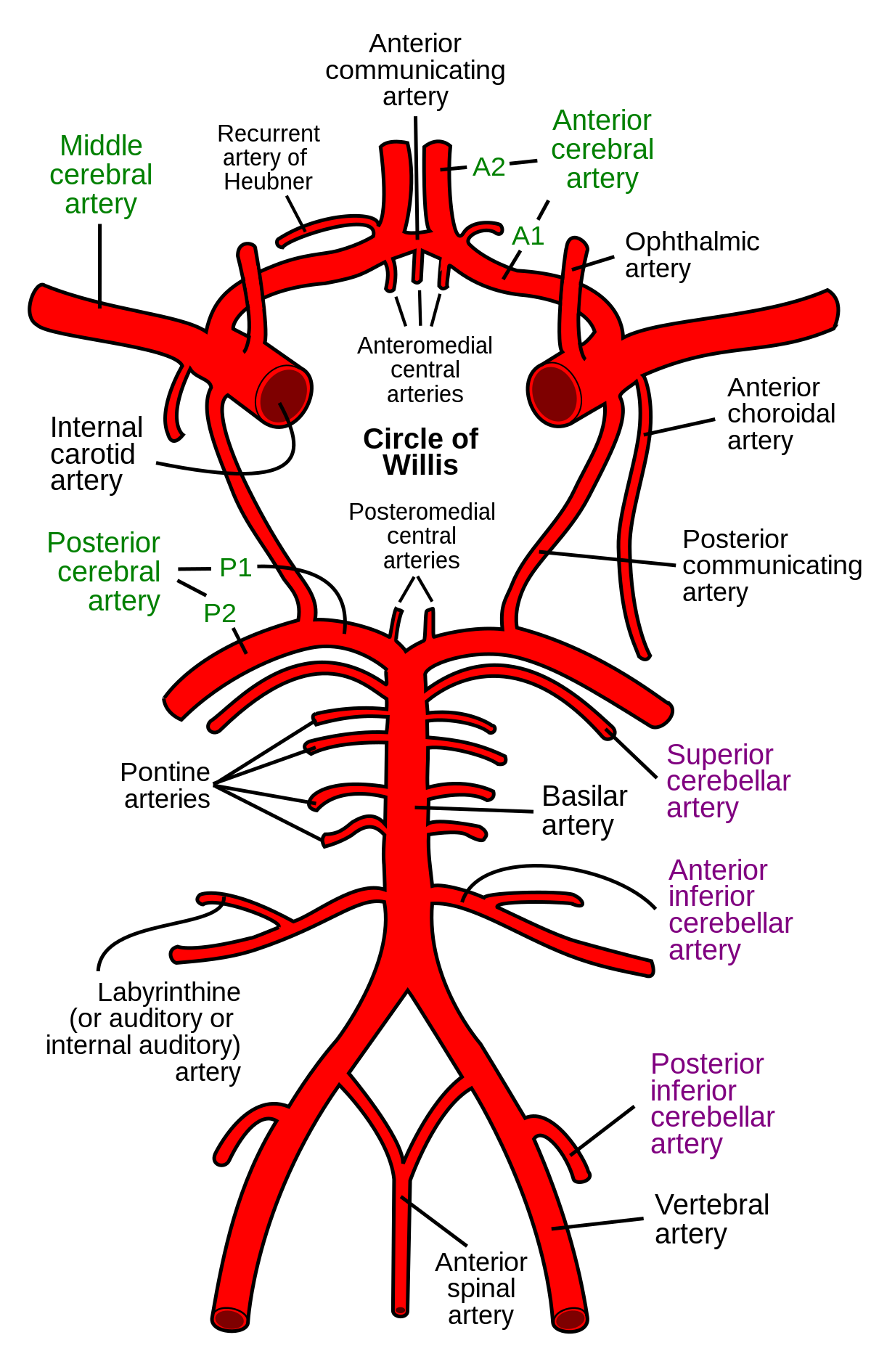
The midbrain receives arterial blood primarily from branches of the basilar artery, including:
- Posterior cerebral artery (PCA) – peduncular branch
- Superior cerebellar artery (SCA)
- Posterior choroidal artery
- Interpeduncular branches of the basilar artery
Key Takeaway
The midbrain integrates visual, auditory, and motor signals, serving as a central hub between higher cortical centers and lower brainstem structures.


