
Learning Objectives
By the end of this session, the learner will be able to describe any peripheral nerve using a five-part systematic framework: Site, Type of Nerve, Roots, Course, and Innervation. This approach is essential for localized diagnosis in neurology, surgery, and clinical anatomy.
The 5-Part Framework for Clinical Neurology
To master the complex wiring of the human body, use this structured rubric. It allows you to logically deduce a patient’s symptoms based on the location of a nerve lesion.
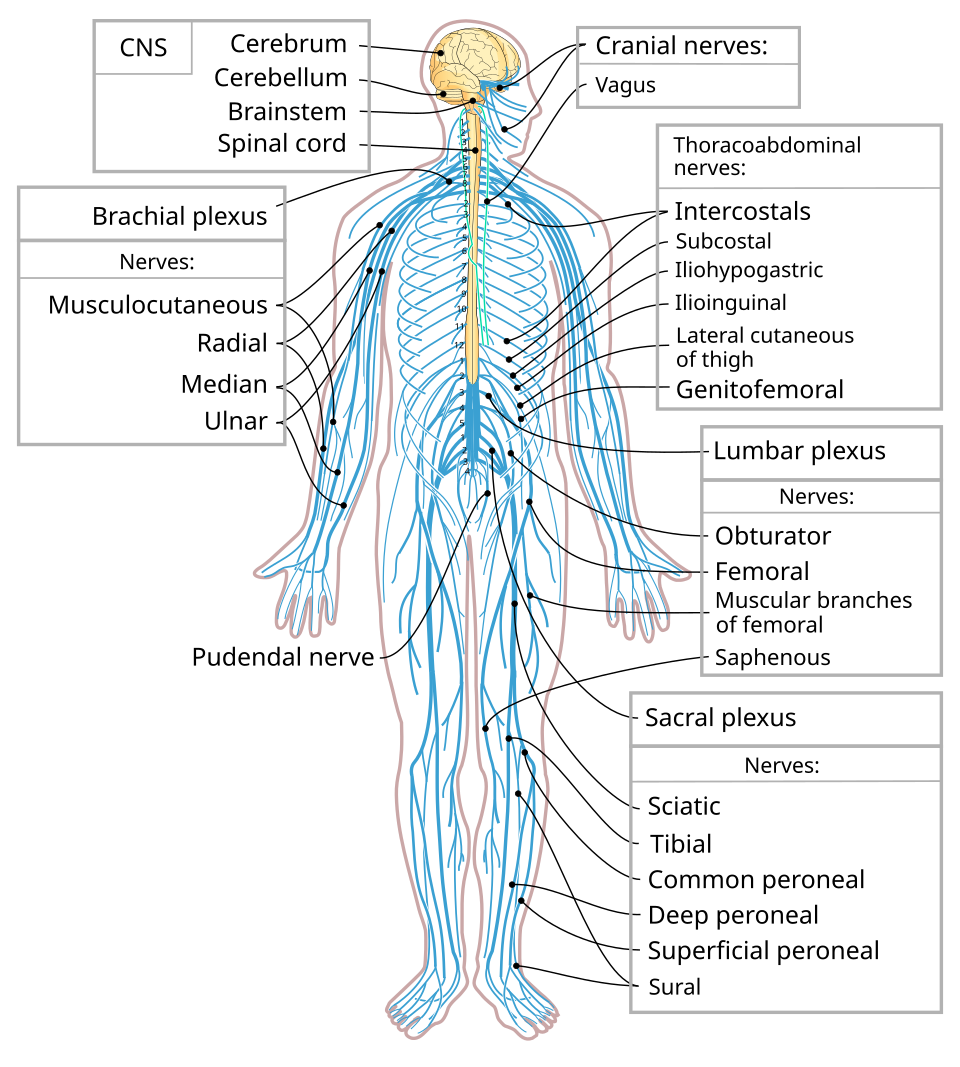
1. Site (Topographical Region)
Establishing the site helps you narrow down which plexus or compartment is involved. This identifies the spatial relationship with nearby landmarks.
| Nerve | Primary Site | Anatomical Region |
|---|---|---|
| Median Nerve | Upper Limb | Arm, Forearm, and Hand. |
| Femoral Nerve | Lower Limb | Anterior Thigh. |
| Sciatic Nerve | Lower Limb | Posterior Thigh and Leg. |
2. Type of Nerve (Functional Components)
Understanding whether a nerve is purely motor, purely sensory, or mixed dictates the clinical presentation of an injury.
| Nerve Type | Fibre Components | Example |
|---|---|---|
| Mixed | Motor + Sensory | Median Nerve (Grip + Palmar sensation) |
| Sensory | Sensory only | Lateral Femoral Cutaneous (Thigh skin) |
| Autonomic | Motor + Sensory + Parasympathetic | Vagus Nerve (CN X) |
3. Roots (Spinal Level)
Roots describe the spinal segments (ventral and dorsal) that merge within plexuses to form the named nerve.
| Nerve | Spinal Roots | Associated Plexus |
|---|---|---|
| Ulnar Nerve | C8–T1 | Brachial Plexus |
| Median Nerve | C5–T1 | Brachial Plexus |
| Femoral Nerve | L2–L4 | Lumbar Plexus |
Activity:
4. Course (Anatomic Path)
The “Course” tracks the landmarks where the nerve is most vulnerable to compression or “entrapment.”
| Landmark Stage | Ulnar Nerve Path | Clinical Risk |
|---|---|---|
| Upper Arm | Medial border of the humerus | Pressure from crutches |
| Elbow | Posterior to Medial Epicondyle | Cubital Tunnel Syndrome |
| Wrist | Through Guyon’s Canal | Handlebar Palsy (Cyclists) |
5. Innervation (Targets)
This refers to the final structures supplied, including motor (muscles), sensory (skin/joints), and autonomic (organs/vessels) supply.
| Nerve | Motor Innervation | Sensory Innervation |
|---|---|---|
| Ulnar Nerve | Intrinsic hand muscles (Interossei) | Medial 1.5 digits |
| Median Nerve | Forearm flexors + Thenar muscles | Lateral 3.5 digits |
| Vagus Nerve | Laryngeal/Pharyngeal muscles | Thoracic/Abdominal viscera |
Activity:
Clinical Pearls for Medical Students:
- Proximal vs. Distal: A lesion at the elbow will affect both the forearm and the hand, whereas a lesion at the wrist will spare the forearm muscles. Always check the Course!
- Plexus Logic: Remember that peripheral nerves are “rearrangements.” If a patient has weakness across multiple nerves but in a specific spinal level pattern, think Roots/Radiculopathy instead of a single nerve lesion.
- Autonomics: For cranial nerves like the Vagus, never forget the parasympathetic component, as this affects heart rate and digestion.
You must be logged in to post a comment.